Clear Sky Science · en
Copper damascene process-based high-performance thin-film lithium tantalate modulators
Why faster light-based chips matter
Every video call, cloud game, or AI query depends on turning electrical signals into light and back again as data races through fiber‑optic cables. The components that perform this translation, called optical modulators, quietly limit how fast and energy‑efficient our networks and computers can become. This paper explores a new way to build these modulators so they work at very high speeds, handle strong optical power, and can be manufactured using the same copper‑based processes already standard in modern microchips.

Turning electricity into light on a chip
Optical modulators sit at the boundary between the electronic brain of a device and the optical fibers that carry information over distance. In many of today’s high‑end systems, these modulators are made from special crystals such as lithium niobate or lithium tantalate, which can change how they bend light when an electric field is applied. Recent advances have shrunk these crystals into thin films on a supporting wafer, allowing light to be tightly guided in miniature pathways, or waveguides, and enabling much faster operation on a small footprint. However, the metal wiring that delivers the electrical drive signals to these tiny structures has not kept pace with the rest of the technology.
Why copper wiring is a big deal
Traditional modulators often rely on gold electrodes, which are easy to fabricate but not ideal for the ultra‑high‑frequency signals needed in modern data centers and AI hardware. When electrical currents oscillate at tens of billions of times per second, they crowd near the edges of narrow metal lines, increasing resistance and energy loss. Copper has a significantly lower electrical resistivity than gold, meaning it wastes less signal as heat. Crucially, copper is already the workhorse metal in mainstream microelectronics, used in the so‑called Damascene process where trenches are etched into an insulating layer, filled with copper, and then polished flat. The authors realized that bringing this industrial copper process to thin‑film lithium tantalate modulators could both cut electrical losses and make it far easier to stack photonic and electronic chips directly on top of each other.
Building the new light modulators
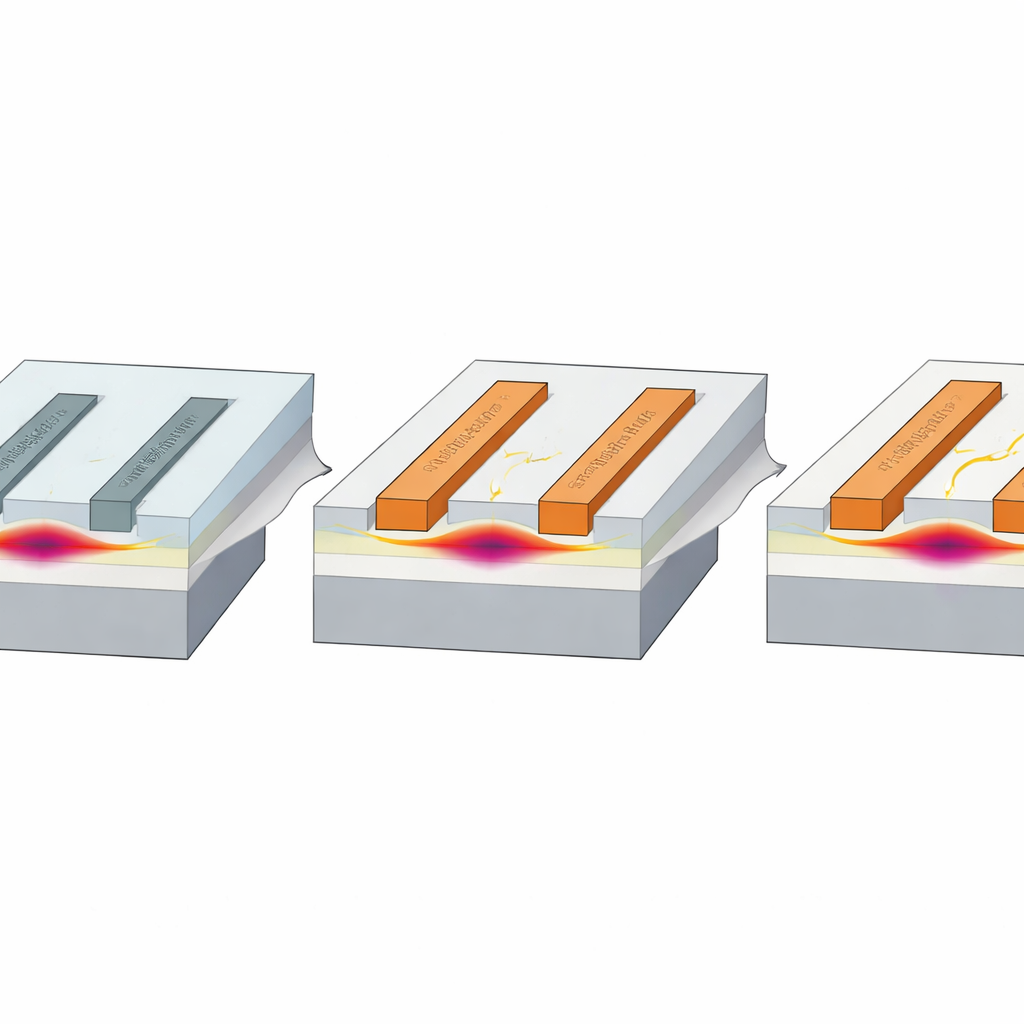
The team started from commercial thin‑film lithium tantalate wafers and patterned tiny waveguides that confine light. They then used a Damascene flow to define shallow channels in an oxide layer above these waveguides, coated them with a copper seed layer, electroplated them to form thick copper lines, and finally planarized the surface using chemical‑mechanical polishing. The result is a set of smooth, embedded copper electrodes that sit close to the optical paths while remaining level with the surrounding material. This flatness is important: it enables future “chip‑on‑chip” or “chip‑on‑wafer” bonding, where driver electronics could be mounted directly above the modulators using emerging copper‑to‑copper hybrid bonding techniques.
What the measurements show
Careful electrical tests revealed that the copper lines exhibit about 20% lower resistivity than comparable thin‑film gold, thanks in part to a natural self‑annealing effect that improves copper’s internal structure over time. When used as high‑frequency transmission lines, these electrodes reduce microwave loss by roughly 10% compared with gold while keeping other properties, such as signal speed and impedance, essentially unchanged. Integrated into Mach–Zehnder modulators—devices that split light into two paths, impose a controllable phase shift, and then recombine the beams—the copper wiring supports impressive performance. The modulators achieve low drive voltages, broad bandwidths up to 100 gigahertz, and stable operation over a wide range of frequencies and optical powers. Long‑term tests show that their operating point drifts by less than half a decibel over 15 hours, minimizing the need for continual electronic correction.
Pushing data rates for tomorrow’s networks
To demonstrate how these devices perform in a realistic setting, the researchers used their copper‑based modulators to transmit complex multi‑level optical signals, known as PAM4 and PAM8, at symbol rates up to 208 gigabaud. After accounting for standard error‑correction techniques, they achieved net data rates exceeding 400 gigabits per second through a single modulator, rivaling the best thin‑film lithium niobate devices reported to date. Importantly, the limiting factor in some tests was the available electronic driver hardware, not the modulator itself, suggesting that the devices have still more headroom.
What this means for everyday technology
In plain terms, this work shows that the same copper‑wiring methods used to build advanced computer chips can also be used to make top‑tier optical modulators on lithium tantalate. By lowering electrical loss, maintaining strong control over light, and offering a flat, bond‑ready surface, the approach opens a practical path toward tightly co‑packaged optics—where light‑based components sit just micrometers away from processors and memory. Such integration could help future data centers, communication networks, and AI accelerators move information faster, with lower energy consumption and smaller footprints than is possible today.
Citation: Lin, M., Li, Z., Kotz, A. et al. Copper damascene process-based high-performance thin-film lithium tantalate modulators. Nat Commun 17, 3211 (2026). https://doi.org/10.1038/s41467-026-69588-6
Keywords: electro-optic modulators, copper damascene, thin-film lithium tantalate, co-packaged optics, high-speed optical interconnects