Clear Sky Science · en
Developmental underpinnings of morphological disparity in the avian bony palate
Why Bird Mouth Bones Matter
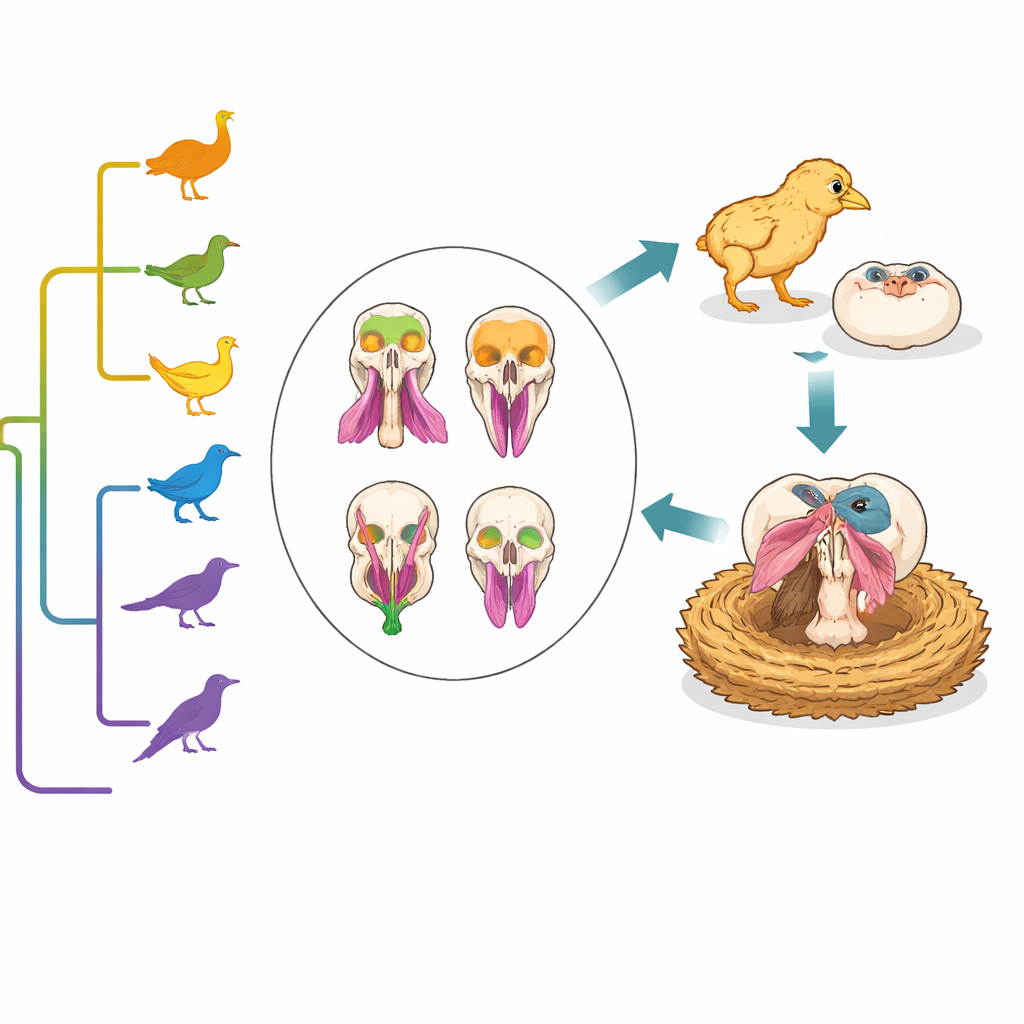
Birds may all look similar at first glance—a beak, two wings, two legs—but hidden inside their skulls lies a surprising world of variety. This study looks at the bony palate, the framework in the roof of a bird’s mouth, and asks why two great branches of modern birds have such different internal designs. By tracing how these bones grow from chick to adult across many species, the authors reveal that the way young birds develop—whether they hatch ready to run or helpless in a nest—helps shape the hidden architecture of their skulls.
Two Big Bird Families, Two Kinds of Palates
Modern birds split early into two main lineages. One includes ostriches, emus, rheas, and tinamous, while the other includes almost all familiar birds, from ducks and chickens to songbirds and parrots. These lineages differ most obviously in a cluster of bones at the base of the skull called the pterygoid–palatine complex, which helps move the upper beak. In most birds, the joint between these bones is mobile, allowing the upper beak to flex. In ostriches and their kin, the bones are fused and rigid. For decades, scientists argued over whether these flightless birds preserved an ancient, primitive palate or had instead evolved it anew by “freezing” a juvenile stage of development. This work tests those ideas using three‑dimensional measurements of skulls from both chicks and adults.
Measuring Shape in Three Dimensions
The researchers scanned the skulls of 70 bird species, sampling all major living groups. They focused on two key bones, the palatine and the pterygoid, and placed sets of digital landmarks on each to capture their shape in three dimensions. By comparing these landmark patterns across species and ages, they built a “morphospace” that shows how different kinds of birds occupy different regions of shape variation. They then traced each species’ path from its immature form to its adult form, measuring both how far each bird travels through shape space and how similar or different those developmental paths are from one another.
Surprising Patterns of Difference and Similarity
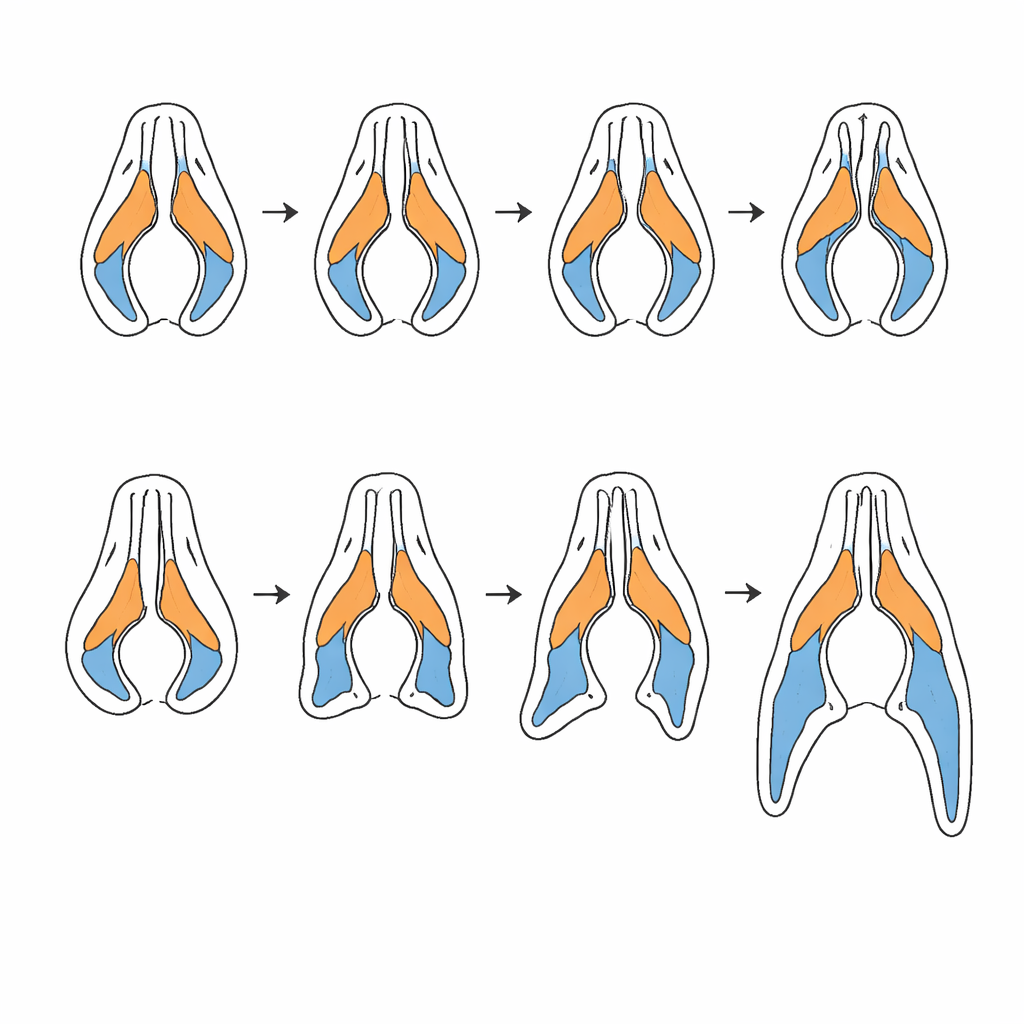
The fused‑palate birds turned out to be the most variable group overall: their palate bones differ more from one another than those of other birds. Much of this variety comes from one bone, the pterygoid, which is relatively conservative in most birds but highly diverse in ostriches and their relatives. When the team compared chicks and adults, they found an intriguing pattern. In most birds, different species start out with somewhat similar palates as hatchlings, then diverge as they grow. In contrast, the fused‑palate birds begin more distinct and actually grow more similar to typical birds over time. Crucially, the shapes of their juvenile palates do not resemble the early stages of other birds, arguing against the idea that they are simply “arrested” juveniles. Statistical tests of how shape scales with size through growth likewise showed that differences between the two lineages are not explained by simple shifts in the timing or speed of development.
Growing Up Fast or Slow
To understand what does drive palate diversity, the authors looked at developmental mode—the spectrum from precocial chicks, which hatch well‑feathered and mobile, to altricial chicks, which hatch blind, naked, and dependent. Precocial birds, including most fused‑palate species and waterfowl, do much of their skull building before hatching; their palates tend to follow converging paths, ending up relatively similar in adulthood. Highly altricial birds, such as many songbirds and parrots, hatch with less ossified skulls and undergo more remodeling after hatching. In these groups, palate shapes fan out over time, producing greater adult differences. Although this link between lifestyle and palate growth becomes weaker once shared ancestry is taken into account, the overall pattern suggests that early life strategy helped set up broad differences in how flexible the palate could become.
What This Means for Bird Evolution
Put together, the study shows that the unusual palate of ostriches and their kin is not a simple throwback or a frozen juvenile state. Instead, it reflects a different balance of mechanical demands and growth patterns, especially the loss of a mobile joint and the way these birds develop before and after hatching. More generally, the work highlights developmental mode as a silent architect of evolution: birds that grow slowly outside the egg seem to have more room for their skulls to experiment with new forms. This helps explain how some lineages have evolved extreme beak and palate shapes, and it complicates efforts to infer what the very first modern bird’s skull looked like just from living species.
Citation: Plateau, O., Navalón, G., Benito, J. et al. Developmental underpinnings of morphological disparity in the avian bony palate. Nat Commun 17, 3806 (2026). https://doi.org/10.1038/s41467-026-69576-w
Keywords: bird skull evolution, avian palate, developmental mode, heterochrony, cranial morphology