Clear Sky Science · en
A tunable autonomous RNA-fueled micro-engine
Tiny Engines for the World of Molecules
Imagine a machine so small that thousands of them could fit across the width of a human hair, each one able to move and reset itself using nothing but simple biochemical fuel. This study describes just such a device: an artificial micro‑engine built from strands of DNA and powered by RNA, the same kind of molecule our cells use to read genetic information. These tiny engines can tug a microscopic bead back and forth on their own, hinting at future robots and smart materials that work inside living systems or lab‑on‑a‑chip devices.
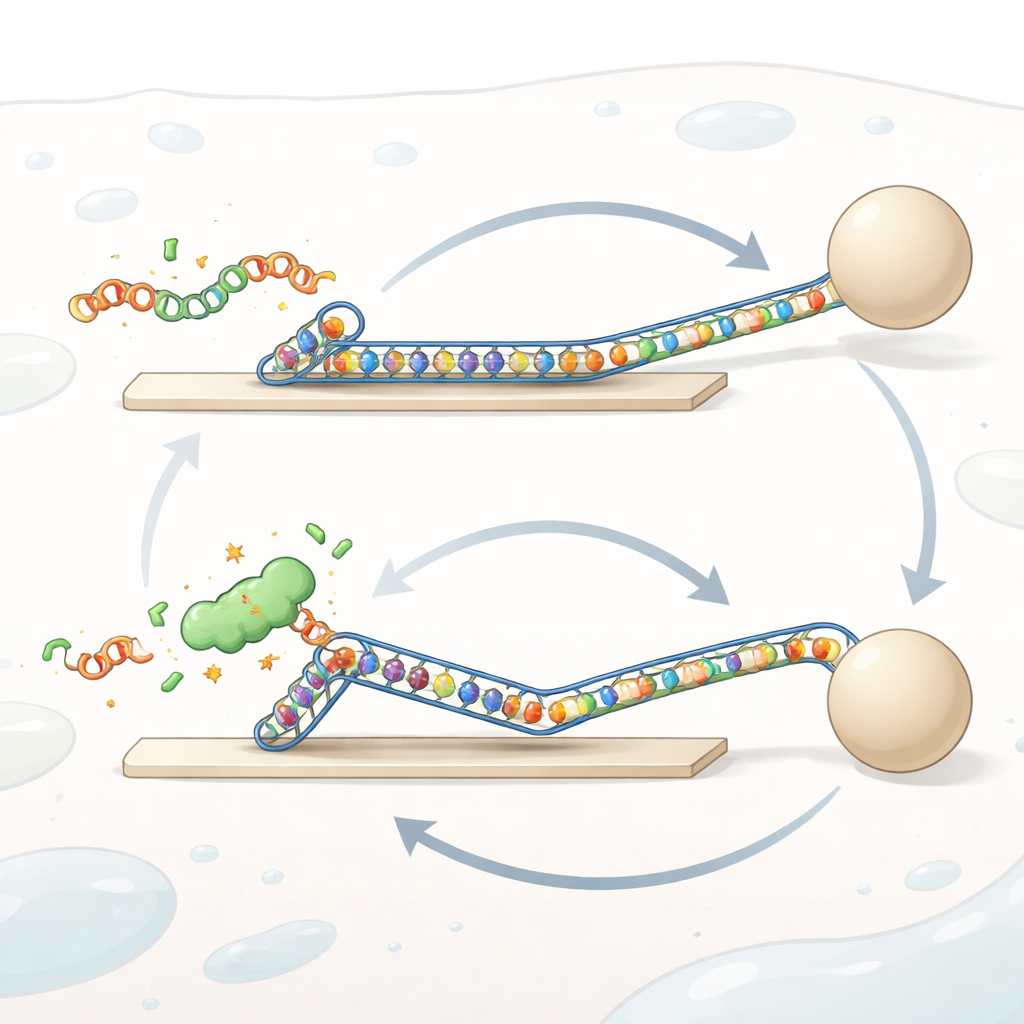
Building a Lever from Genetic Material
The core of the engine is a carefully folded DNA structure known as DNA origami. The researchers arranged four stiff DNA rods in a row, and connected the first two rods with short, flexible DNA strands that act like a springy hinge. At the far end of the last rod, they attached a plastic sphere about half a micrometer wide—large enough to see and track under a microscope. One end of the engine is anchored to a surface, so when the hinge bends or straightens, the bead moves between two distinct positions, converting tiny molecular rearrangements into motion on a scale we can observe.
Fueling Motion with RNA and an Enzyme
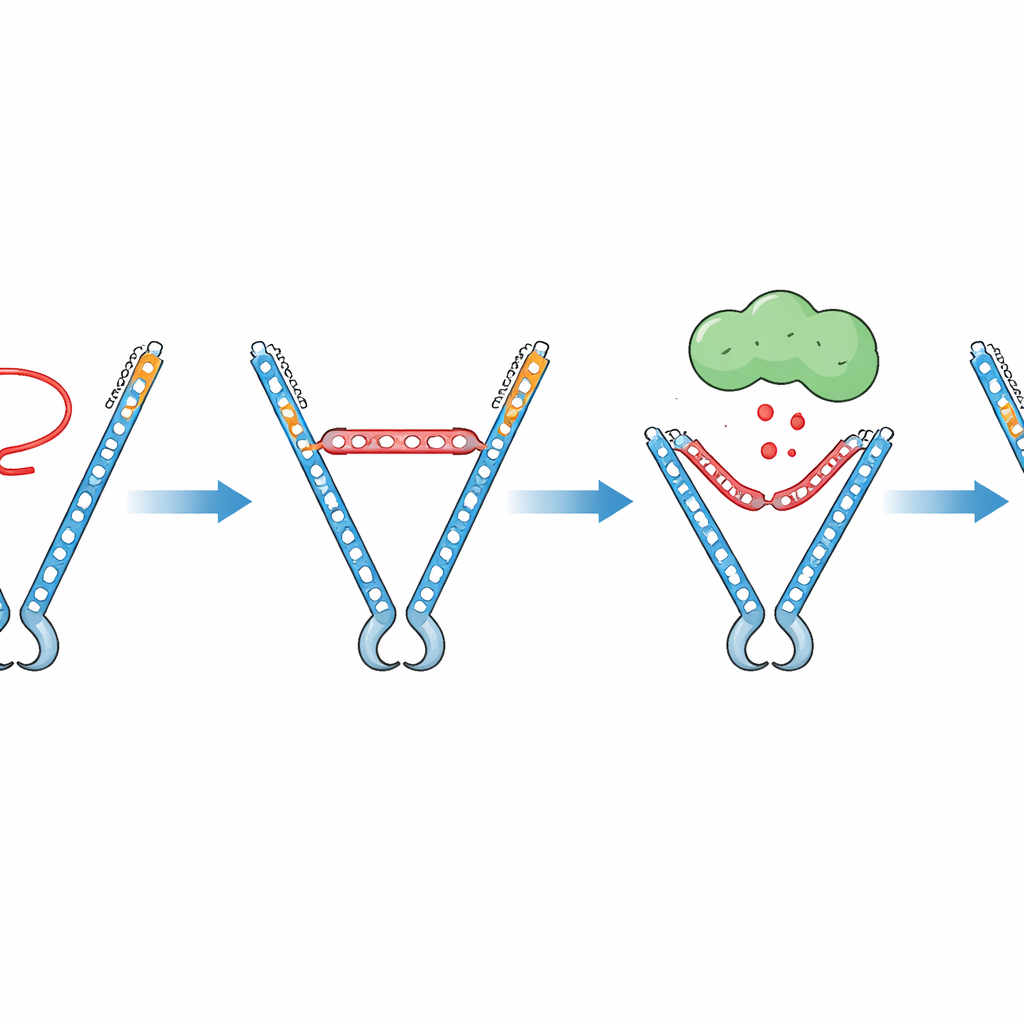
To make the hinge move on its own, the team used a short RNA strand as fuel and an enzyme called RNase H as the reset mechanism. Two exposed DNA ends sit near the hinge like open hooks. When an RNA “linker” strand comes along, it sticks to both hooks at once, forming an arch that pulls the hinge into a folded, U‑shaped configuration and stores mechanical energy in the stretched spring. RNase H recognizes the paired RNA in this arch and cuts it apart, releasing the constraint. The hinge then springs back to the unfolded position, driven by the built‑in tension of the flexible DNA. As long as fresh RNA and enzyme are present, this fold‑and‑unfold cycle repeats without any external control.
Watching a Single Engine at Work
By following the motion of the fluorescent bead attached to the engine, the researchers could see when the device was folded or unfolded. With only the engine present, the bead wandered around a region corresponding to the open state. Adding RNA alone shifted the bead to a new region, indicating a folded state. When the enzyme was added, the bead jumped back, showing that cutting the RNA reopened the hinge. Supplying both RNA and enzyme together led to continuous, random switching between the two states. Careful analysis of thousands of these switching events showed that the engine typically spent on the order of half a minute in each state under moderate conditions, confirming that the motion is both autonomous and repeatable.
Dialing the Speed with Heat and Fuel
The team then explored how to tune the engine’s behavior. Raising the temperature from cool to body‑like warmth sped up both folding and unfolding, because RNA binding and enzymatic cutting both happen faster when molecules move more quickly. Increasing the amount of RNA mainly shortened the time the engine waited in the open state before folding, while changing the amount of enzyme mostly altered how long it stayed folded before reopening. A mathematical model that included both correct and misfolded binding events matched the experimental data, revealing that the open‑state waiting time depends on two factors: how quickly RNA finds the right spots and how efficiently the enzyme clears away incorrect partial bindings.
Why These Molecular Machines Matter
Because the RNA fuel is recognized by its exact sequence, each engine can be given its own molecular “address” that responds only to its matching RNA code. This makes it possible, in principle, to build many different engines in the same solution and turn each type on independently by supplying a specific RNA signal—perhaps produced by a gene circuit that senses a chemical or disease marker. The study shows that DNA‑based structures can generate forces and energies comparable to those of natural protein motors while remaining programmable and self‑resetting. In everyday terms, the authors have built a tiny, reusable hinge that runs itself on biochemical fuel, offering a blueprint for future nanoscale transporters, smart drug carriers, and responsive materials that move and adapt on their own.
Citation: Wang, K., Chen, W., Guo, B. et al. A tunable autonomous RNA-fueled micro-engine. Nat Commun 17, 3164 (2026). https://doi.org/10.1038/s41467-026-69521-x
Keywords: DNA nanomachines, molecular motors, RNA fuel, DNA origami, nanorobotics