Clear Sky Science · en
Single-cell and spatial transcriptomics define 20E-driven developmental reprogramming in silkworm wing disc
Why insect wings matter to all of us
Insects are the only invertebrates that can fly, a talent that lets them escape predators, find food and mates, and spread across almost every habitat on Earth. Yet the way a soft larval tissue reshapes itself into a precisely patterned, paper-thin wing has remained surprisingly mysterious. This study uses cutting-edge gene-reading technologies to watch, cell by cell and over time, how the future wing of the silkworm is built and how a single hormone pulse can fast‑forward that process. The work not only deepens basic knowledge of how organs form, but also hints at new strategies for controlling agricultural pests and inspiring bio‑engineered materials.
Peeking inside a growing wing
In the silkworm, like in many insects, the adult wing develops from a hidden structure inside the larva called the wing disc. The authors combined single‑cell RNA sequencing, which reads gene activity in individual cells, with spatial transcriptomics, which maps those cells back into their original positions. Across ten stages from late larva to pupa, they built a “cell atlas” of over 120,000 cells from the wing disc. This atlas revealed twelve main cell types, including a central group that drives wing formation, surrounding epithelial layers that will shape the wing surface, outer cuticle‑forming cells that build the protective shell, and supporting immune, matrix, nerve‑related, metabolic, and ciliated cells. By overlaying these cell types on physical sections of the disc, the team reconstructed how each cell group is arranged in three dimensions and how that architecture shifts as the wing takes shape. 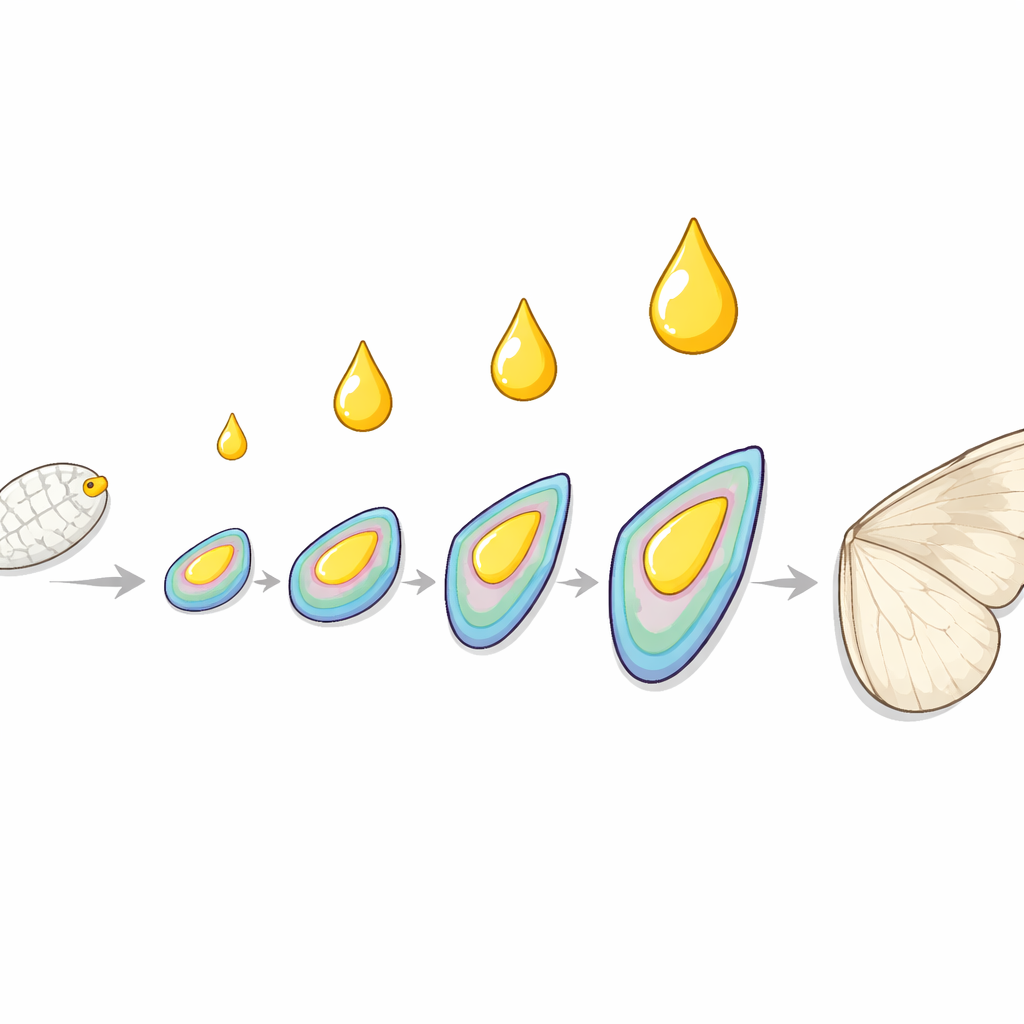
A central hub that decides cell fates
One of the most striking discoveries is a cell population the authors call wing morphogenesis (Wm) cells. These cells sit in the wing bud region and gradually disappear as the larva transforms into a pupa, suggesting they act as progenitors. Using computational “pseudotime” analyses, the researchers traced how Wm cells branch into two major lineages: epithelial cells that line and pattern the wing and cuticle cells that form the wing’s outer coat. Within each branch, early subtypes appear in larval stages while more mature subtypes dominate as the insect nears pupation. Key gene‑control proteins, including Rfx, Blimp‑1, Dll, and Pur‑alpha, shape these choices. When the team used RNA interference to reduce Rfx in silkworms and in a related moth, the wings developed severe structural defects, confirming that this factor is a master regulator of proper wing architecture.
Hormone pulses as nature’s fast‑forward button
Insects rely on the steroid hormone 20‑hydroxyecdysone, or 20E, to trigger major developmental transitions. The authors measured 20E levels directly in wing discs and also bathed dissected discs in 20E in the lab while sampling their nuclei over six hours. They found that Wm, epithelial, and cuticle cells respond within minutes: first genes for larval cuticle and early remodeling switch on, then genes for lipid handling, cell differentiation, and cytoskeleton rearrangement follow. Communication between cell types, carried by signals such as FGF, Notch, BMP, and others, strengthens and shifts over time. Comparing these short‑term hormone responses with natural development showed a “time‑axis compression” effect: half an hour of 20E exposure can induce gene programs that normally unfold over several developmental days, especially those driving Wm cells toward epithelial and cuticle fates. 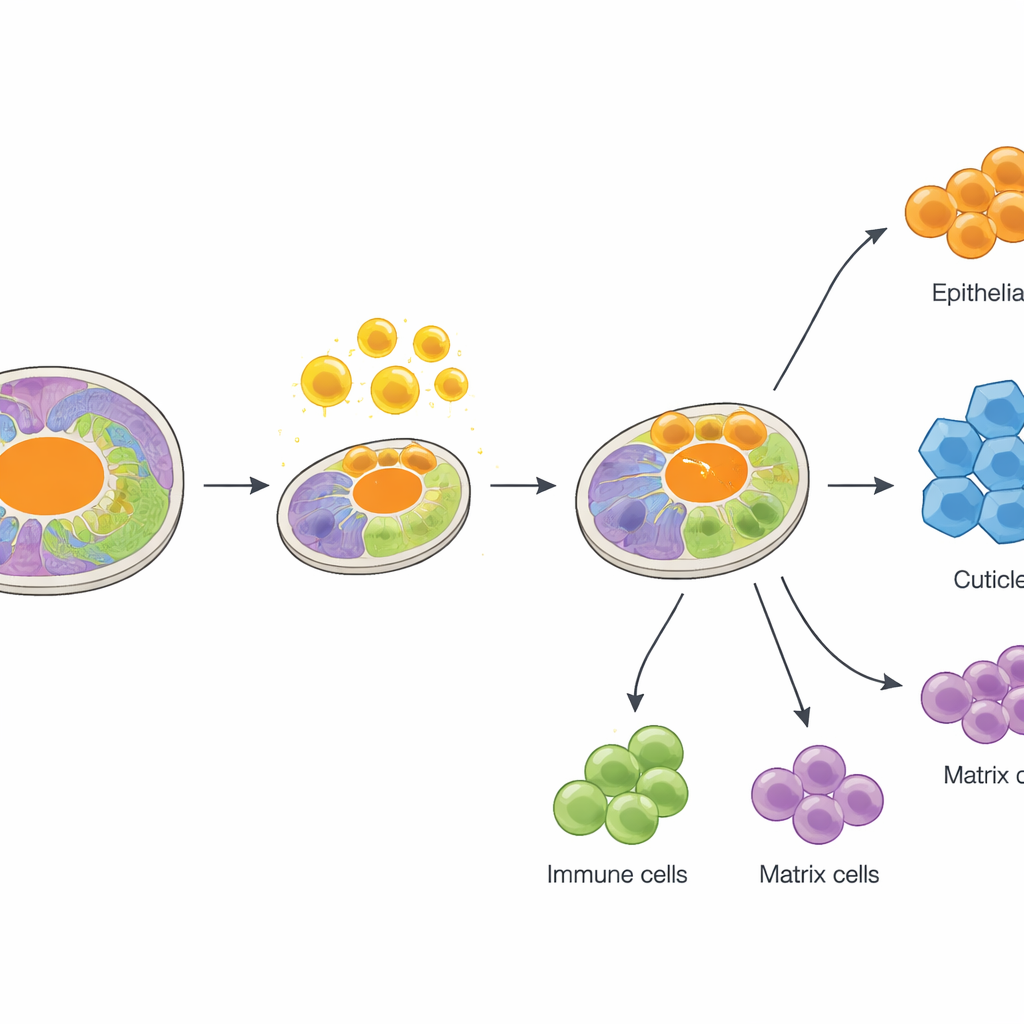
Five stages in building a wing
By integrating hormone levels, cell composition, tissue shape, and gene activity, the authors propose a five‑stage Gene Transition Model for wing disc development. In the earliest “blueprint” stage, 20E is low but cells are highly flexible, with early patterning signals active. The “cellular foundation” stage brings sustained growth and DNA maintenance as the disc thickens and organizes into layers. A sharp rise in 20E marks a “remodeling and sculpting” stage, when boundaries are redrawn and the future wing regions become clearer. Next comes “structural formation,” where energy and protein‑making pathways ramp up to build the final architecture. At the final “maturation and stability” stage, cuticle cells dominate and signaling networks simplify as the fully formed wing cuticle hardens and long‑term tissue maintenance programs take over.
What this means beyond silkworms
For non‑specialists, the takeaway is that organ building in insects is not just a simple response to a hormone surge. Instead, a small group of progenitor cells, guided by a few powerful gene switches, interprets hormone levels and local signals to decide when and how to branch into different lineages. The authors’ atlas shows this process unfolding in space and time at single‑cell resolution, offering a reference for other insects and a potential toolkit for more precise pest control: by targeting regulators like Rfx or tuning hormone responses, it may be possible to disrupt wing formation without broadly harming other tissues.
Citation: Liu, Q., He, M., Chen, H. et al. Single-cell and spatial transcriptomics define 20E-driven developmental reprogramming in silkworm wing disc. Nat Commun 17, 3064 (2026). https://doi.org/10.1038/s41467-026-69518-6
Keywords: insect wing development, single-cell transcriptomics, silkworm wing disc, hormone 20E, cell fate reprogramming