Clear Sky Science · en
Iron-borane catalyzed carbonyl hydroboration and isolation of an iron(I)-ketyl radical
Turning Common Chemicals into Useful Alcohols
Alcohols are everywhere around us, from medicines and perfumes to crop-protection agents. Many of these useful molecules are made by converting “carbonyl” groups—simple chemical units found in industrial feedstocks and even in carbon dioxide—into alcohols. This paper explores a new way to do that using iron, an abundant and inexpensive metal, together with a boron‑based partner, to carry out these transformations under relatively gentle conditions while revealing an unusual, previously unseen reaction pathway.
Why a New Route Matters
Traditional industrial methods to turn carbonyl compounds and carbon dioxide into alcohols rely on high‑pressure hydrogen gas or harsh reaction conditions. Chemists have been searching for milder, more selective routes that waste less material and can use Earth‑abundant metals. One promising approach is “hydroboration,” where a boron‑hydrogen unit is added across a carbon‑oxygen double bond to give an intermediate that can be converted into an alcohol. Many catalysts based on rare metals are known, but robust iron‑based systems—and a clear picture of how they work—have been lacking.
An Iron Partner That Does Heavy Lifting
The authors focus on a previously developed iron complex, called complex A, that carries both phosphorus and boron atoms around the iron center. They show that this complex is a highly efficient starter catalyst for hydroboration of a wide range of ketones (a major class of carbonyl compounds), as well as ring‑shaped esters known as lactones and even carbon dioxide. With only tiny amounts of the iron complex and a common boron reagent (HBpin), many ketones are converted at room temperature within minutes to the desired boron‑containing intermediates in high yields. The system can also perform a rare “double hydroboration” on cyclic esters, effectively opening the ring to give diol precursors. For carbon dioxide, switching to a bulkier boron reagent, (9‑BBN)2, allows selective formation of a methanol‑like product under mild conditions. 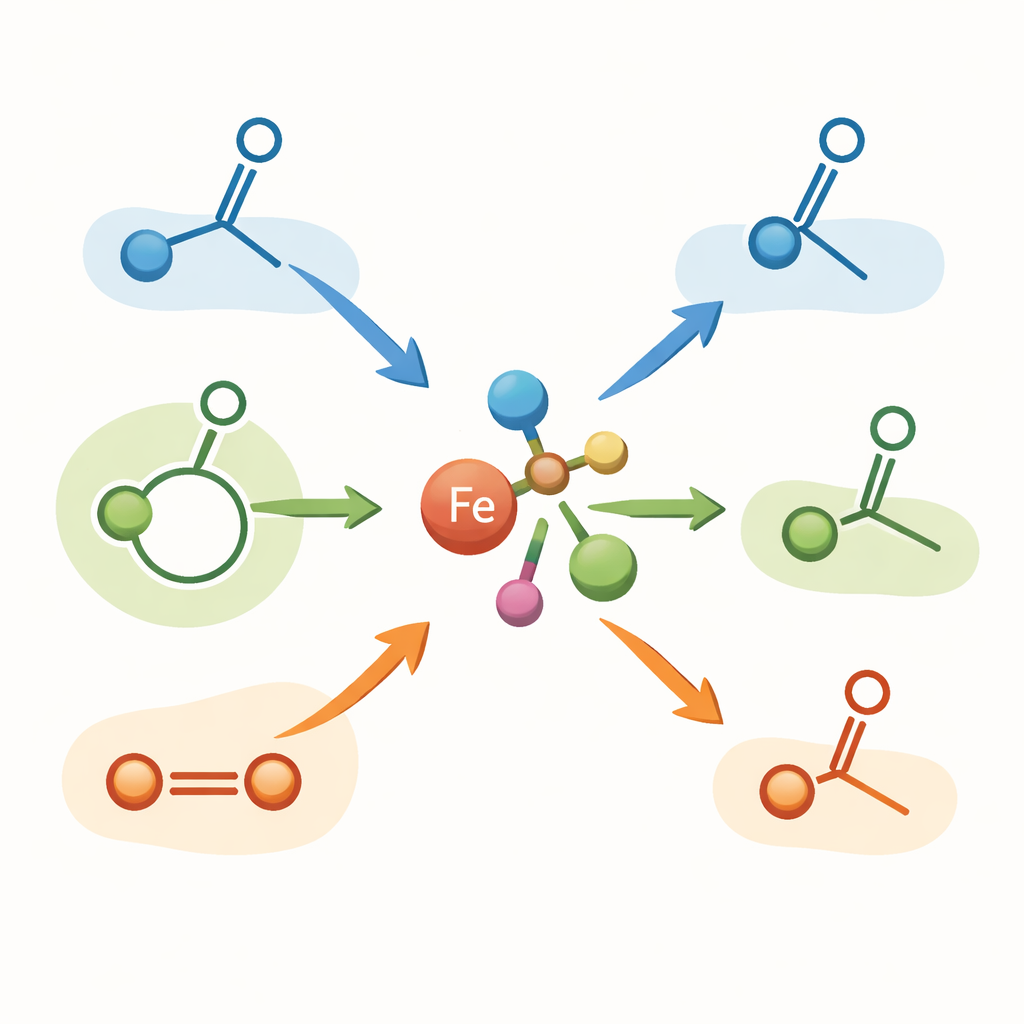
Watching the Reaction in Real Time
Beyond demonstrating broad reactivity, the researchers dig into how the iron complex actually drives the reaction. By carefully monitoring reaction rates using nuclear magnetic resonance spectroscopy and varying the amounts of catalyst, ketone, and boron reagent, they deduce that the active iron species behaves as if only part of the dimeric complex is doing the catalytic work at any given time. The rate speeds up with more ketone but eventually levels off, suggesting that excess substrate can tie up the iron in inactive forms. Surprisingly, adding more boron reagent actually slows the reaction, implying that it can compete with ketone for access to the catalyst. Isotope experiments, where the hydrogen attached to boron is replaced with its heavier cousin deuterium, show that breaking the boron–hydrogen bond is a key, rate‑limiting step.
Catching a Rare Radical in the Act
To see what the iron complex looks like when it contacts a carbonyl group, the team carried out stoichiometric model reactions. When complex A meets benzophenone, it forms a striking purple compound in which the ketone has been turned into a “ketyl” radical—essentially a carbonyl that has picked up an extra electron—and now binds to iron through its oxygen atom. Detailed structural studies using X‑ray crystallography, magnetic measurements, and computer calculations reveal that this species is unusual: it combines an iron center with three unpaired electrons and a ketyl radical that is magnetically opposed to them, giving an overall spin state of one. Although remarkable, further tests show that this radical complex is not the main highway for catalysis; instead, it likely sits in equilibrium with more conventional, two‑electron intermediates. 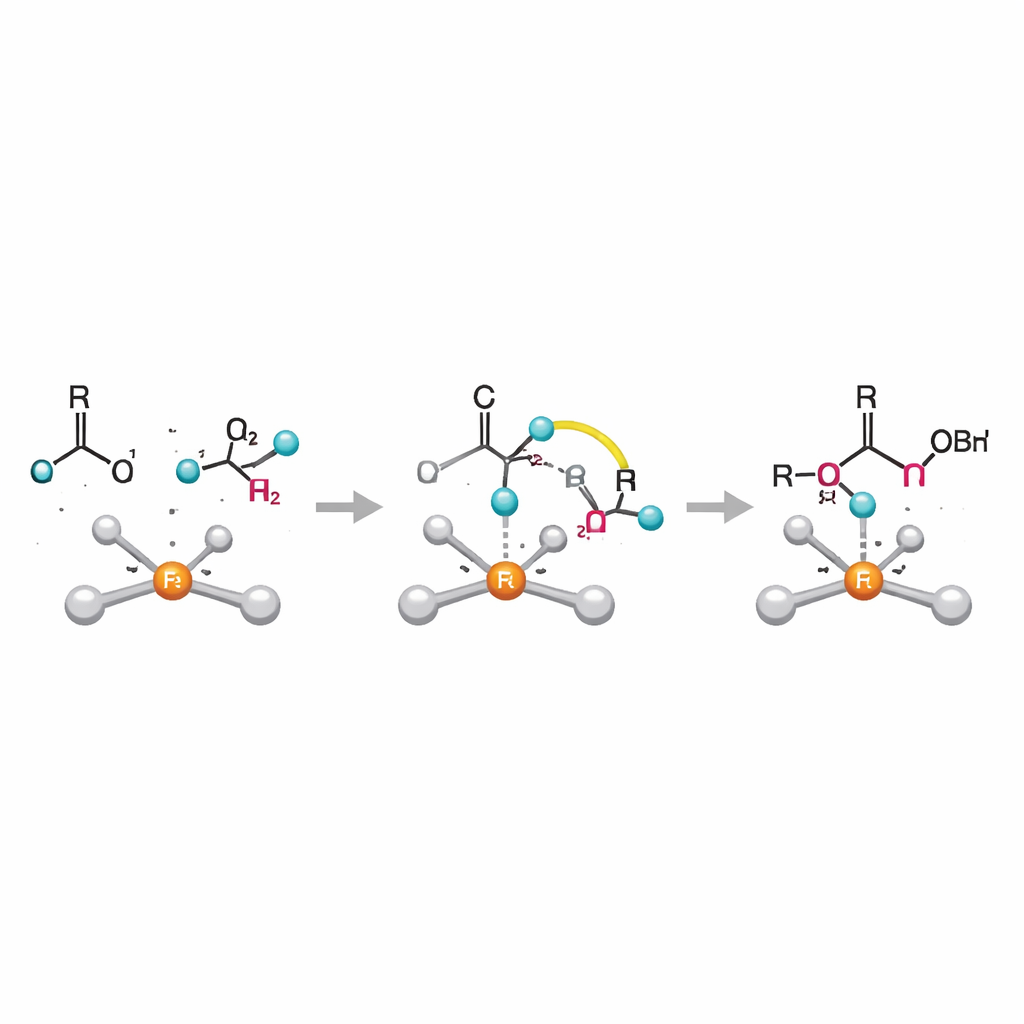
A New Kind of Motion Between Partners
Using quantum‑chemical calculations, the authors map out a full catalytic cycle that fits the kinetic and experimental data. In their picture, the boron reagent first binds near the iron center, and the incoming ketone links its oxygen atom to boron, forming a bridge between the two partners. Then comes the key step: a direct “ligand‑to‑ligand hydride transfer,” in which the hydrogen originally attached to boron migrates to the carbon atom of the ketone while the entire event is orchestrated by iron. This motion, rather than a traditional metal‑centered hydride step, has not been reported before for this type of reaction. Once the transfer is complete, the hydroborated product detaches, and the iron complex reforms, ready for another cycle.
What This Means Going Forward
In everyday terms, this work shows that a cleverly designed iron complex can act like a conductor, coordinating the movement of atoms between boron reagents and carbonyl groups to make alcohol precursors from common chemicals, including carbon dioxide, under mild conditions. At the same time, it uncovers a new kind of internal hydrogen‑shuttling step and a rare iron‑ketyl radical, deepening our understanding of how such catalysts really function. Insights like these can guide the design of next‑generation, low‑cost systems for turning simple, abundant molecules into valuable products more efficiently and sustainably.
Citation: Grose, L.A., Schwamm, R.J., Brookfield, A. et al. Iron-borane catalyzed carbonyl hydroboration and isolation of an iron(I)-ketyl radical. Nat Commun 17, 2929 (2026). https://doi.org/10.1038/s41467-026-69500-2
Keywords: iron catalysis, hydroboration, carbonyl reduction, carbon dioxide conversion, ligand-to-ligand hydride transfer