Clear Sky Science · en
A large-scale optogenetic neurophysiology platform for improving accessibility in non-human primate behavioral experiments
Opening a Window Into the Working Brain
Understanding how brain activity gives rise to behavior is one of neuroscience’s biggest challenges, especially in species whose brains closely resemble our own. This paper describes a new experimental platform that lets scientists shine light onto the brains of monkeys to turn specific nerve cells up or down, while simultaneously listening to the resulting brain activity and watching behavior change. By making this toolkit more stable and easier to use, the work aims to speed research on conditions such as stroke, depression, and other brain disorders.
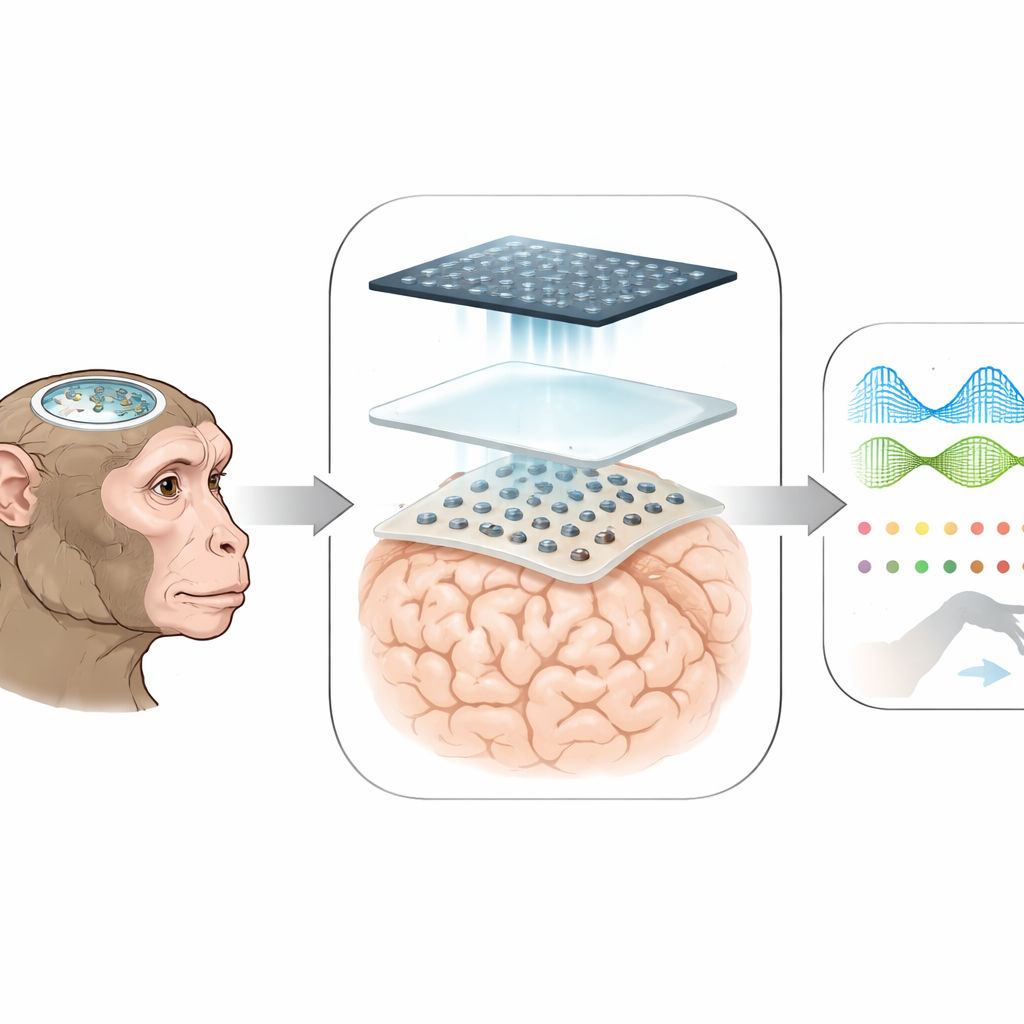
A New Toolkit for Light-Guided Brain Control
The researchers set out to solve a practical problem: optogenetics—using light-sensitive proteins to control neurons—has transformed rodent studies, but has been much harder to deploy in monkeys. Larger brains require broader coverage, long experiments demand hardware that can safely stay in place for years, and many labs lack access to specialized surgical imaging. The team designed a modular platform that brings together five key pieces: a custom skull-mounted chamber, a transparent artificial membrane that doubles as an electrical sensor array, flexible light sources that can cover large brain regions, a simpler method to spread light-sensitive proteins over wide areas, and software to clean up light-related noise in the electrical recordings.
A Clear Window With Built-In Listening Posts
At the heart of the system is a “multi-modal artificial dura,” a soft, transparent cap that replaces part of the brain’s natural covering. Embedded in this clear sheet are dozens of tiny electrodes that sit gently on the brain’s surface, recording electrical activity over a wide area. The cap is shaped like a shallow top hat, with the brim sliding under the edge of the removed natural membrane to discourage regrowth that would block light. Cables from the electrodes are tucked into grooves inside a titanium chamber fixed to the skull, where they can be easily connected to recording equipment when needed but safely stored between sessions. In two rhesus macaques, this chamber and cap remained stable for nearly four and five years, respectively.
Delivering Light and Light-Sensitive Proteins at Scale
To control neurons, the team first needed to spread an inhibitory light-sensitive protein, called Jaws, across large stretches of parietal cortex. Instead of relying on slow diffusion from point injections or technically demanding MRI-guided procedures, they used convection-enhanced delivery: a tiny stepped-tip needle gently pumps viral solution into the tissue under pressure, allowing it to spread evenly through the surrounding brain. Because the brain surface was visible through the surgical opening, clinicians could immediately spot and correct any leakage. Weeks later, the transparent cap allowed them to image green fluorescence over the same region, confirming successful expression across tens of square millimeters. On the stimulation side, the group built flat LED arrays in red and blue wavelengths that sit above the clear cap, separated by a glass cover and air gap to limit heating. The LEDs are driven by smooth analog currents to avoid electrical chatter in the recordings, and can be patterned in space and time to stimulate distinct patches of cortex.
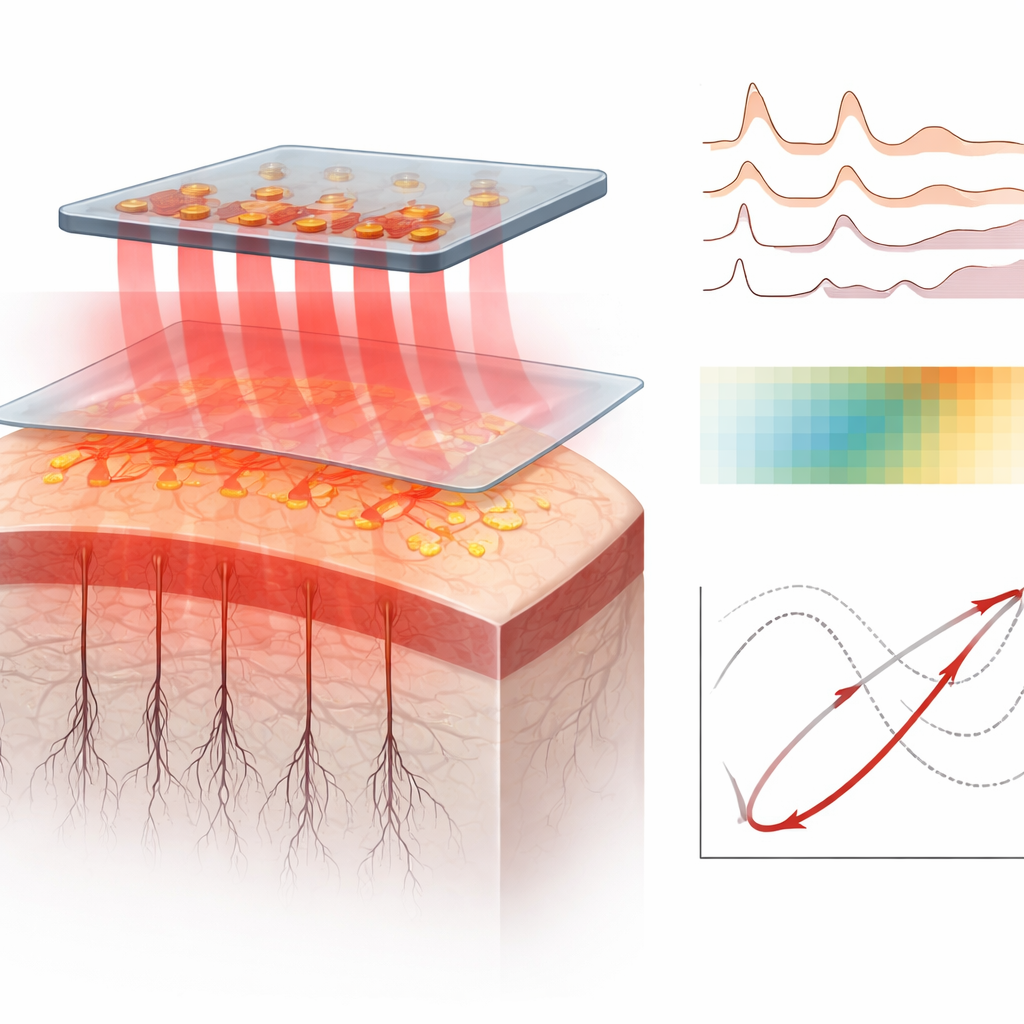
Listening Through the Light and Probing Movement
Bright flashes of light create their own electrical artifacts, which can swamp the subtle signals of neurons. To solve this, the researchers first recorded how stimulation looked in a simple salt solution, then used those patterns to subtract the light-induced artifacts from monkey brain recordings. With this correction in place, they showed that red light over Jaws-expressing tissue reliably altered brain rhythms, both when the animals were resting and when they performed a reaching task. Surprisingly, although Jaws is designed to silence neurons, the surface recordings often showed increased power at many frequencies. Simulations and prior work suggest a likely mechanism: strong inhibition near the surface may relieve deeper cells from their usual brake, resulting in increased activity in the layers that contribute most to surface signals.
Slowing a Reach With a Brief Burst of Light
To test whether these neural changes matter for behavior, the monkeys were trained to reach from a central start point to one of four targets on a screen using their right hand. On half of the trials, a 900-millisecond burst of red light was applied to the posterior parietal cortex, a region known to help plan and guide arm movements. The basic shape of the reaching paths stayed similar, but the time to reach the target and the length of the path increased, particularly for downward and leftward movements and especially in the monkey with stronger expression near a key parietal groove. At the same time, high-frequency brain activity over the light-sensitive region rose more during stimulated trials than in nearby non-expressing regions, linking the optogenetic perturbation to both local circuit changes and measurable behavioral delays.
Why This Matters for Brain Research and Medicine
This work delivers a long-lasting, flexible “window” into the monkey brain that lets scientists both control and observe large neural networks over months and years. By avoiding the need for real-time MRI during surgery, relying on commercially available components and basic lab tools, and sharing designs and code openly, the platform lowers the barrier for many groups to adopt advanced optogenetic studies in non-human primates. In the long run, such tools may illuminate how distributed brain circuits support movement, perception, and recovery from injury, and could help refine stimulation-based therapies for human neurological and psychiatric disorders.
Citation: Griggs, D.J., Stanis, N., Bloch, J. et al. A large-scale optogenetic neurophysiology platform for improving accessibility in non-human primate behavioral experiments. Nat Commun 17, 3128 (2026). https://doi.org/10.1038/s41467-026-69448-3
Keywords: optogenetics, non-human primates, electrocorticography, neural stimulation, motor behavior