Clear Sky Science · en
Embedding two dimensional Al2O3 platelets array into YSZ ceramics for high-temperature applications
Protecting Engines from Extreme Heat
Modern jet engines and gas turbines run so hot that even advanced metals need a ceramic "shield" to survive. Yet today’s ceramic coatings struggle when bombarded by intense heat and corrosive ash, limiting how efficiently engines can operate. This paper reports a new way to build tougher, more heat‑resistant ceramic armor by carefully arranging tiny flat plates of alumina (a form of aluminum oxide) inside a widely used ceramic called yttria‑stabilized zirconia (YSZ). 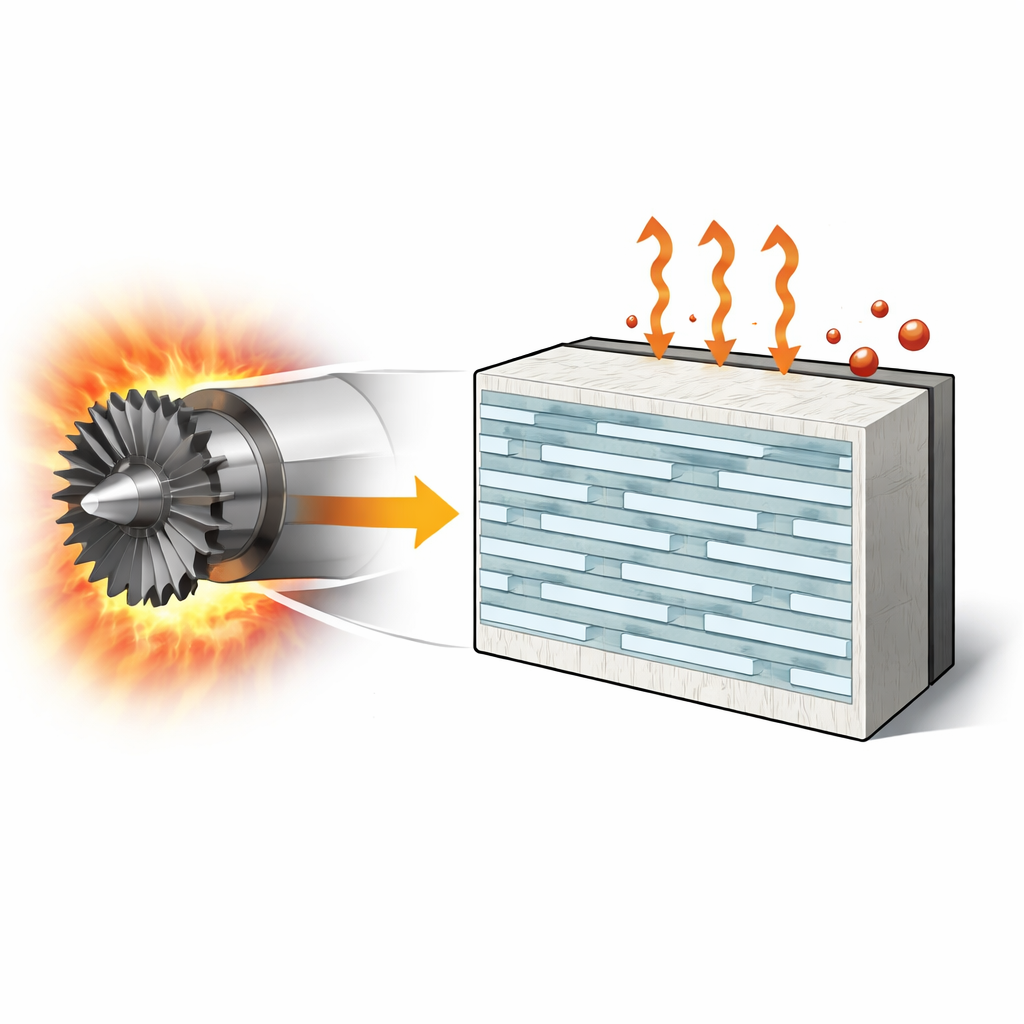
Why Current Ceramic Shields Fall Short
YSZ is the workhorse material for thermal barrier coatings that insulate turbine blades and other hot‑section parts. It combines good strength with an unusual ability to deform slightly without cracking. But at the blistering temperatures inside engines, YSZ lets through a lot of near‑infrared radiation—an invisible form of light that carries heat—so the metal underneath can still overheat. Worse, airborne ash rich in calcium, magnesium, aluminum, and silicon can melt on the surface into a glassy liquid known as CMAS. This molten layer eats into YSZ, triggers harmful changes in its crystal structure, and eventually robs it of toughness.
A New Kind of Reinforcement Plate
To tackle these problems, the researchers chose alumina as a helper material. Alumina is hard, chemically stable, and already used in harsh, high‑temperature settings. Instead of mixing it as simple grains, they used it in the form of thin platelets—tiny flakes only a fraction of a micrometer thick but several micrometers across. They devised a processing route that gently stirs these platelets with YSZ powder in water, protects them from damage during mixing, and then uses a combination of vibration, gravity, heat, and pressure during sintering to line them up almost parallel inside the solid ceramic. The result is a dense composite in which stacks of flat alumina plates are embedded like pages in a book within the YSZ matrix.
Bouncing Heat and Light Away
The ordered platelets dramatically change how the material handles heat. In ordinary YSZ, more than half of the near‑infrared light around two micrometers wavelength can pass straight through a one‑millimeter thick sample, contributing to radiative heat transfer. By contrast, the new alumina‑platelet composite lets through less than ten percent across the whole measured range. The flat plates and the contrast in optical properties between alumina and YSZ cause incoming light to scatter and reflect many times instead of penetrating. This also lowers the portion of thermal conductivity carried by radiation to about one‑fifth that of pure YSZ at 1000 °C. At the same time, the many interfaces between YSZ and the platelets scatter heat‑carrying vibrations in the solid, further reducing heat flow without making the material porous. 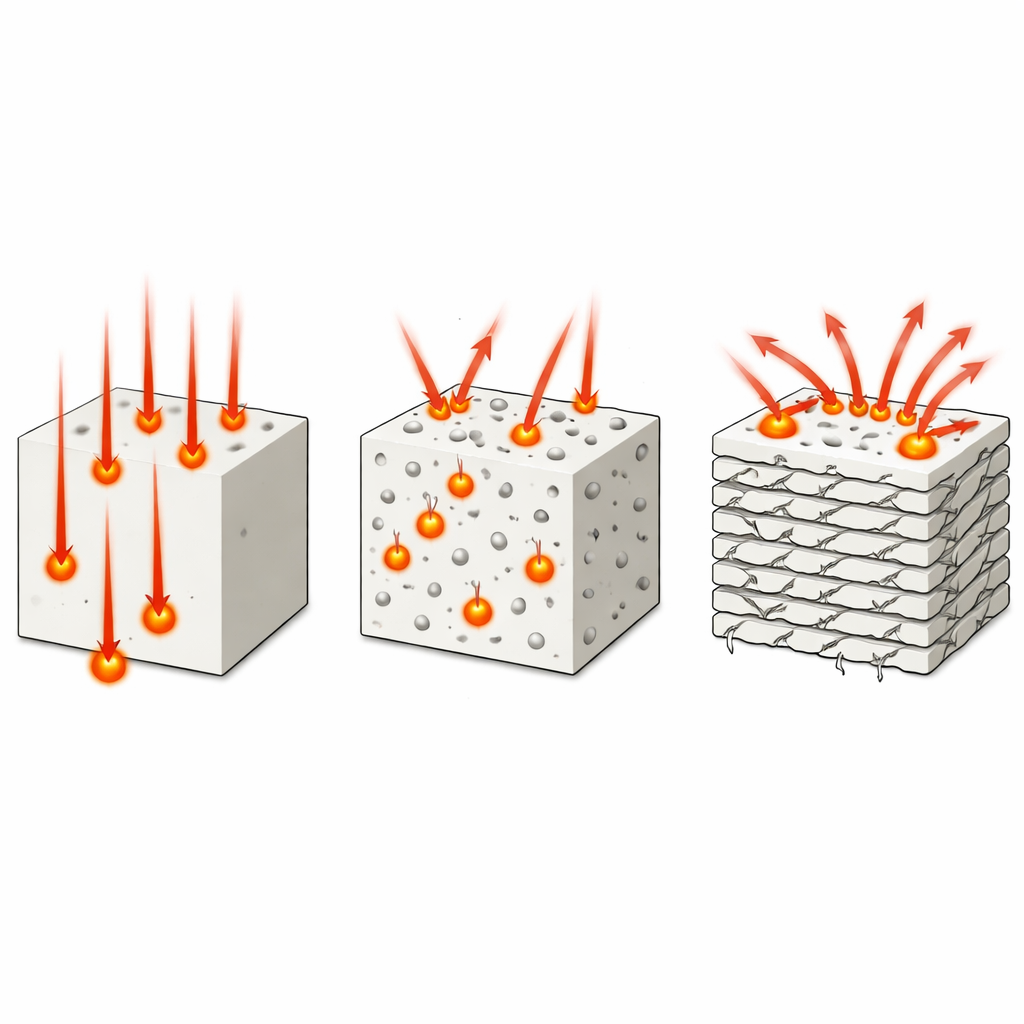
Standing Up to Corrosive Ash and Cracks
The parallel alumina plates also act as a barrier against CMAS attack. When exposed to molten CMAS at 1250 °C, pure YSZ suffered deep infiltration—nearly 200 micrometers into the material. Adding alumina as random particles helped somewhat, but arranging it as platelets cut the penetration depth to about 40 percent of that in pure YSZ. Chemical reactions at the plate surfaces form a protective crystalline layer that traps the molten ash near the surface instead of letting it seep downward. Meanwhile, mechanical tests and computer simulations show that the platelets deflect and bridge growing cracks. Local changes in the YSZ crystal structure near the alumina interface help redirect cracks along more tortuous paths, increasing the energy needed for them to spread. As a result, the composite maintains higher hardness and fracture toughness than plain YSZ from room temperature up to several hundred degrees Celsius.
What This Means for Real‑World Machines
Together, these effects make the alumina‑reinforced YSZ ceramic both a better insulator and a more durable shield against corrosive deposits and mechanical damage. In practical terms, such coatings could allow turbine blades and similar components to run hotter for longer without failure, improving engine efficiency and reducing fuel consumption. The study also demonstrates a general strategy: by embedding stable, two‑dimensional oxide platelets in a controlled, aligned array inside a ceramic, engineers can tailor how heat, light, and cracks move through the material. This opens a path toward a new generation of high‑temperature ceramics designed from the inside out to thrive in some of the harshest environments technology can create.
Citation: Yang, Z., Zhang, X., Jin, J. et al. Embedding two dimensional Al2O3 platelets array into YSZ ceramics for high-temperature applications. Nat Commun 17, 2988 (2026). https://doi.org/10.1038/s41467-026-69355-7
Keywords: thermal barrier coatings, yttria-stabilized zirconia, alumina platelets, high-temperature ceramics, CMAS corrosion