Clear Sky Science · en
Root traits and mycorrhizal fungi mediate reactive N and warming impacts on soil organic carbon
Why the Hidden Life of Roots Matters
Soils store more carbon than the atmosphere and all plants combined, and much of that carbon arrives through plant roots and their fungal partners. This study asks a deceptively simple question with big climate implications: as human-made nitrogen pollution increases and the world warms, will grassland soils keep locking away carbon or start leaking more of it back into the air? By zooming in on the fine roots of plants and the microscopic fungi that coat them, the authors uncover how subtle shifts belowground can tip the balance between storing carbon and releasing it.
A Grassland as a Living Test Bed
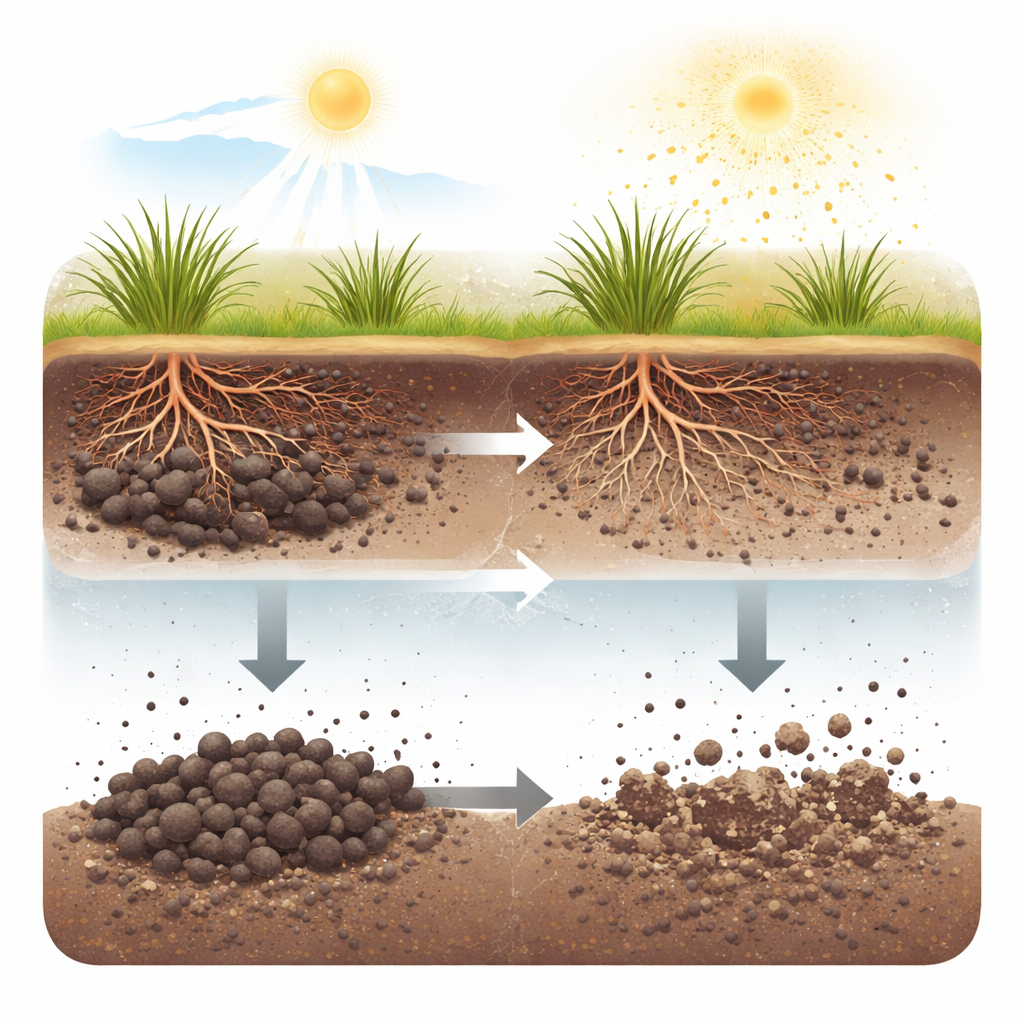
The researchers set up a long-term experiment in a semi-arid grassland on China’s Loess Plateau. They applied extra reactive nitrogen, similar to fertilizer or airborne pollution, and used transparent chambers to gently warm the air and soil by about 2 °C. Over several years they tracked how plants, roots, and soil responded. They measured aboveground and belowground plant growth, watched which plant types thrived, and used DNA tools to identify the underground fungi called arbuscular mycorrhizal fungi that form intimate partnerships with roots. To follow carbon’s path into the ground, they also used a harmless heavy form of carbon (¹³C) as a tracer, allowing them to distinguish new carbon entering the soil from the older carbon already there.
Plants Change Their Strategy Underground
Extra nitrogen acted like a fertilizer that reshaped the plant community. The grassland shifted from being dominated by forbs (broad-leaved herbs) to being dominated by grasses. At the same time, plants altered how they invested in their roots. With more nitrogen available, roots became richer in nitrogen, longer for their mass, and had greater surface area but lower tissue density, traits linked to fast growth and short life. Warming, in contrast, tended to favor thicker, shorter roots with less surface area, reflecting a strategy better suited to drier, warmer conditions. These changes created a fundamental tradeoff: plants could either build dense, long-lived roots and rely strongly on fungal partners, or build cheaper, short-lived roots and depend less on fungi.
Fungal Partners Shift and Soil Protection Weakens
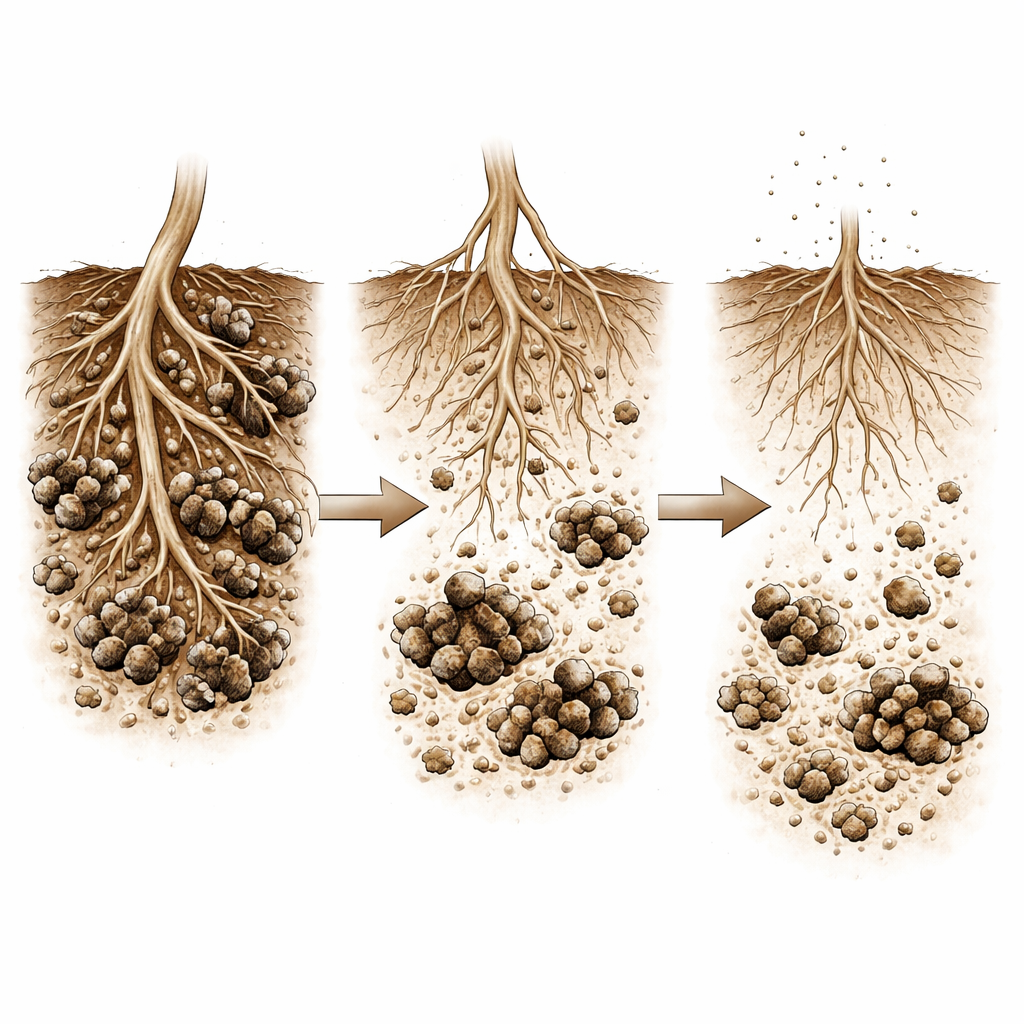
The same forces that reshaped roots also reshaped their fungal allies. Added nitrogen reduced both the amount of fungal tissue colonizing roots and the fungal networks in the surrounding soil. It also pushed the fungal community away from groups that typically build thicker, more carbon-rich threads toward groups with finer, more extensive filaments that demand less carbon from the plant. Warming further trimmed fungal biomass, especially under dry conditions. These shifts matter because roots and fungi help glue soil particles together and bind organic matter to minerals, forming a protected pool of carbon that can remain in the ground for decades or longer. When dense roots and certain fungi decline, soil aggregates loosen and carbon becomes easier for microbes to attack.
Less Carbon Enters, More Carbon Leaves
By tracking the ¹³C tracer, the team found that both nitrogen additions and warming reduced the amount of new plant-derived carbon entering the soil through roots and fungi. They also lowered the amount of this new carbon that ended up safely attached to minerals, a particularly stable form known as mineral-associated organic carbon. At the same time, extra nitrogen sped up the breakdown of added plant residues when roots and fungi were present, indicating that the new, thinner, high-turnover roots and altered fungal communities stimulated microbes to decompose organic matter faster. Measures of microbial remains and mineral-bound carbon both declined under nitrogen and warming, signaling that not only was less carbon being stored, but some of the existing protective structures were being eroded.
What This Means for Climate and Land Management
Taken together, the study shows that rising nitrogen pollution and warming do more than simply boost or shrink plant growth: they rewire the underground partnership between roots and fungi in ways that can undermine soil’s ability to store carbon. Plants shift toward faster, leakier root systems and less protective fungal partners, while microbial decomposers gain easier access to once-protected carbon. For grasslands on the front lines of global change, this means that soils may become a weaker brake on climate warming than many models assume. Accounting for these root–fungus tradeoffs will be essential for predicting how much carbon future soils can hold and for designing land-use and fertilizer practices that help keep carbon in the ground.
Citation: Qiu, Y., Zhao, Y., Wang, B. et al. Root traits and mycorrhizal fungi mediate reactive N and warming impacts on soil organic carbon. Nat Commun 17, 3184 (2026). https://doi.org/10.1038/s41467-026-69301-7
Keywords: soil organic carbon, grassland roots, mycorrhizal fungi, nitrogen deposition, climate warming