Clear Sky Science · en
Oxygen octahedron framework design for large energy capacitive relaxors
Smaller, Faster, Cleaner Energy Storage
Modern gadgets, electric cars, and medical equipment all depend on components that can store and release electrical energy in a split second. Today’s best high‑power capacitors often rely on lead‑based materials, which pose environmental concerns. This study reports a new design strategy for lead‑free ceramic capacitors that can pack a lot of energy into a small volume while wasting very little as heat, pointing toward greener and more compact power electronics.
Why Ordinary Capacitors Hit a Wall
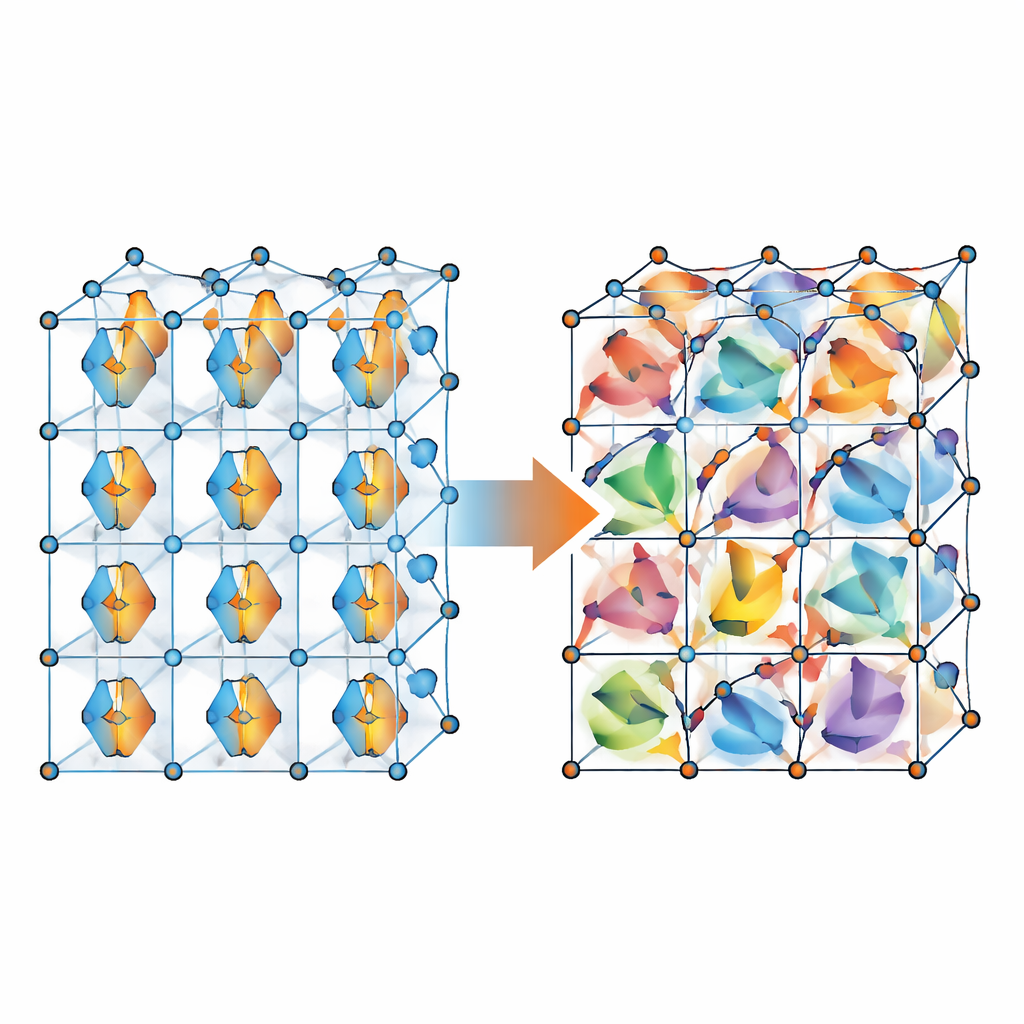
Many advanced capacitors are made from ferroelectric ceramics, whose internal electric dipoles can flip when an external voltage is applied. In a conventional ferroelectric, these dipoles line up into large, well‑ordered regions called domains. That order gives a strong response to an electric field, but it also means that flipping the domains consumes extra energy. On a chart of polarization versus electric field, this shows up as a wide, square‑shaped loop—evidence that a lot of the input energy is lost instead of recovered. For future devices, engineers want materials that still polarize strongly at high voltage, but relax quickly and cleanly when the field is removed.
Turning Domains into a Slushy Landscape
One promising route is to use so‑called relaxor ceramics, where polarization is broken into many tiny “polar nanoregions” instead of large domains. These materials naturally show slimmer loops and better efficiency, but the usual way to make them—mixing in non‑active atoms—tends to weaken the overall polarization. The authors tackle this trade‑off with a different idea: keep most of the “ferroactive” atoms that strongly respond to electric fields, and instead tune how the surrounding oxygen atoms tilt within the crystal lattice. In their lead‑free system, based on Bi0.5Na0.5TiO3 (BNT) and AgNbO3 (AN), they deliberately disrupt the long‑range pattern of these oxygen tilts. This creates a patchwork of tiny regions where both polarization and tilt vary over only a few billionths of a meter.
How Tilted Oxygen Cages Control Polarization
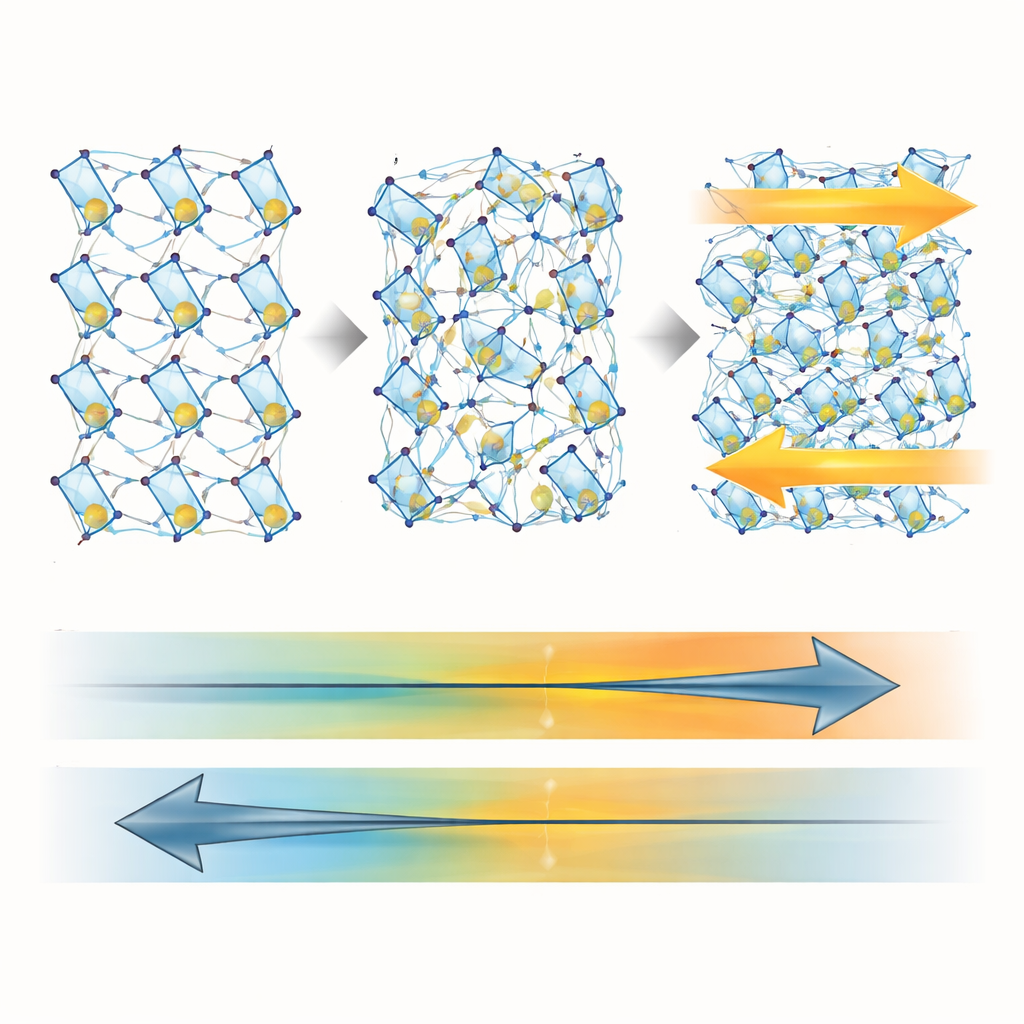
Using a suite of high‑resolution electron microscopy and X‑ray techniques, the team visualized how atoms shift in this tailored ceramic. They found “slush‑like” polar nanoregions just 1–3 nanometers across, stitched together by dense walls of slightly distorted crystal structure. Within these regions, dipoles point in many directions but retain large local strength thanks to the high content of responsive cations such as Bi, Na, Ag, Ti, and Nb. At the same time, oxygen octahedra—the cage‑like units surrounding the central metal atoms—show a mix of clockwise and anticlockwise tilts with varying angles. This disordered tilt pattern generates tiny, irregular strains in the lattice that act like springs, resisting sudden growth of large domains and gently pulling the polarization back when the field is removed.
From Atomic Disorder to Superior Performance
This carefully engineered “framework” of oxygen tilts has two key effects under an applied voltage. First, the weak coupling between neighboring nanoregions allows them to reorient quickly, giving a large overall polarization before saturation sets in. Second, the random elastic fields from the tilt disorder delay the point at which all dipoles fully align, stretching out the useful range of electric field. Together, these features produce a very slim polarization‑electric field loop with high maximum polarization but nearly zero leftover polarization when the field is turned off. In measurements on the optimal composition, labeled 0.8BNT–0.2AN, the material achieved a recoverable energy density of about 17 joules per cubic centimeter with about 86% efficiency at a high electric field—figures that compete with or exceed many state‑of‑the‑art lead‑free ceramics.
What This Means for Future Electronics
To a non‑specialist, the message is that the authors found a way to make the electric dipoles in a ceramic behave more like a responsive, springy fluid than a rigid, clunky solid—without sacrificing strength. By redesigning the oxygen “scaffolding” inside a lead‑free perovskite crystal, they created a dense forest of nanoscale polar regions that charge and discharge quickly, store a lot of energy, and waste very little. This oxygen octahedron framework approach opens a new, environmentally friendlier path to compact, reliable capacitors for pulsed power electronics, from electric vehicles to advanced medical devices.
Citation: Liu, Y., Li, H., Wu, J. et al. Oxygen octahedron framework design for large energy capacitive relaxors. Nat Commun 17, 2812 (2026). https://doi.org/10.1038/s41467-026-69282-7
Keywords: lead-free capacitors, relaxor ferroelectrics, energy storage ceramics, polar nanoregions, perovskite oxides