Clear Sky Science · en
Dual-Band Infrared PbS Colloidal Quantum Dot Focal Plane Array
Seeing More Than Meets the Eye
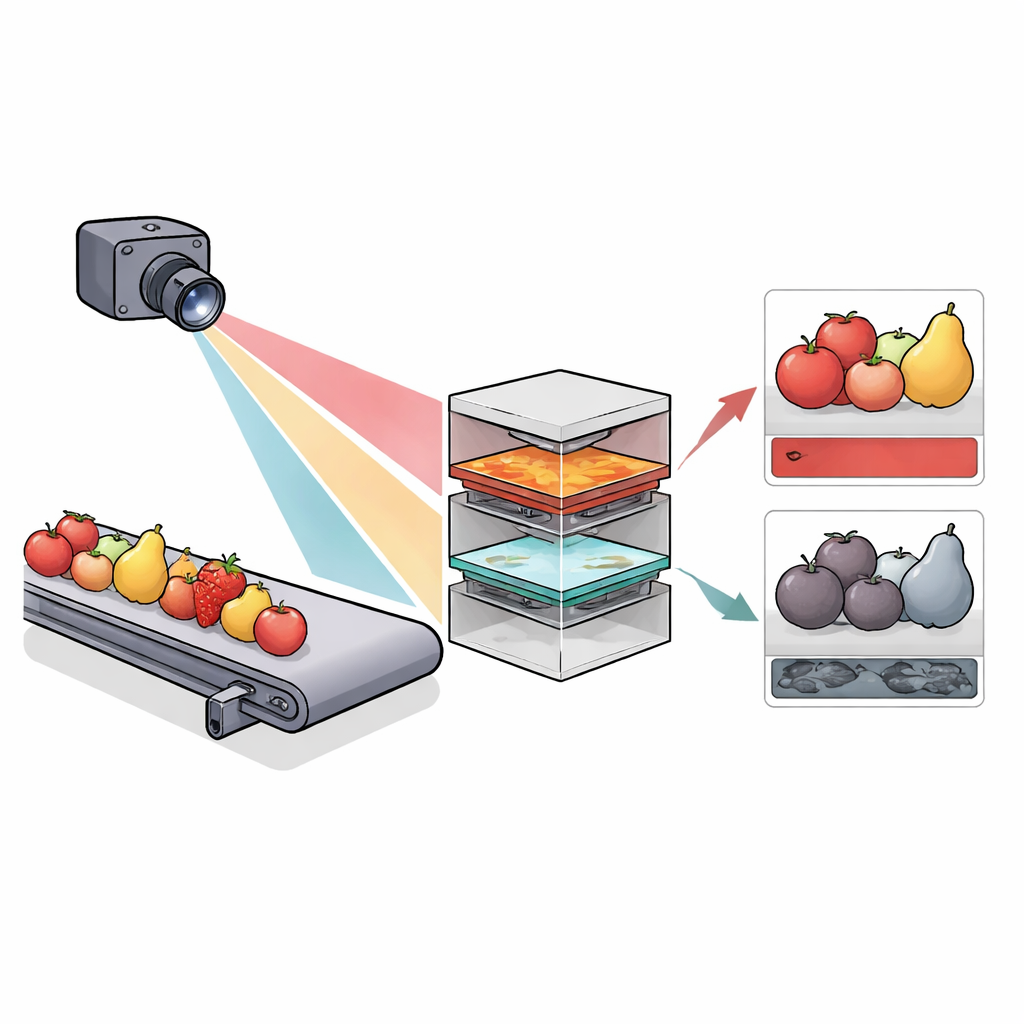
Many things around us hide important details beneath their surfaces: bruises inside fruit, flaws in plastic parts, even features inside living tissue. This study describes a new kind of tiny camera chip that can see in two different infrared "colors" at once, allowing it to look both just below the surface and deeper inside objects. Built with low-cost, solution-processed materials that work with standard electronics, it points toward future scanners that are smaller, cheaper, and easier to build into everyday machines, from food-sorting lines to medical tools.
Why Two Invisible Colors Matter
Our eyes see only a narrow band of light. Just beyond red lies the near-infrared (NIR) and, farther out, the short-wave infrared (SWIR). These bands interact with materials in different ways: they respond to the chemical bonds in water, fats, and sugars and they penetrate to different depths. That means NIR and SWIR images can reveal both surface texture and hidden structure. Today, systems that combine these views usually rely on two separate detectors—often silicon for NIR and a compound called indium gallium arsenide for SWIR—plus bulky optics to line everything up and software to merge the images. These setups are powerful but large, expensive, and hard to shrink into portable devices or dense camera arrays.
Stacking Quantum Dots for Two-Band Vision
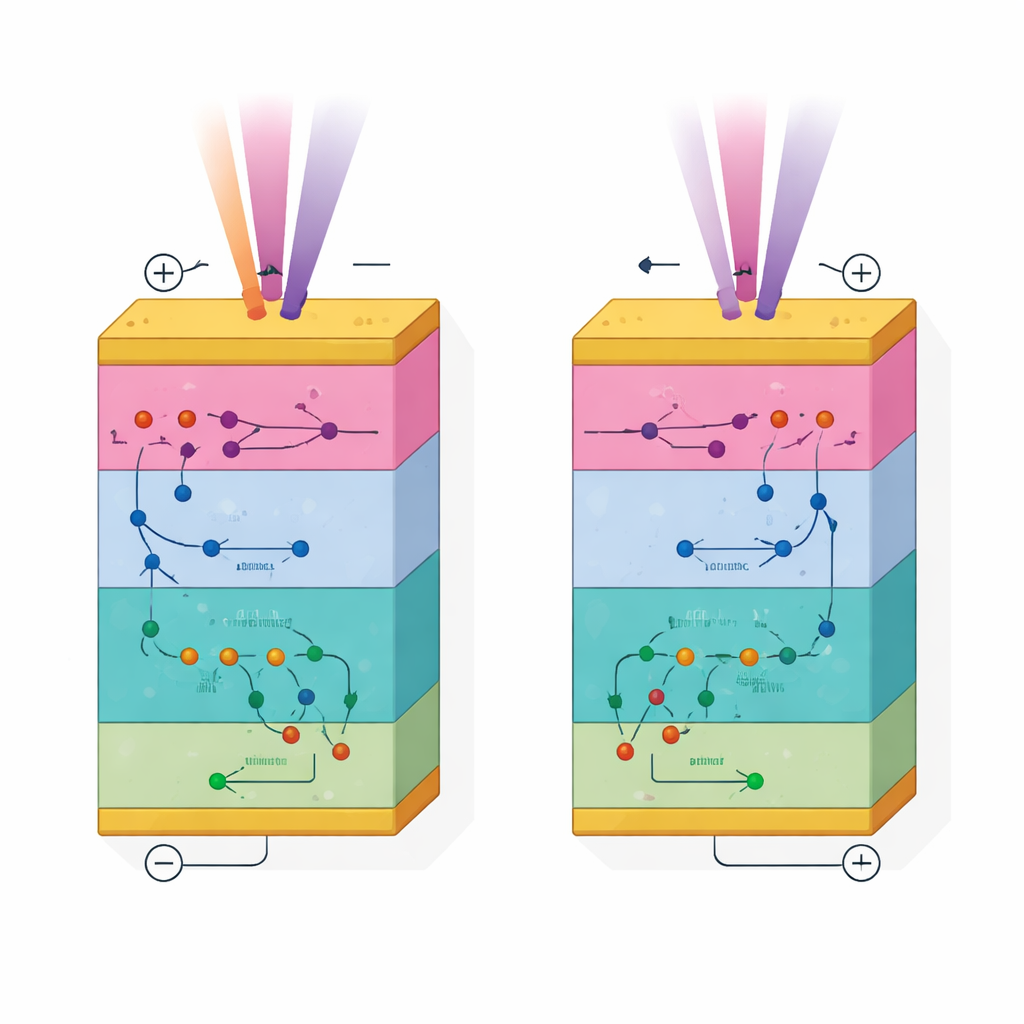
The authors tackle this challenge using colloidal quantum dots, nanoscale crystals of lead sulfide (PbS) that can be tuned to absorb different wavelengths simply by changing their size. They build a single, vertically stacked device that contains two PbS layers: a top layer made of smaller dots that favors NIR light, and a bottom layer of larger dots that responds to SWIR. Sandwiched with carefully chosen contact and barrier layers, this p-i-n-i-p structure behaves like two back-to-back diodes. When the voltage across the device is set one way, the electric field helps collect charges mainly from the NIR-sensitive top layer; when the voltage is reversed, it instead favors collection from the SWIR-sensitive bottom layer. In effect, the same pixel can "switch" between two invisible colors simply by changing the bias.
Clean Signals with Little Crosstalk
A key difficulty in such designs is crosstalk: stray NIR light leaking into the SWIR channel or vice versa, making it hard to tell which band produced which signal. The researchers solve this with careful energy-band engineering. They introduce a strong barrier for one type of charge carrier between the layers so that, under the chosen bias, carriers mainly flow from only one absorber at a time. By mapping how the detector responds across wavelength and voltage, they identify operating points where one band dominates and the other is strongly suppressed. The resulting device reaches very high sensitivity (detectivity above 1011 in standard units) in both NIR and SWIR while keeping SWIR contamination of the NIR signal to about 0.5% and NIR leakage into SWIR to under 8%, all at room temperature.
From Single Pixel to Working Camera Chip
To show this is more than a laboratory curiosity, the team connects their quantum-dot stack directly onto a custom-made readout chip, forming a 128-by-128-pixel focal plane array. This readout electronics is designed to handle both polarities of current, so the same chip can operate first in NIR mode and then in SWIR mode just by flipping the bias. The resulting camera captures hundreds of frames per second. In demonstrations, it reveals patterns hidden beneath paint and even through a silicon wafer, since NIR and SWIR light pass through these materials differently. It also distinguishes colored inks and the contents of opaque plastic bottles, highlighting how the two bands can uncover different aspects of the same scene useful for quality control, sorting, and security.
What This Means for Future Sensors
In everyday terms, this work brings us closer to compact, affordable cameras that see more than the human eye, using a single, simple chip instead of two separate detectors. By harnessing solution-processed quantum dots and a clever stacked design, the authors achieve a sensor that can swap between two invisible colors on command, with low noise and little mixing between channels. Such dual-band infrared imagers could help farmers spot hidden bruises in fruit, factories catch defects before products ship, and doctors or researchers probe tissues non-destructively—all using technology that can, in principle, be manufactured at scale on silicon.
Citation: Di, Y., Ba, K., Ye, L. et al. Dual-Band Infrared PbS Colloidal Quantum Dot Focal Plane Array. Nat Commun 17, 3527 (2026). https://doi.org/10.1038/s41467-026-69199-1
Keywords: dual-band infrared imaging, quantum dot photodetector, near-infrared and short-wave infrared, focal plane array, multispectral sensing