Clear Sky Science · en
Modeling roles and trade-offs in multiplex networks
Why many kinds of ties matter
In everyday life, we relate to the same people in many different ways: we chat with them, ask them for health advice, or borrow money. These layers of connection form a web that is richer than any single friendship or help-giving tie. This article introduces a new way to study such layered social worlds, showing how people juggle limited time and resources across social, health, and economic relationships, and how different kinds of ties depend on who we are, who others are, and how we mutually influence each other.
Seeing villages as layered webs
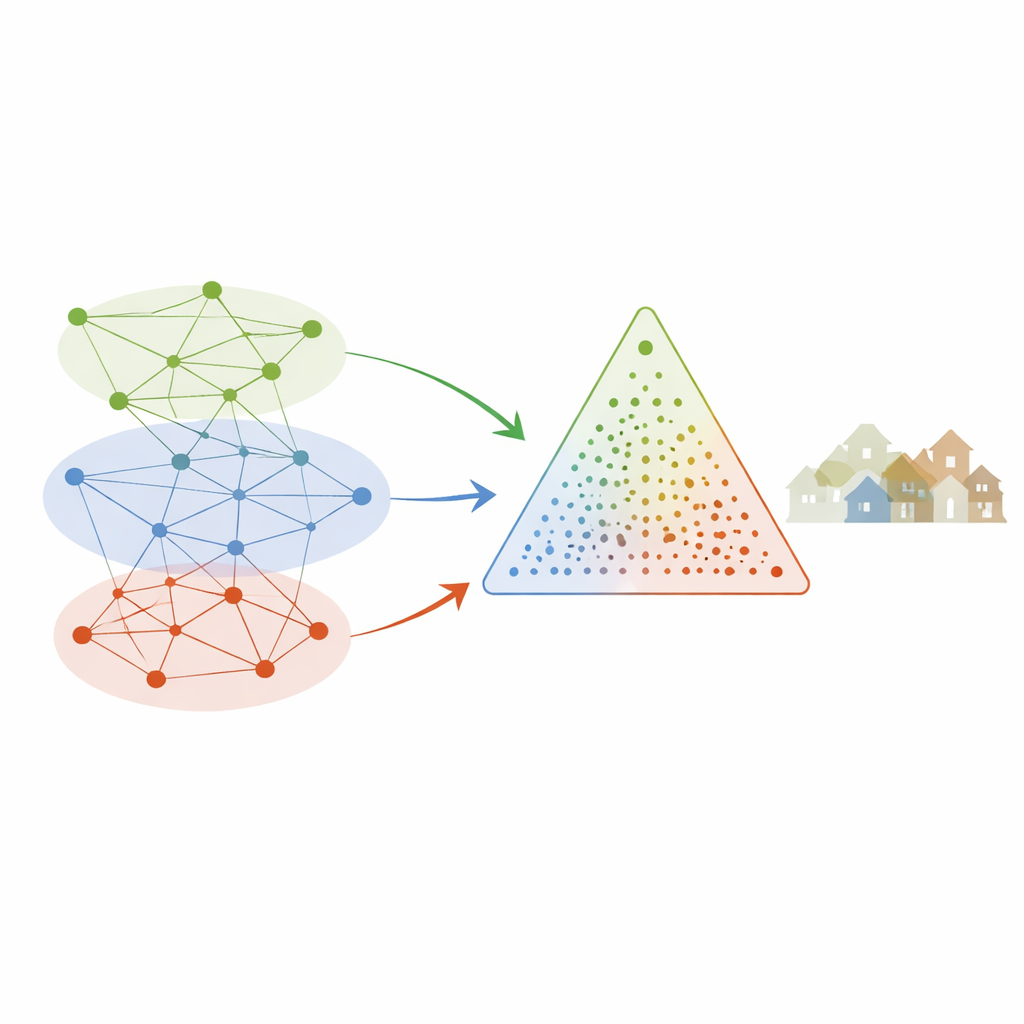
The researchers focus on “multiplex” networks, where the same individuals are linked in several kinds of relationships at once. Using detailed data from 176 villages in western Honduras—covering who spends free time together, who talks about health, and who would lend or borrow money—they build three parallel layers of ties for each community. These layers capture three basic modes of social exchange: independence (ties driven mostly by the sender’s own effort and initiative), dependence (ties drawn to people with status or resources), and interdependence (ties shaped by the mutual fit and ongoing relationship between two people). The central challenge is to see, in a unified way, how each person allocates their limited “relationship budget” across these overlapping layers.
Turning complex ties into simple roles
To tackle this, the authors introduce the Multiplex Latent Trade-off (MLT) model. It represents each person’s behavior as a position inside a triangle-like space, where each corner corresponds to one layer: social, health, or economic. A person closer to one corner invests more of their ties in that layer. Crucially, the model separates how people act as senders (who they reach out to) and as targets (who others seek out), and it treats these positions as roles: a person might be a strong social hub, a health adviser, or a financial helper. At the same time, the model uncovers hidden communities within each layer at multiple scales—from broad groupings down to small, tightly connected clusters—without assuming in advance where these communities lie.
What village networks reveal
Applying the model to all 176 villages, the authors find that social ties dominate people’s relational lives. Most villagers are involved in social connections as both senders and targets, and some individuals become almost “pure” social roles. By contrast, far fewer people are central in health or economic layers, especially as targets, reflecting that being a sought-after health adviser or lender usually requires special knowledge or resources. Yet these layers still form their own multi-level community structures, with groups of people who rely on each other in more specialized ways. Importantly, the roles the model finds only partly reflect simple counts of how many ties a person has, suggesting it is capturing deeper patterns of who is connected to whom, and in which capacity.
When mutual influence really counts
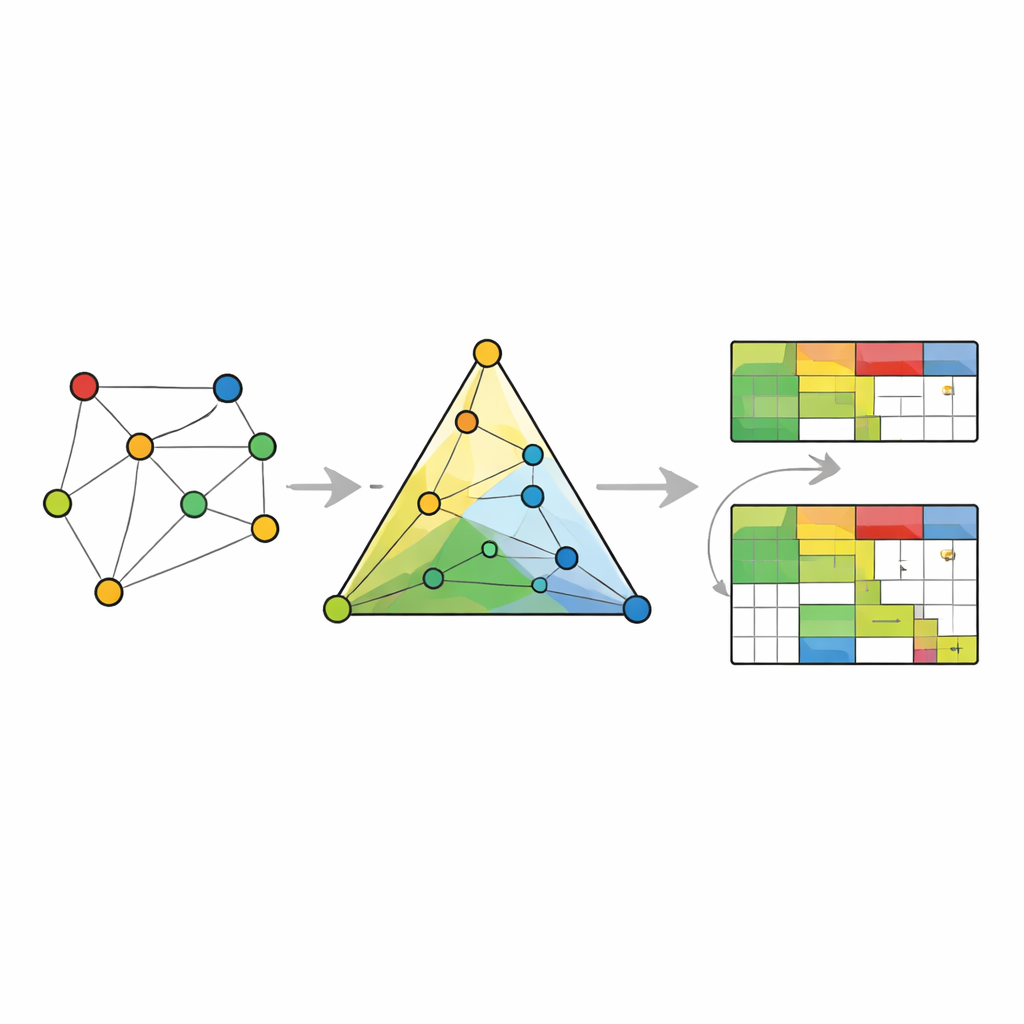
The team then asks how much of these networks can be explained just by individual activity and popularity, versus by genuine interdependence between pairs of people. They compare a stripped-down model that only accounts for how active people are as senders and how attractive they are as targets with the full MLT model that also includes pairwise interaction structure. If adding interdependence greatly improves the ability to predict which ties exist, that is evidence that mutual influence is structurally important. They find that this is especially true for social relationships: modeling interdependence yields large gains in prediction, even after accounting for how active or popular people are. In health and economic layers, the gains are smaller and more closely tied to how engaged people are in those activities, reinforcing the idea that these ties are more instrumental and status-driven.
What this means for understanding communities
Overall, the study shows that our social lives cannot be reduced to simple counts of how many connections we have. In the Honduran villages, everyday social ties are deeply shaped by complex, reciprocal patterns that are “built into” the structure of the network, while health and economic help follow more targeted, status-based logics. The MLT framework offers a clear, interpretable map of how people trade off their limited time and resources across different domains of life, and how roles and communities emerge from these trade-offs. For a lay reader, the key takeaway is that who we talk to, who we trust with our health, and who we rely on financially are related but distinct choices—and their patterns can be systematically uncovered using careful, role-based modeling of multiplex social networks.
Citation: Nakis, N., Lehmann, S., Christakis, N.A. et al. Modeling roles and trade-offs in multiplex networks. Nat Commun 17, 3622 (2026). https://doi.org/10.1038/s41467-026-68896-1
Keywords: multiplex social networks, social exchange, network roles, community structure, interdependence