Clear Sky Science · en
Milliwatt-level UV generation using sidewall poled lithium niobate
Brighter Ultraviolet Light on a Chip
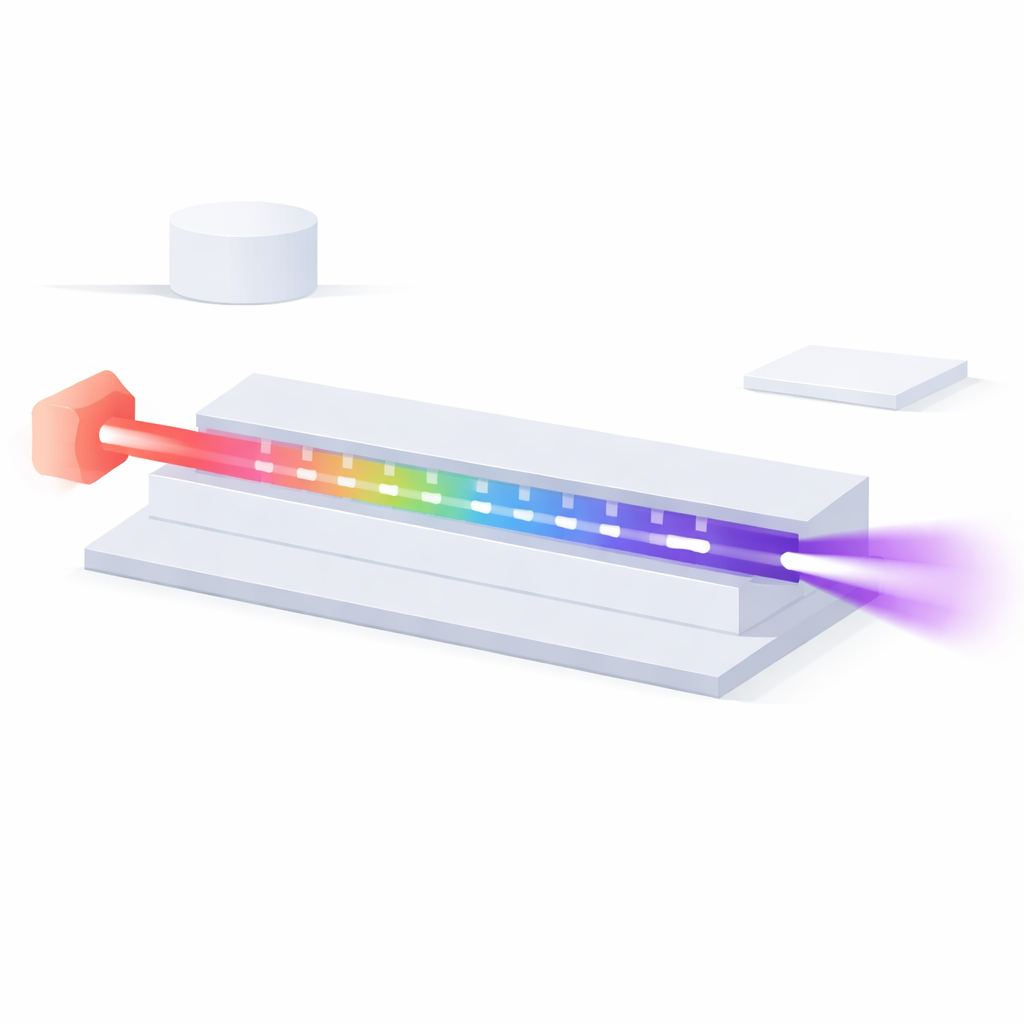
Ultraviolet (UV) lasers are workhorses of modern technology, quietly enabling precision clocks, advanced microscopes, and promising quantum computers. Yet building compact, reliable UV light sources has been surprisingly hard: the tiny semiconductor lasers that work so well in the red and blue often fail or perform poorly in the deep violet and UV. This paper presents a new way to generate strong, stable UV light directly on a tiny chip, potentially shrinking room-sized optical systems down to something more like a smartphone component.
Why We Need Better UV Light
Many cutting-edge devices depend on high-quality UV light. Trapped-ion quantum computers use UV beams to control and read out individual atoms. Optical clocks, which keep time so precisely they would gain or lose less than a second over the lifetime of the universe, use UV to probe atomic transitions. High-resolution microscopes and sensitive chemical detectors also rely on UV. Unfortunately, semiconductor UV laser diodes are difficult to make and often lack the tunability, stability, or power these applications demand. An attractive alternative is to start with a well-behaved visible or near-infrared laser and "upconvert" its color to UV using a special crystal. This has been done in bulk optics for years, but shrinking the same capability onto an integrated chip, with practical power levels, has remained out of reach.
A New Kind of Tiny UV Factory
The authors use a material called thin-film lithium niobate, a clear crystal bonded to a chip that has become a favorite in integrated photonics. It naturally supports strong nonlinear optical effects, where incoming light can be combined to create new colors. In this work, redder light at 780 nanometers is converted to its second harmonic at 390 nanometers in the UV. The conversion happens inside a narrow lithium niobate waveguide, which confines the light much like a microscopic glass fiber etched into the chip. To make this process efficient, the crystal must be patterned so that its internal electric poles flip direction periodically along the waveguide, a technique known as poling. This periodic flip keeps the color-conversion process in step as the light travels, dramatically boosting the output.
Shaping the Crystal from the Sides
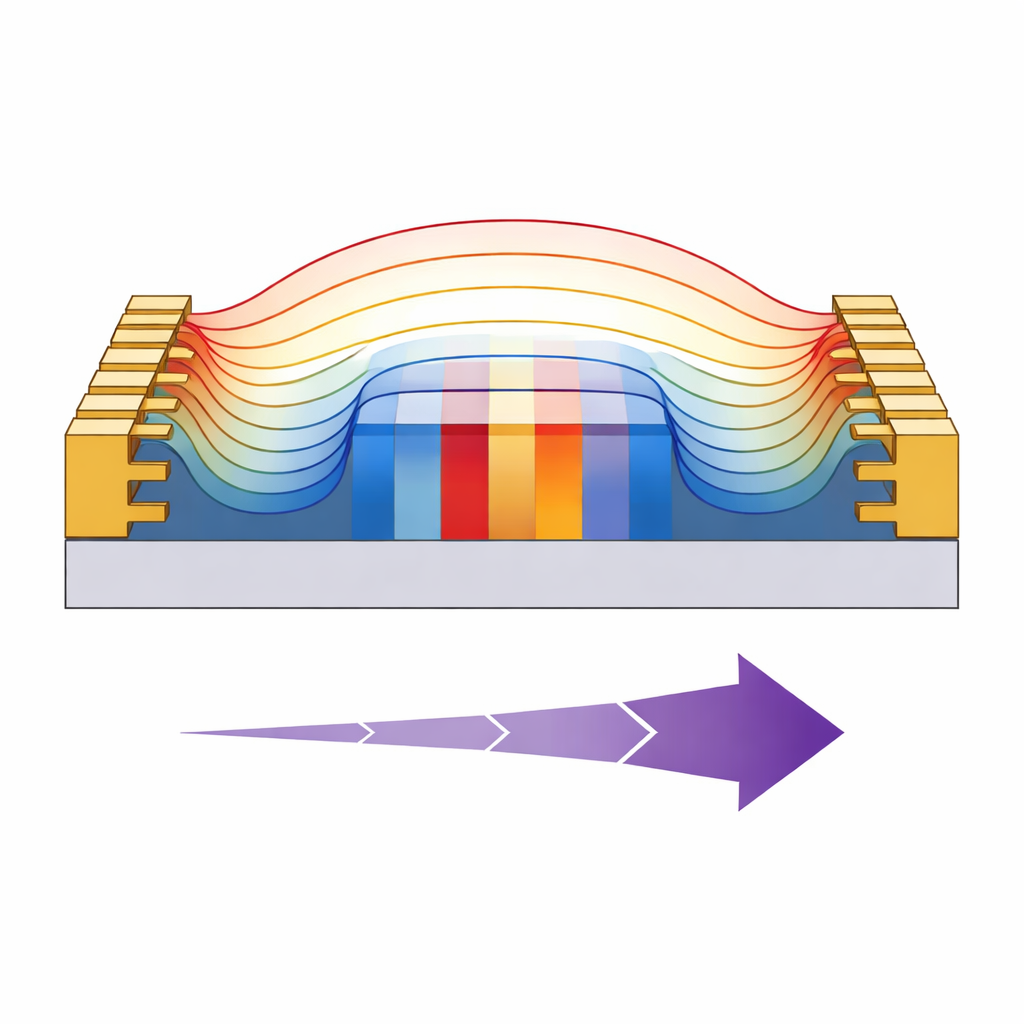
The key innovation is how the team flips the internal orientation of the crystal. Previous "pole-after-etch" methods placed metal electrodes only on the flat regions beside the waveguide. That left much of the guided light in an unflipped region, severely limiting efficiency. Here, the researchers extend metal electrodes up onto the sidewalls of the raised ridge that carries the light. When a voltage is applied, the electric field penetrates the entire cross-section of the waveguide, inverting the crystal domains all the way through its thickness rather than just in the surrounding slab. Careful design of the waveguide width and film thickness makes the process less sensitive to tiny fabrication errors. Using high-resolution microscopes and electron microscopy, the team confirms that the flipped regions are straight, uniform, and have an almost ideal 50–50 pattern along 1.5-centimeter-long waveguides.
Record Power from a Chip-Scale Source
Once the domains are correctly patterned, the metal electrodes are removed to minimize optical loss, leaving behind a permanently poled structure. The authors then send in tunable red light and measure the generated UV. They find that their design has exceptionally low loss at UV wavelengths and a very clean phase-matching condition, meaning the color-conversion remains well aligned along the full length of the device. At low input powers, the UV output grows quadratically as expected, and the waveguides reach a record-high conversion efficiency for this platform. Pushing harder, they achieve 4.2 milliwatts of UV power on the chip—more than a hundred times the previous best in similar lithium niobate technology. At these power levels, subtle nonlinear absorption effects in the material begin to matter, hinting at new physics and suggesting directions for further material optimization.
What This Means Going Forward
By redesigning how the crystal is poled—reaching around the waveguide and shaping it from the sides—this work turns thin-film lithium niobate into a practical UV light engine on a chip. The demonstrated power level is already suitable for many ion-trap experiments, precision measurements, and advanced microscopy, and the same approach can be tuned to different UV wavelengths simply by adjusting the poling pattern. Because the method is compatible with other chip-scale lasers that already offer extremely narrow linewidths, it opens a path to compact, highly coherent UV sources that could replace bulky tabletop setups. In essence, the authors show how thoughtful engineering of a crystal’s internal structure can unlock bright, controllable ultraviolet light from a device small enough to sit on a fingertip.
Citation: Franken, C.A.A., Ghosh, S.S., Rodrigues, C.C. et al. Milliwatt-level UV generation using sidewall poled lithium niobate. Nat Commun 17, 3651 (2026). https://doi.org/10.1038/s41467-026-68524-y
Keywords: integrated UV photonics, lithium niobate waveguides, frequency upconversion, second harmonic generation, quantum technologies