Clear Sky Science · en
Correlative molecular-to-mesoscale evolution in conjugated polymers for intrinsically stretchable organic photovoltaics
Stretchy solar cells for moving bodies
Imagine a solar cell that bends, twists, and stretches with your skin or clothing without falling apart. This study explores how special plastic-like materials used in flexible solar cells change internally when pulled. By watching these changes in real time with powerful X-ray tools, the researchers uncover how these materials manage to stay both electronically useful and mechanically tough—an essential step toward durable, wearable power sources.
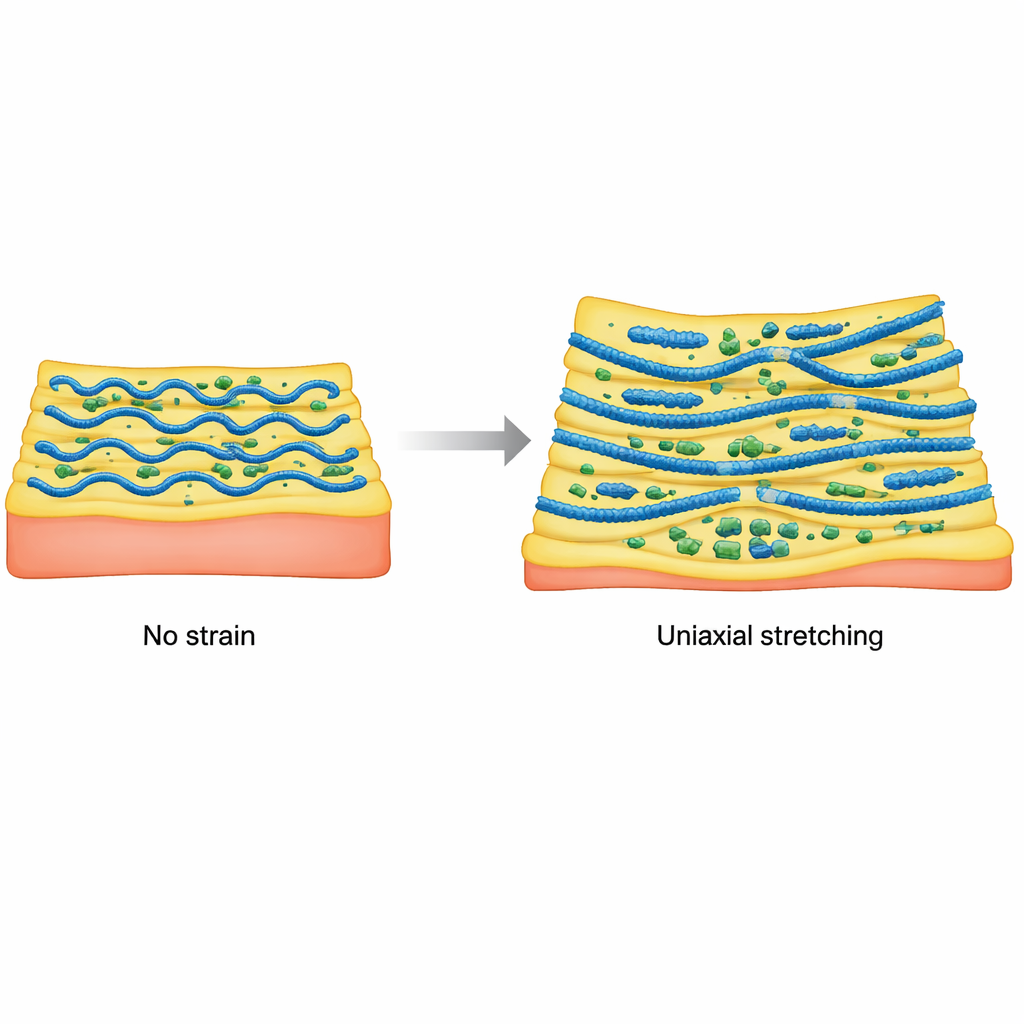
How plastic conductors bear the pull
The devices in question are made from conjugated polymers—long chains of molecules that can carry charge and absorb light. Unlike soft everyday plastics, these chains are relatively stiff and form tiny crystalline regions, so they tend to crack rather than stretch. Yet, with the right design, thin films of these polymers can survive large strains and still function as electronic components. The key unknown has been what happens to the material’s structure, from individual chains up to larger bundles, as it is pulled. Untangling this hierarchy of changes is crucial for improving stretchable solar cells, sensors, and light-emitting devices.
Watching molecules line up and twist
The team focused on a widely studied n-type polymer, P(NDI2OD-T2), as a model. They stretched thin films supported on a soft rubbery backing while probing them with finely tuned X-rays. One technique, X-ray absorption spectroscopy, revealed how the polymer chains reoriented. At small to moderate strains, the chains gradually rotated so that their backbones lined up along the pulling direction, like strands of cooked spaghetti being straightened. At higher strains, the bonds between certain building blocks in each chain twisted more strongly, increasing the angle between them. Computer simulations confirmed that this twisting costs energy but becomes a powerful way for the material to absorb mechanical stress without snapping.
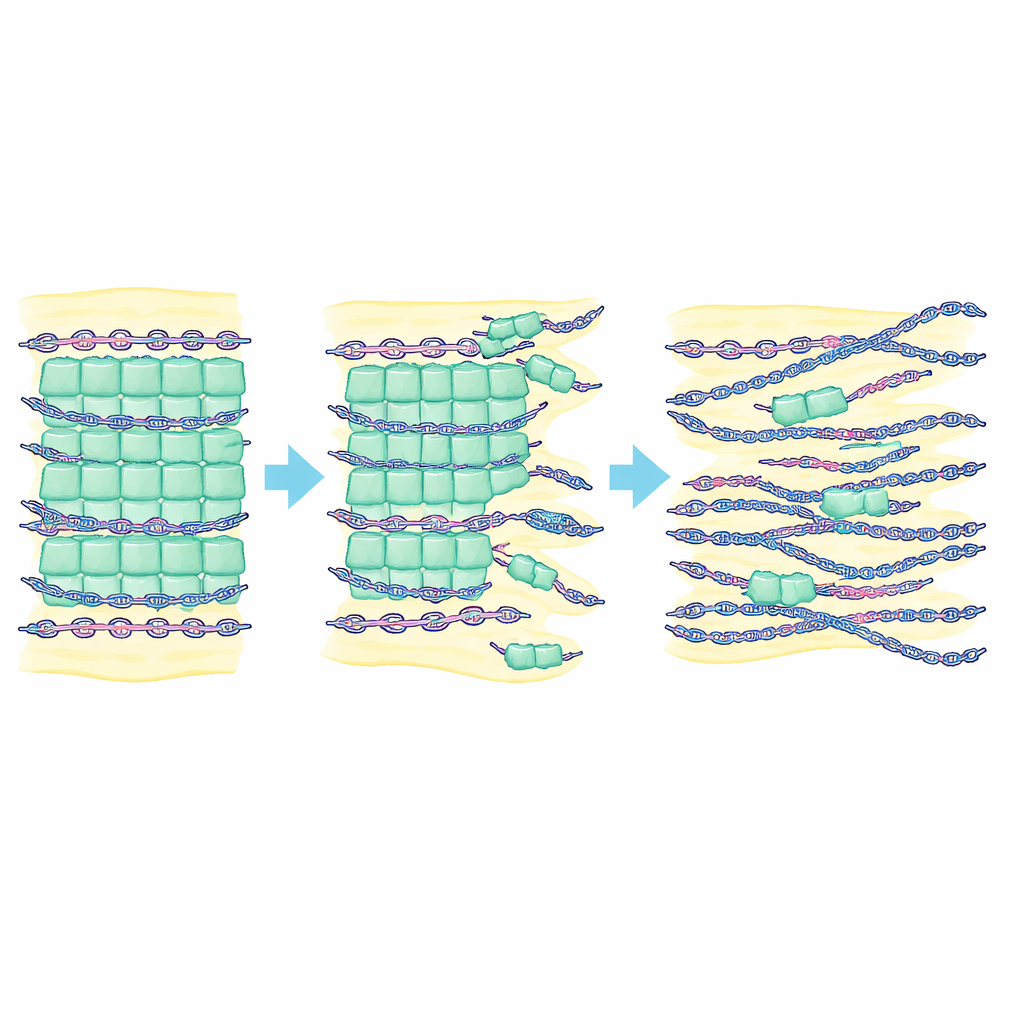
Crystals break, slide, and peel apart
To understand what happens to the tiny crystalline regions within the film, the researchers used resonant X-ray scattering methods that are particularly sensitive to how chains pack together. They found a clear two-stage response. Early in stretching, many crystalline blocks—especially those oriented across the pulling direction—broke down quickly. Some layers slid past each other (“slippage”), while others peeled away from the edges (“peeling”), feeding more chains into the surrounding disordered regions. These structural changes were largely irreversible: once the crystallites fragmented, they did not fully reform when the film was released. At the same time, larger-scale imaging showed that the film’s fibril-like textures grew and became more aligned along the pull, forming an oriented network that helps distribute stress across the material.
From microscopic shifts to device performance
These internal rearrangements also changed how the material interacted with light and carried electrical charge. As the film was stretched, its main absorption peak shifted to slightly shorter wavelengths and narrowed. This shift signals a move from more ordered to more twisted chain segments, which shortens the distance over which excited states can spread. When the polymer was blended with a donor polymer to form a fully stretchable solar cell, the device started with a respectable power conversion efficiency near 7%. Under 30% strain, it still retained about 84% of its original efficiency, but its current output and charge collection both dropped. Microscopy confirmed that the originally fine, interconnected network of the acceptor polymer coarsened into larger aggregates under strain, hampering charge generation and transport and increasing loss processes.
Design lessons for future wearable power
Overall, the work reveals that these stretchable electronic materials protect themselves through a coordinated, multiscale response. First, crystalline regions fragment and reorient, then individual chains twist and align across larger distances. Together, these steps dissipate mechanical energy and delay catastrophic failure, but they also gradually compromise the very order that makes the materials good at harvesting light and moving charges. By mapping these trade-offs in detail, the study offers practical guidelines: future stretchable solar cells may need extra “shock absorbers,” such as dynamic bonds or elastic networks, to preserve electronic performance while still surviving repeated bending and stretching in real-world use.
Citation: Zhong, W., Freychet, G., Su, G.M. et al. Correlative molecular-to-mesoscale evolution in conjugated polymers for intrinsically stretchable organic photovoltaics. Nat Commun 17, 2980 (2026). https://doi.org/10.1038/s41467-025-68265-4
Keywords: stretchable electronics, organic solar cells, conjugated polymers, polymer mechanics, X-ray scattering