Clear Sky Science · en
Cost-effective interfacial high-concentration electrolyte for stable lithium metal batteries
Why better batteries matter
From electric cars to home solar storage, our lives are steadily plugging into rechargeable batteries. To go farther on a single charge, engineers are turning to lithium metal batteries, which can store much more energy than today’s lithium‑ion cells. But these promising batteries face a stubborn problem: they are hard to make safe, long‑lasting, and affordable at the same time. This study presents a clever way to redesign the liquid inside the battery—the electrolyte—so that lithium metal batteries can run longer, pack more energy, and cost less.
Balancing speed, safety, and cost
At the heart of a lithium metal battery is a thin sheet of lithium that stores charge. When the battery cycles, lithium ions move through a liquid electrolyte between the positive and negative sides. Standard electrolytes, used in many commercial cells, conduct ions quickly and are relatively cheap. However, they tend to form a fragile surface film on lithium and supply ions unevenly, which can lead to needle‑like growths called dendrites and early failure. Very salty “high‑concentration” electrolytes fix many of these issues by forming a tougher surface layer and delivering lithium more evenly, but they are thick, slow, and require large amounts of expensive lithium salt.
A concentrated layer where it counts most
Instead of making the entire battery bath highly concentrated, the researchers created what they call an interfacial high‑concentration electrolyte. They keep a normal, low‑cost electrolyte in the bulk of the cell, but add a very thin polymer coating on top of the lithium metal. This coating soaks up solvent and lithium salt to create a tiny, local reservoir of highly concentrated electrolyte directly at the lithium surface. The rest of the battery enjoys the fast, low‑viscosity behavior of a standard electrolyte, while the immediate neighborhood of the lithium experiences the protective chemistry of a concentrated one. 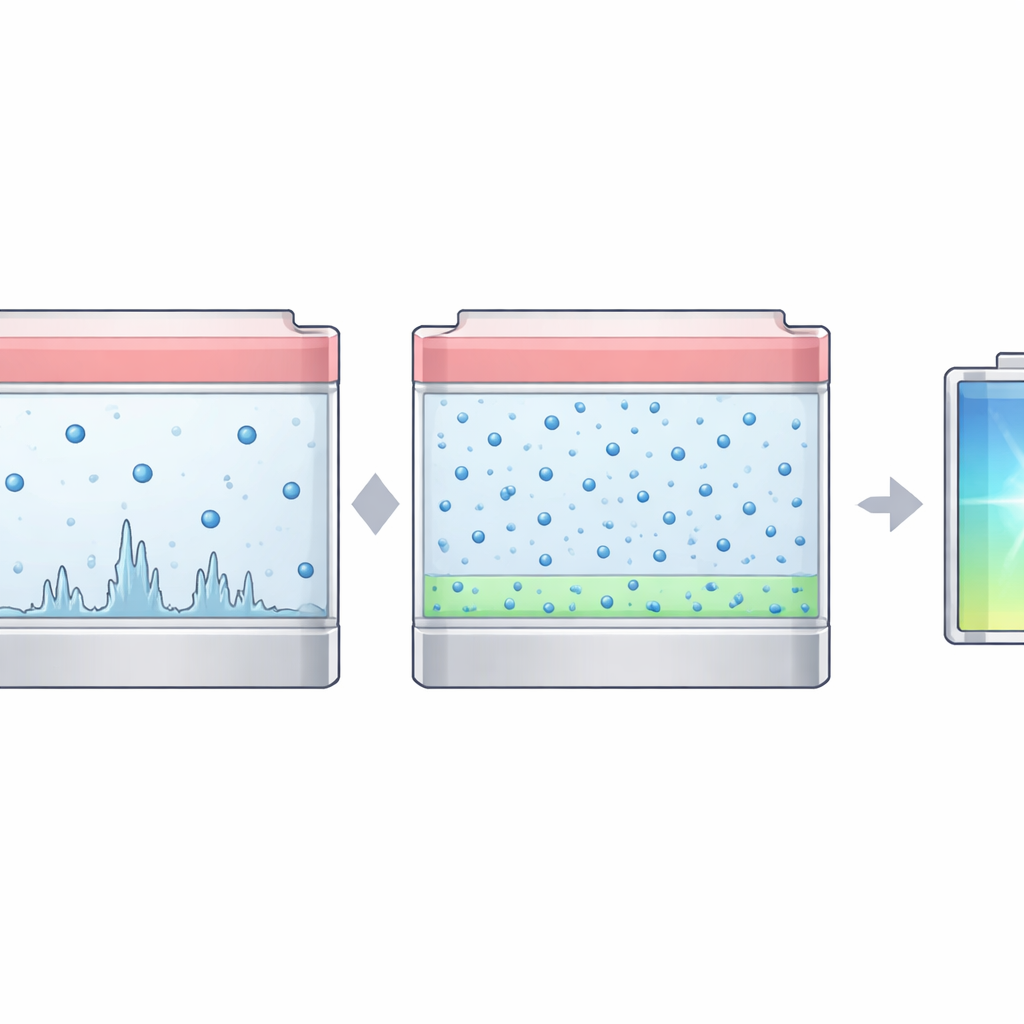
How the smart coating traps salt
The key to this design is the structure of the polymer layer. It is built from two intertwined plastics that naturally form a fine, bicontinuous network of tiny domains. One component is rich in fluorine and gives mechanical strength, while the other is better at soaking in solvent and letting ions move. Computer simulations and lab measurements show that the pores in this network are smaller than the size of the dissolved salt complexes, which physically blocks the salt from escaping into the bulk electrolyte. At the same time, subtle attractions—similar to hydrogen bonds and charge‑dipole interactions—anchor the negative part of the salt to the polymer chains. Together, these effects lock most of the salt near the lithium surface, maintaining a highly concentrated environment without wasting material throughout the cell.
Smoother lithium and faster ion traffic
With this interfacial layer in place, lithium grows in a much more orderly fashion. Electron microscope images reveal that, under demanding conditions, lithium deposits as compact, flat grains rather than as porous, needle‑like structures. Simulations confirm that the coating keeps lithium‑ion levels near the surface high and uniform, which smooths the electric field and discourages dendrites. Measurements of ion transport show that a larger share of the current is carried by lithium ions rather than by slower, heavier partners, and that the energy barrier for ions crossing the surface film is reduced. As a result, test cells with the new design operate with lower voltage loss at high current, meaning they can charge and discharge more quickly with less internal strain. 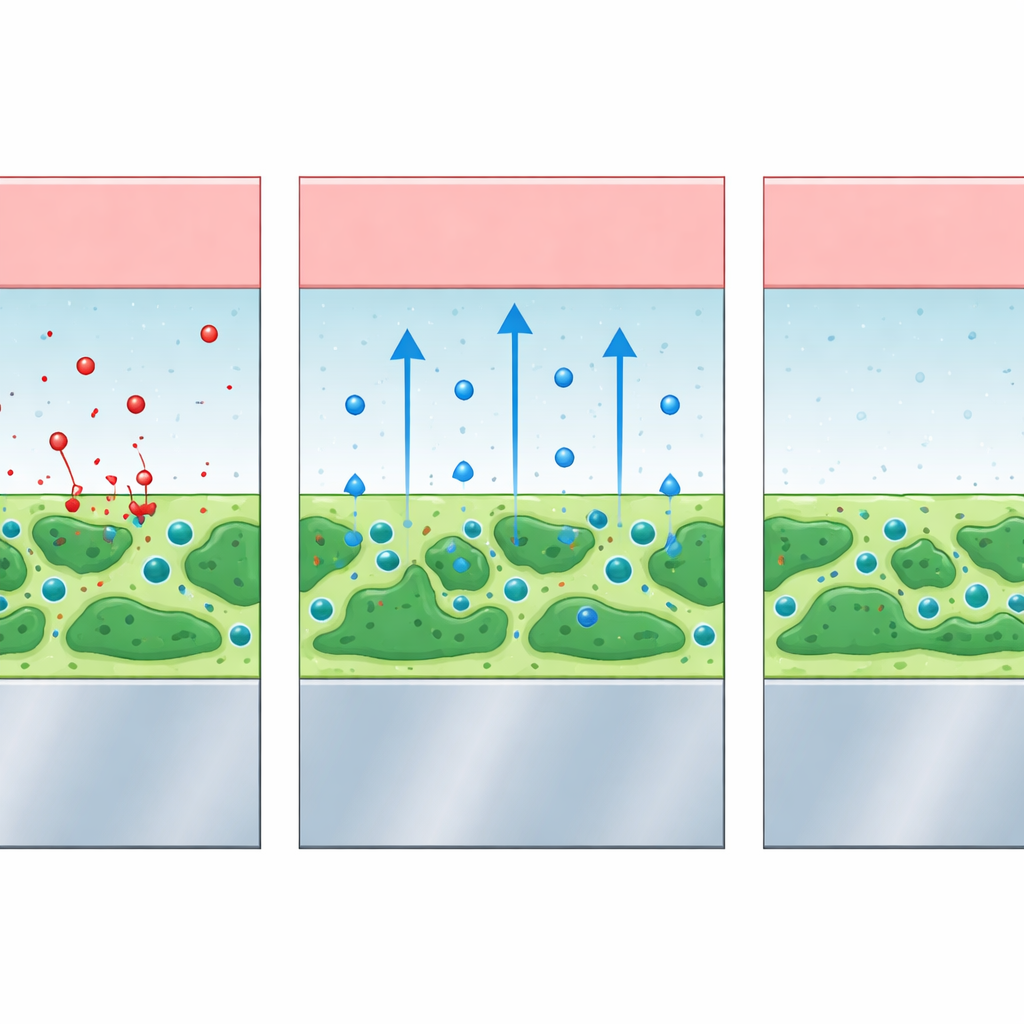
From lab concept to practical cell
To test real‑world relevance, the team built full cells using a high‑capacity nickel‑rich cathode and thin lithium metal, along with limited amounts of electrolyte—conditions close to what industry targets for high‑energy packs. Coin cells using the interfacial layer retained about 80% of their capacity after hundreds of cycles, far outlasting cells based on either standard or fully concentrated electrolytes alone. They then scaled up to a 6.8 amp‑hour pouch cell that reached a specific energy of about 506 watt‑hours per kilogram and still kept over three‑quarters of its capacity after 200 cycles. Because only a small fraction of the electrolyte is highly concentrated, the approach cuts lithium salt usage and its cost by roughly 70% compared with using a concentrated electrolyte everywhere.
What this means for future batteries
This work shows that a carefully engineered coating can give lithium metal batteries the best of both worlds: the stability of a salty electrolyte right where it is needed, and the speed and low cost of a standard liquid elsewhere. By improving how lithium moves and deposits, while also reducing expensive materials, the strategy points toward batteries that are lighter, longer‑lasting, and more affordable. If adopted in commercial designs, such interfacial electrolytes could help unlock practical electric vehicles and grid storage systems with higher energy density and smaller environmental and economic footprints.
Citation: Wu, W., Li, T., Zhao, T. et al. Cost-effective interfacial high-concentration electrolyte for stable lithium metal batteries. Nat Commun 17, 3243 (2026). https://doi.org/10.1038/s41467-025-65697-w
Keywords: lithium metal batteries, electrolyte design, energy storage, battery lifetime, sustainable materials