Our immune system is built to chase away short‑lived threats such as the flu. But many of the world’s deadliest health problems, including HIV, hepatitis, and cancer, are not short skirmishes—they are long wars. This review article explains how a key group of white blood cells, called killer T cells, gradually change when they are forced to fight for months or years on end. Understanding this “tired but still working” state is reshaping treatments such as cancer immunotherapy and may help us design better vaccines and antiviral drugs.
Fast Battles Versus Long Wars
In a typical short infection, naive killer T cells recognize a new germ, receive strong activating signals, and rapidly multiply. Some become frontline fighters that destroy infected cells, while others become long‑lived memory cells that patrol the body and spring into action if the same microbe returns. These memory cells form a flexible army, stationed in blood, lymph nodes, and tissues, that can ramp up energy use and weapon production within hours. This balance between swift attack and lasting memory is what makes vaccines so successful against acute infections.
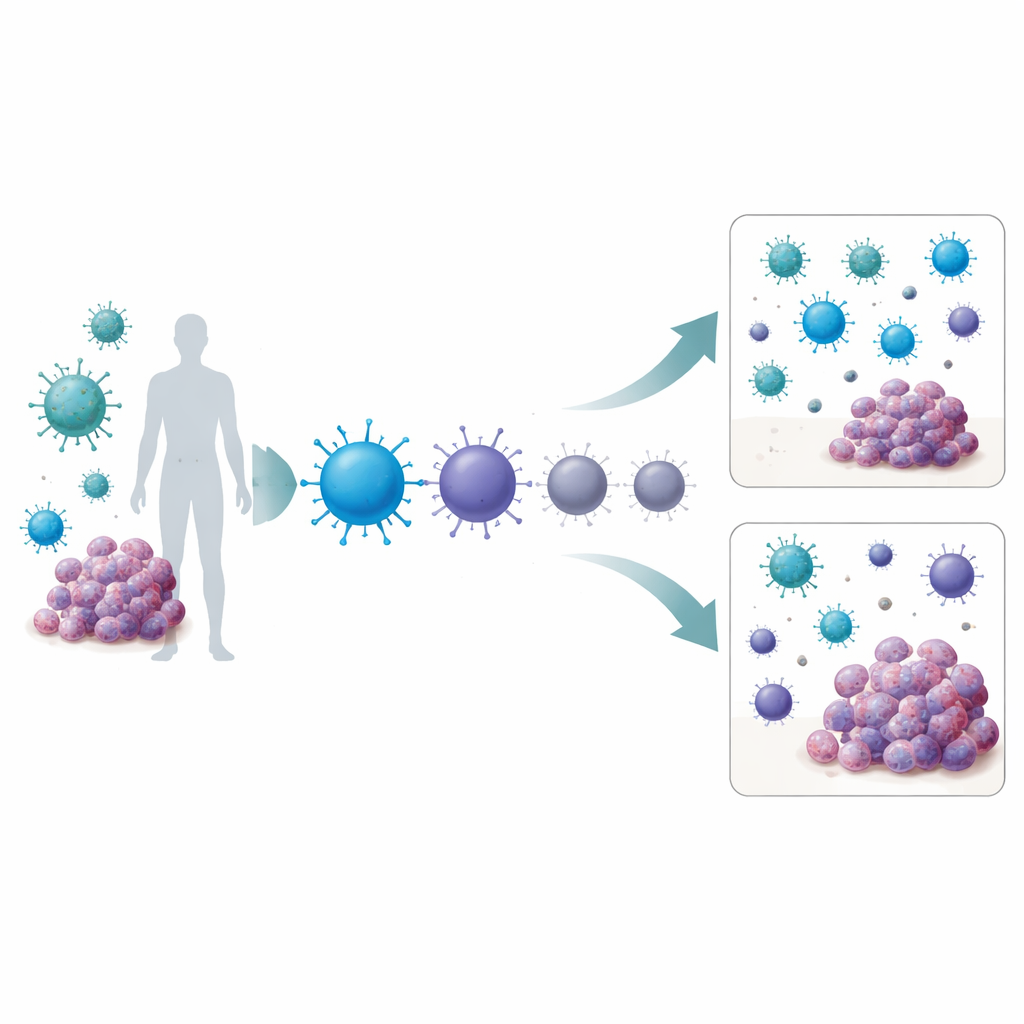
How Constant Threats Rewire Immune Cells Figure 1.
Chronic viral infections and growing tumors present a very different challenge. Here, killer T cells are bombarded by a steady stream of alarm signals and viral or tumor fragments. To avoid burning out the body with endless inflammation, these cells follow an alternate developmental path known as exhaustion. Exhausted T cells lose some of their punch: they divide less, release fewer helpful molecules, and show sluggish killing. They also display many inhibitory switches on their surface and undergo deep changes in how their genes are controlled and how they handle energy. Importantly, this is not simple failure; it is a form of adaptation that still restrains infection or tumor growth, but at a cost to full control.
Layers and Flavors of Tired T Cells
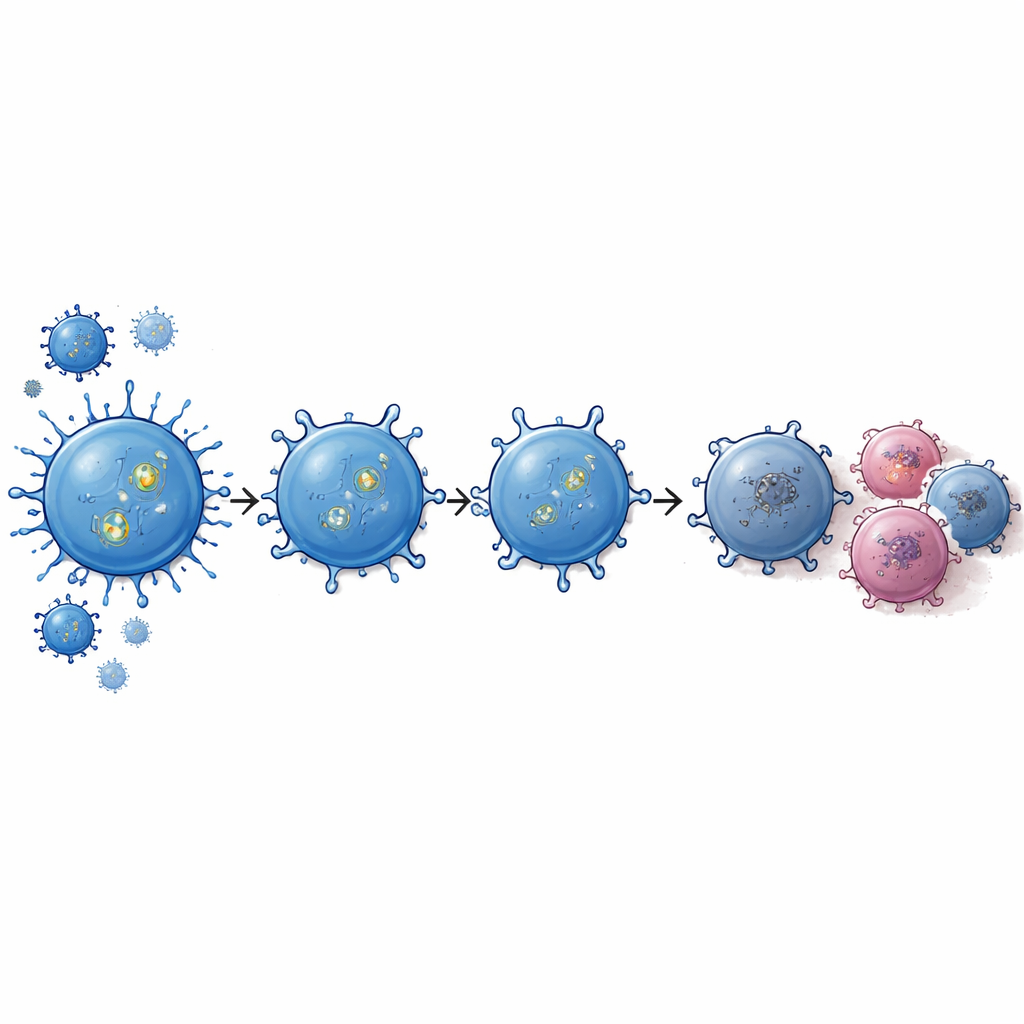
Exhausted T cells are not all the same. The authors describe a hierarchy ranging from early “stem‑like” cells to fully spent cells. Stem‑like exhausted cells live mainly in lymph nodes, retain the ability to self‑renew, and can still respond to therapies by producing more specialized descendants. At the other extreme, terminally exhausted cells settle in infected organs or tumors, carry high levels of inhibitory switches, and are difficult to revive. In between lie effector‑like cells that recover some killing power under certain treatments. This layered structure appears in chronic human infections such as HIV, hepatitis B and C, and in many cancers, although the balance of subsets and the local tissue conditions create disease‑specific twists.
What We Learn from Viruses and Tumors Figure 2.
Long‑lasting viral infections reveal how ongoing exposure to a pathogen sculpts T cell behavior. In HIV, strong and persistent activation drives deep exhaustion, helped along by regulatory cells and calming molecules such as IL‑10. In hepatitis C, some exhausted T cells survive even after curative drugs clear the virus, but they carry an “epigenetic scar” that keeps them from behaving like normal memory cells. Hepatitis B shows an even more complex picture, where some virus‑specific T cells look classically exhausted while others are dampened by the liver’s naturally tolerant environment. In cancers, T cells face not only chronic stimulation but also a harsh neighborhood of low oxygen, scarce nutrients, and suppressive cells. This tumor microenvironment shapes a mix of stem‑like, tissue‑resident, anergic, and bystander T cells that together determine whether tumors are held in check or escape.
Turning Tired Cells into Treatment
These insights have led to breakthrough treatments that deliberately target exhausted T cells. Checkpoint‑blocking antibodies against PD‑1, PD‑L1, and CTLA‑4 lift some of the inhibitory brakes, especially on stem‑like exhausted cells, and have transformed care for several cancers. Yet most patients still do not achieve long‑term benefit, because tumors hide their antigens, alter their surroundings, or rely on additional brakes. The article highlights emerging strategies: combining checkpoint drugs with metabolic rewiring, cytokines such as IL‑2 or IL‑15, therapeutic vaccines, epigenetic drugs, or engineered T cells like CAR‑T and TCR‑T. These approaches aim not only to re‑energize tired T cells but also to steer their development away from harmful exhaustion and toward durable, tumor‑ or virus‑controlling states.
Why This Matters for Future Medicine
The authors conclude that chronic infections and tumors teach us a common lesson: when the immune system is forced into a long war, its cells adapt in ways that both protect and limit us. Exhausted T cells preserve life by preventing runaway damage, but they also leave viruses and cancers with room to persist. The future of immunotherapy lies in reading these cellular “adaptation programs” and learning how to redirect them. By integrating where T cells sit in tissues, how they evolve over time, and which molecular circuits define their fate, clinicians may design treatments that maintain the protective side of exhaustion while safely boosting its ability to clear chronic infections and cancers.
Citation: Luxenburger, H., Thimme, R. & Hofmann, M. T cell adaptation in chronic infections and tumors.
Cell Mol Immunol23, 440–456 (2026). https://doi.org/10.1038/s41423-026-01405-y