Clear Sky Science · en
Lytic IFNγ is stored in cytotoxic granules and coreleased with granzyme B to mediate cytotoxic T lymphocyte killing
How Killer Immune Cells Take Aim
Our immune system relies on specialized “killer” T cells to hunt down virus-infected and cancerous cells. This study uncovers a surprising twist in how these killers work: a well-known immune messenger called interferon gamma (IFNγ) is not only a long-range signal but can also be packed like a weapon inside the same toxic granules that physically punch holes in target cells. Understanding this dual role could help scientists design smarter cancer immunotherapies that are both more precise and more powerful.
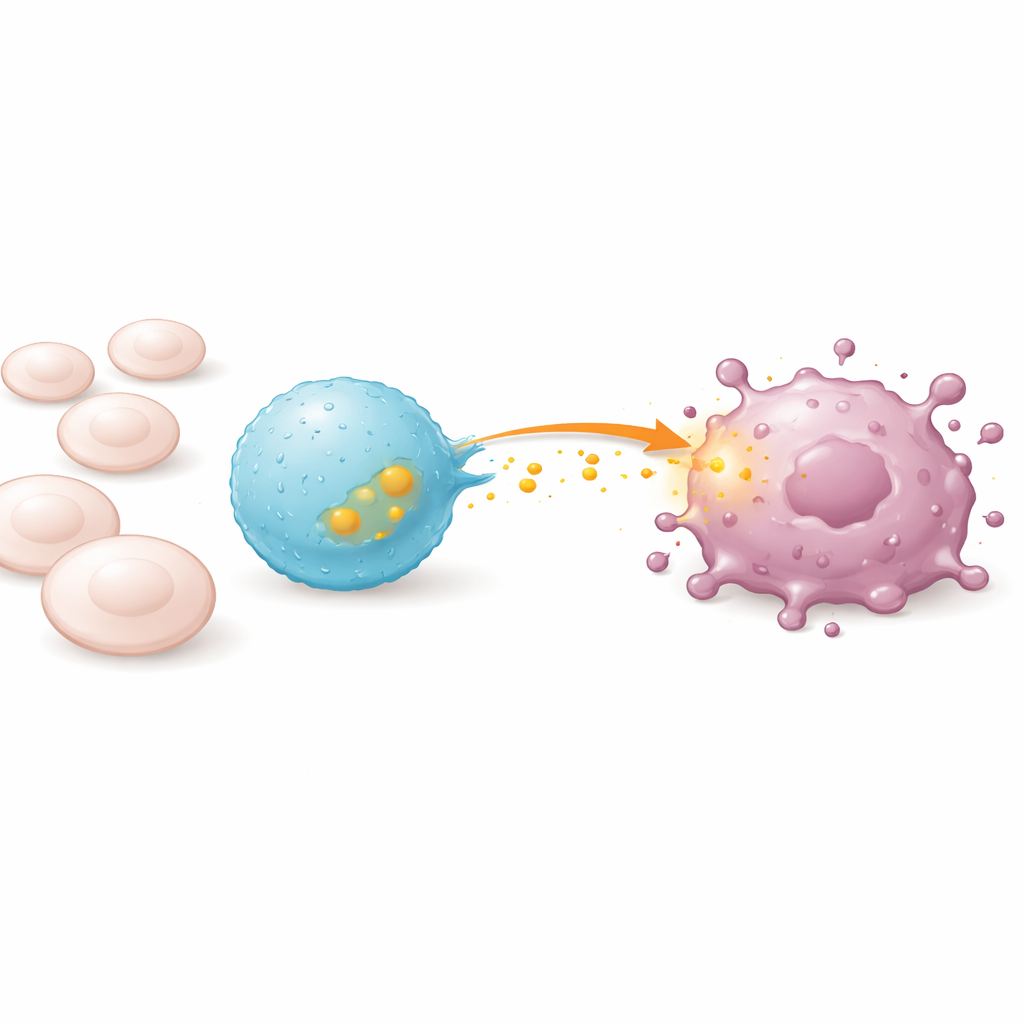
Two Ways an Immune Messenger Acts
IFNγ is usually thought of as a broadcast message. When released, it alerts nearby cells, boosts their defenses, and reshapes the tumor environment to favor immune attack. Traditionally, it has been viewed as a regulator rather than a direct killer. Cytotoxic T lymphocytes (CTLs), on the other hand, use compact granules filled with perforin and enzymes such as granzyme B to punch holes in target cells and trigger their death. The key question the authors address is whether IFNγ only acts from a distance or whether it also participates directly in this close-contact, granule-based killing.
A Hidden Stockpile Inside Killer Granules
Using high-resolution imaging in mouse and human CTLs, the researchers discovered that a substantial portion of IFNγ is physically stored inside the same granules that contain granzyme B. These storage units come in different forms: simple single-core granules and more complex multicore granules that can shed sturdy “attack particles.” The team found that most IFNγ-positive compartments also carried granzyme B, meaning that IFNγ is not scattered randomly inside the cell but is deliberately sorted into the CTL’s main killing machinery. The authors refer to this pool as “lytic IFNγ” to distinguish it from IFNγ that is made and released more diffusely elsewhere in the cell.
Coordinated Release at the Killing Site
When a CTL forms a tight contact, known as an immunological synapse, with a target cell, these granules race toward the interface and fuse with the membrane. Live-cell imaging showed that IFNγ and granzyme B often exit the same granule at the same time, either as a quickly dispersing cloud or as longer-lasting attack particles. In both mice and humans, the majority of IFNγ released during the first minutes of contact was bundled with granzyme B. Disrupting the priming protein Munc13-4, which is essential for granule release, blocked this early burst of lytic IFNγ and sharply reduced the CTLs’ ability to kill target cells, even though the cells still made normal amounts of IFNγ internally.
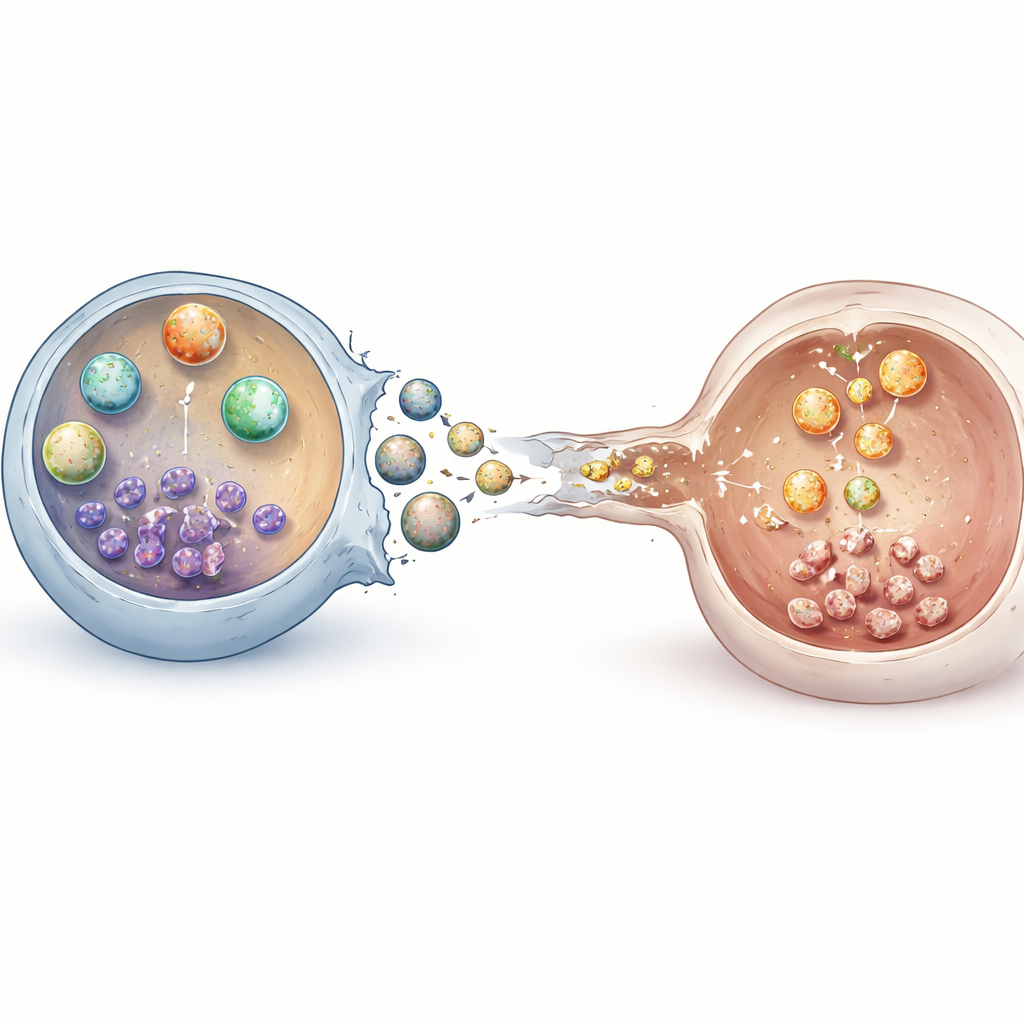
Boosting Death Signals Inside Tumor Cells
Functionally, lytic IFNγ turned out to be more than just a bystander. When the authors neutralized IFNγ in CTL–tumor cell co-cultures, killing dropped; adding extra IFNγ restored and even enhanced the effect, but only when perforin and granzyme B were also present. On its own, IFNγ did not kill tumor cells. Instead, it amplified death pathways once the granule enzymes had breached the cell. The study traced this boost to the IFNγ–STAT1–caspase-3 pathway, a chain of signals inside the target cell that leads to programmed cell death. In mouse tumor models, CTLs infiltrating the tumor carried granules containing both granzyme B and IFNγ, supporting the idea that this mechanism operates in real tumors, not just in culture.
A Second, Slower Signaling Route
The story does not end at the synapse. During prolonged stimulation, CTLs also released IFNγ from regions of the cell membrane away from the contact site. This delayed, less-focused secretion did not depend on Munc13-4 and appeared to arise from multivesicular bodies that can bud off tiny vesicles, similar to exosomes. Imaging and biochemical fractionation showed IFNγ present in these compartments as well. This second pool likely serves as a broader communication channel, bathing the surrounding tissue in IFNγ to adjust the overall immune response, even as the focused lytic pool acts at the point of attack.
Why This Matters for Cancer Therapy
To a layperson, the takeaway is that killer T cells do not rely on a single weapon, but on a coordinated arsenal. IFNγ, once thought to be only a distant messenger, is also preloaded into the CTL’s sharpest tools and discharged directly into tumor cells at the moment of contact, where it cooperates with perforin and granzyme B to drive those cells toward death. At the same time, a slower, more diffuse release of IFNγ shapes the wider tumor environment. This dual system of tightly targeted and more global signaling helps explain how CTLs can be both precise killers and powerful immune regulators, and it offers new levers—such as tuning granule-associated IFNγ—for improving next-generation cancer immunotherapies.
Citation: Li, X., Schirra, C., Wirkner, ML. et al. Lytic IFNγ is stored in cytotoxic granules and coreleased with granzyme B to mediate cytotoxic T lymphocyte killing. Cell Mol Immunol 23, 400–416 (2026). https://doi.org/10.1038/s41423-026-01391-1
Keywords: cytotoxic T cells, interferon gamma, granzyme B, tumor immunity, immune synapse