Clear Sky Science · en
p63 in skin homeostasis and disease: molecular mechanisms and therapeutic potentials
Why This Skin Gene Matters to You
Our skin does far more than cover our bodies: it seals in moisture, keeps out germs, and repairs itself after daily wear and tear. This article explores a master control gene called p63, which acts like a conductor for many of the skin’s most important jobs. When p63 works properly, it helps build and renew healthy skin. When it is missing, mutated, or misregulated, the result can be fragile skin, poor wound healing, early aging traits, or even skin cancer. Understanding how this single gene can influence so many aspects of skin health opens the door to new ways of treating stubborn skin diseases.
The Gene at the Center of Skin Control
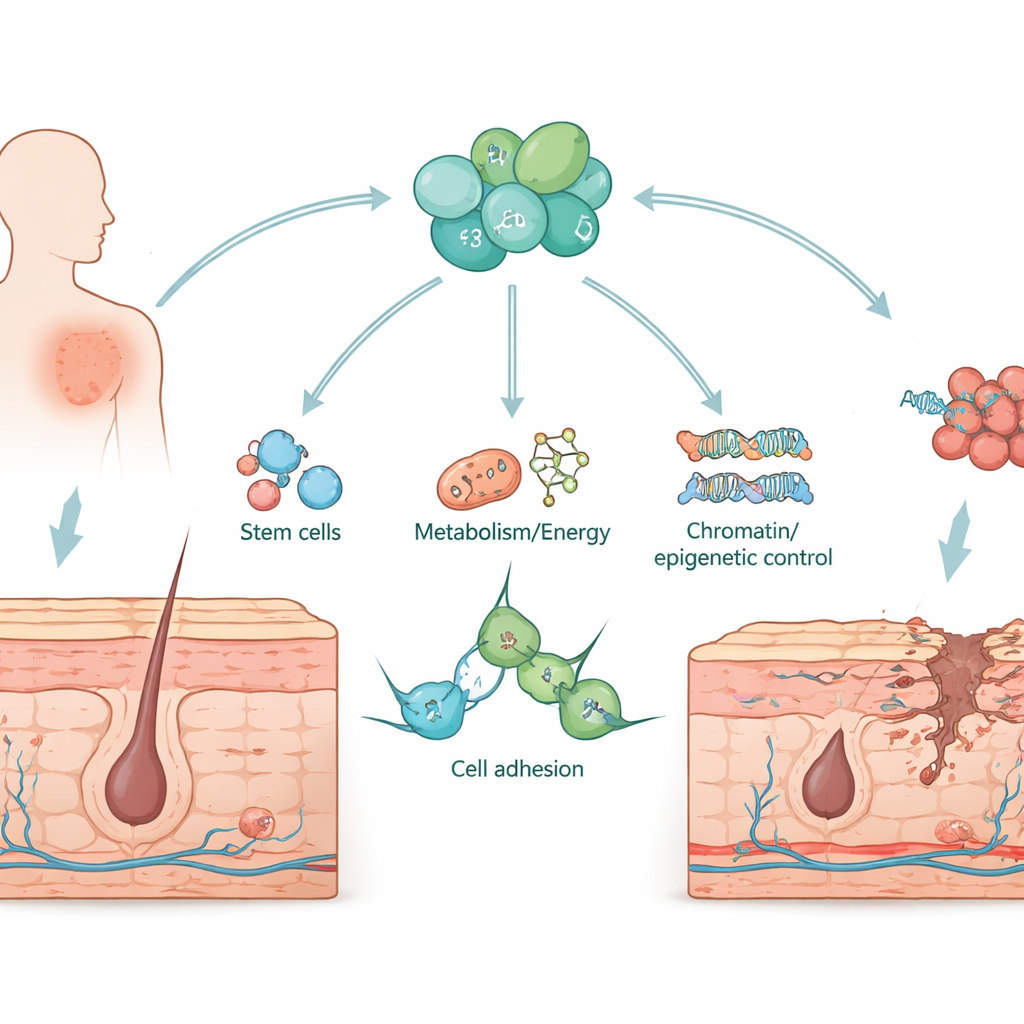
p63 belongs to the same gene family as the famous tumor suppressor p53, but it has carved out its own specialty in skin. The gene can be read in different ways to produce several versions, or isoforms, of the p63 protein. Two major types dominate: TAp63, which is more active under stress, and ΔNp63, which is highly abundant in the skin’s bottom layer. Together they help control whether skin cells keep dividing, start to mature, or shut down in response to damage. ΔNp63 mainly supports growth and renewal, while TAp63 leans toward protecting cells from stress and preventing tumors. This balance allows our skin to stay both resilient and orderly throughout life.
Building Layers, Barriers, and Skin Appendages
From early embryo to adult, p63 helps transform a simple sheet of cells into the layered, specialized tissue we recognize as skin. It guides early cells to choose a skin fate instead of turning into nerve or other tissues. As development proceeds, p63 directs the formation of distinct layers—basal cells that divide, middle cells that mature, and outer cells that form the tough barrier. It also helps assemble hair follicles, sweat glands, and tight junctions that lock neighboring cells together. Much of this control happens through p63’s influence on the packaging of DNA: it can open up or close down regions of the genome so that entire sets of skin genes switch on or off at the right time.
Keeping Skin Renewing and Repairing Itself
Even after development, p63 remains essential for everyday skin renewal and wound repair. In the basal layer, ΔNp63 maintains pools of stem cells by supporting their ability to divide while preventing them from maturing too soon. It does this by dialing down genes that stop the cell cycle, by shaping the activity of major signaling pathways such as Wnt and Notch, and by cooperating with proteins that remodel chromatin. p63 also rewires the cell’s energy use, boosting sugar breakdown and fine-tuning fat production so that rapidly dividing skin cells have enough fuel and protection against oxidative stress. During wound healing, p63 levels and stability increase in stem cells, helping them proliferate and migrate to close the gap and rebuild the barrier.
When p63 Goes Wrong: From Inherited Syndromes to Cancer
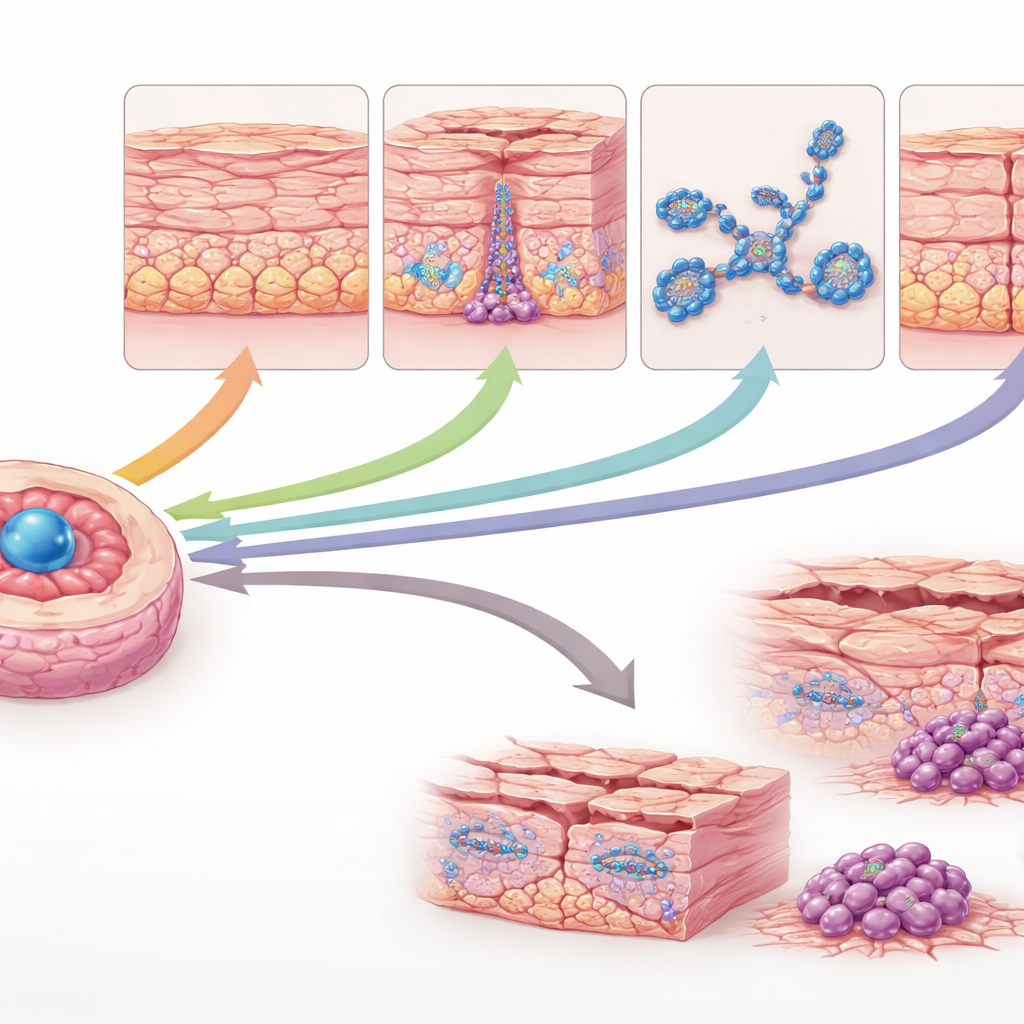
Because p63 sits so high in the control hierarchy, faults in this gene can cause a wide spectrum of skin and ectodermal disorders. Inherited mutations in critical domains of p63 lead to ectodermal dysplasia syndromes, which combine fragile, dry skin with problems in hair, nails, teeth, and limbs, and often cleft lip or palate. Other changes in p63 activity appear in acquired diseases. In atopic dermatitis, altered p63 signaling contributes to a leaky barrier and chronic inflammation. In cutaneous squamous cell carcinoma, the same protein can behave as both oncogene and tumor suppressor depending on disease stage: some forms of ΔNp63 help tumors grow, while TAp63 counters malignant transformation. Imbalanced p63 signaling is also linked to keloids and to premature-aging syndromes that feature scleroderma-like skin.
New Paths Toward Targeted Skin Therapies
The deepening picture of how p63 orchestrates skin biology is already inspiring new treatment ideas. Researchers are testing small molecules that stabilize faulty p63 proteins or restore their normal shape, as well as gene-silencing and gene-editing approaches that selectively correct harmful mutations. Personalized stem cell therapies using corrected patient cells show promise for repairing corneal and skin defects in specific p63 syndromes. Noninvasive methods such as targeted light therapy may boost p63 activity to speed wound healing or strengthen the barrier. Overall, the article concludes that p63 is both a cornerstone of normal skin function and a powerful therapeutic entry point: by understanding and adjusting this single master regulator, clinicians may one day treat a wide range of currently stubborn skin conditions more precisely and effectively.
Citation: Cong, Y., He, Z., Hao, H. et al. p63 in skin homeostasis and disease: molecular mechanisms and therapeutic potentials. Cell Death Discov. 12, 154 (2026). https://doi.org/10.1038/s41420-026-03060-8
Keywords: p63, skin regeneration, ectodermal dysplasia, epidermal stem cells, cutaneous squamous cell carcinoma