Clear Sky Science · en
Exosomal miR-92a-3p promotes pancreatic cancer cells' extravasation by inducing vascular permeability through inhibition of DAB2IP
How tiny packages help cancer spread
Pancreatic cancer is one of the deadliest cancers, largely because it often spreads to distant organs before it is found. This study investigates how microscopic packages released by pancreatic cancer cells can travel through the blood and make blood vessels leaky, creating an easier path for cancer cells to escape the bloodstream and seed new tumors in the lungs and liver.
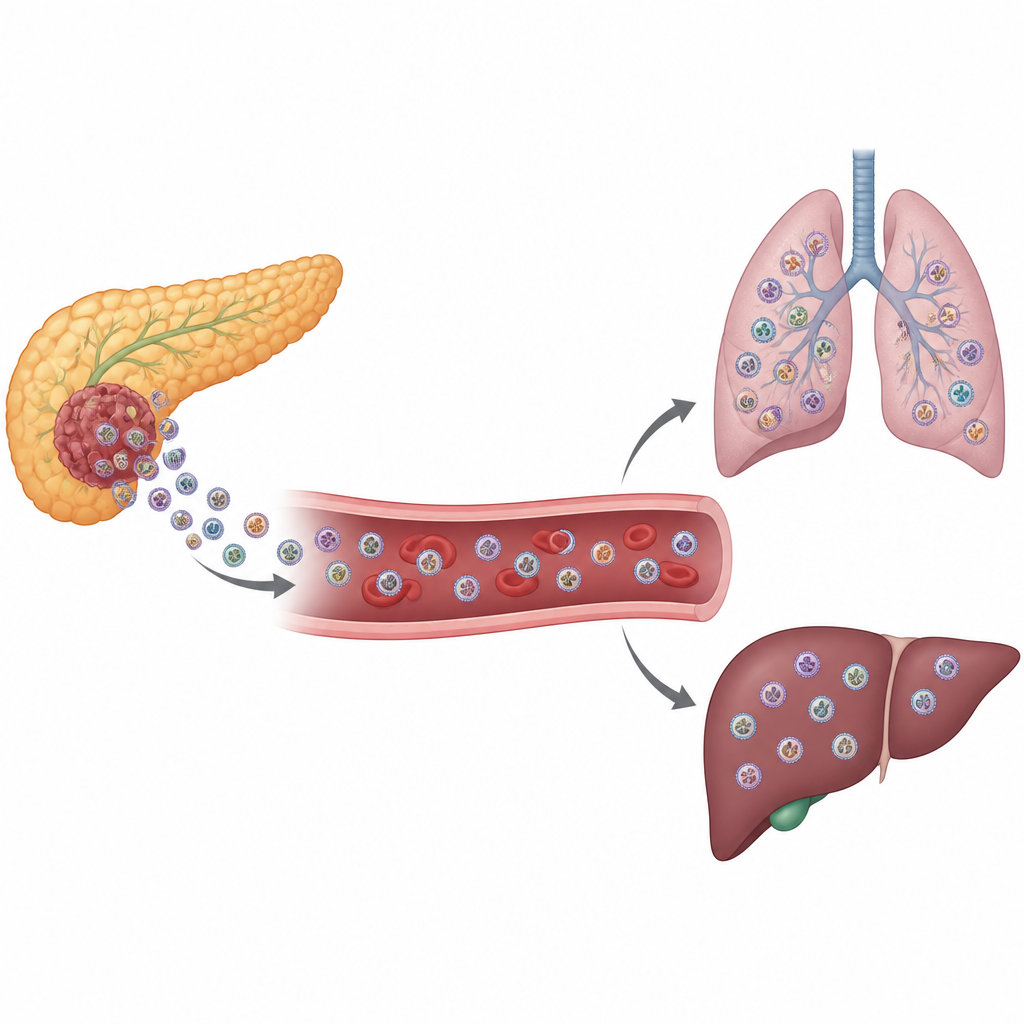
Small messengers on the move
Our cells constantly release nano sized bubbles called exosomes, which carry proteins and genetic material as messages to other cells. The researchers compared exosomes circulating in the blood of patients with metastatic and non metastatic pancreatic cancer, as well as healthy volunteers. Using RNA sequencing, they found that a particular small RNA molecule, called miR-92a-3p, was much more abundant in exosomes from patients whose cancer had already spread. Its levels dropped after surgeons removed the primary tumor, suggesting that the tumor was the main source of this signal.
How exosomes change blood vessel behavior
To see what these exosomes do, the team isolated them from various pancreatic cancer cell lines and exposed human blood vessel cells grown in the lab to exosomes with either high or low levels of miR-92a-3p. When the exosomes were rich in miR-92a-3p, the normally tight layer of vessel cells became more permeable, allowing fluorescent dye and then cancer cells to pass through more easily. Electrical measurements confirmed that the barrier grew weaker. In contrast, exosomes engineered to carry less miR-92a-3p, or taken from cancer cells where this molecule was deleted, strengthened the vessel wall and reduced cancer cell passage.
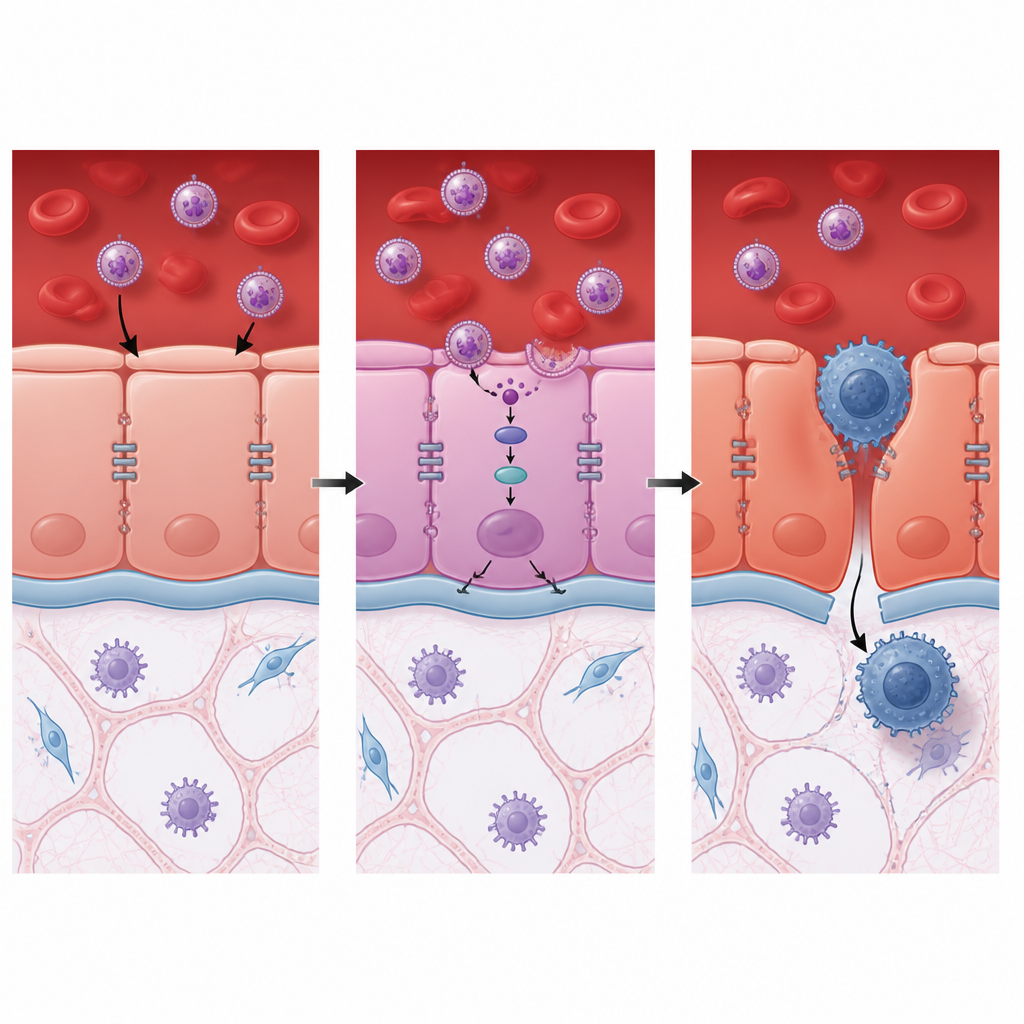
Breaking the seals between cells
The researchers next asked how this small RNA weakens blood vessels. They used computational tools and cell based tests to pinpoint a target protein called DAB2IP, which normally acts as a brake on a growth related signaling route known as the PI3K AKT pathway. Exosomes loaded with miR-92a-3p lowered DAB2IP levels in vessel cells, which in turn switched on PI3K AKT and related signals. This activation reduced key junction proteins that act like molecular rivets between neighboring cells and boosted an enzyme linked to vessel leakiness. When the scientists reintroduced DAB2IP in a form that miR-92a-3p could not block, or used a drug to inhibit PI3K AKT, the vessel barrier recovered and became less permeable.
From lab dish to living lungs
To test these ideas in animals, the team injected labeled pancreatic cancer exosomes into mice. The exosomes accumulated strongly in the lungs and liver, and lung vessel cells took them up. Repeated treatment with miR-92a-3p rich exosomes lowered DAB2IP in lung vessels, heightened PI3K AKT activity, and reduced junction proteins, as seen earlier in cell cultures. Under the electron microscope, lung blood vessels from treated mice showed looser contacts between cells. When cancer cells were later injected into these mice, those pretreated with miR-92a-3p rich exosomes developed many more lung tumors, whereas mice given exosomes carrying a blocking version of miR-92a-3p had far fewer metastatic nodules.
Turning the signal up or down in tumors
The investigators also altered miR-92a-3p directly in pancreatic cancer cells themselves. Boosting its production did not change the size of the original tumors grown in the pancreas of mice, but it did increase the number of lung metastases. Knocking out the gene segments that produce miR-92a-3p had the opposite effect, sharply reducing spread to the lungs. Tumors with high miR-92a-3p showed reduced DAB2IP and weaker cell cell adhesion molecules inside the cancer, consistent with greater mobility and detachment from the primary site. These cancer cells also released exosomes that, once again, made distant lung vessels more leaky.
What this means for future treatment
Overall, the study suggests that a single small RNA, miR-92a-3p, helps pancreatic cancer spread by traveling in exosomes to distant organs, where it weakens blood vessel walls and aids cancer cells in escaping the bloodstream. Because blocking miR-92a-3p in exosomes reduced metastases in mice without shrinking the main tumor, the work points to a potential strategy to slow or limit the spread of pancreatic cancer by targeting this tiny messenger or its signaling route in blood vessel cells.
Citation: Li, L., Cui, Y., Zhang, M. et al. Exosomal miR-92a-3p promotes pancreatic cancer cells' extravasation by inducing vascular permeability through inhibition of DAB2IP. Cell Death Dis 17, 489 (2026). https://doi.org/10.1038/s41419-026-08719-9
Keywords: pancreatic cancer, exosomes, metastasis, vascular permeability, microRNA