Clear Sky Science · en
Topical eye treatment with JGRi1, a protein/protein interaction inhibitor, mitigates retinal degeneration
Protecting the eye’s wiring
Vision loss from diseases like glaucoma often begins silently, as delicate nerve cells at the back of the eye slowly die. This study explores a new kind of eye drop that aims to protect those cells by calming harmful chemical overload, offering a potential future way to slow or prevent certain forms of blindness.
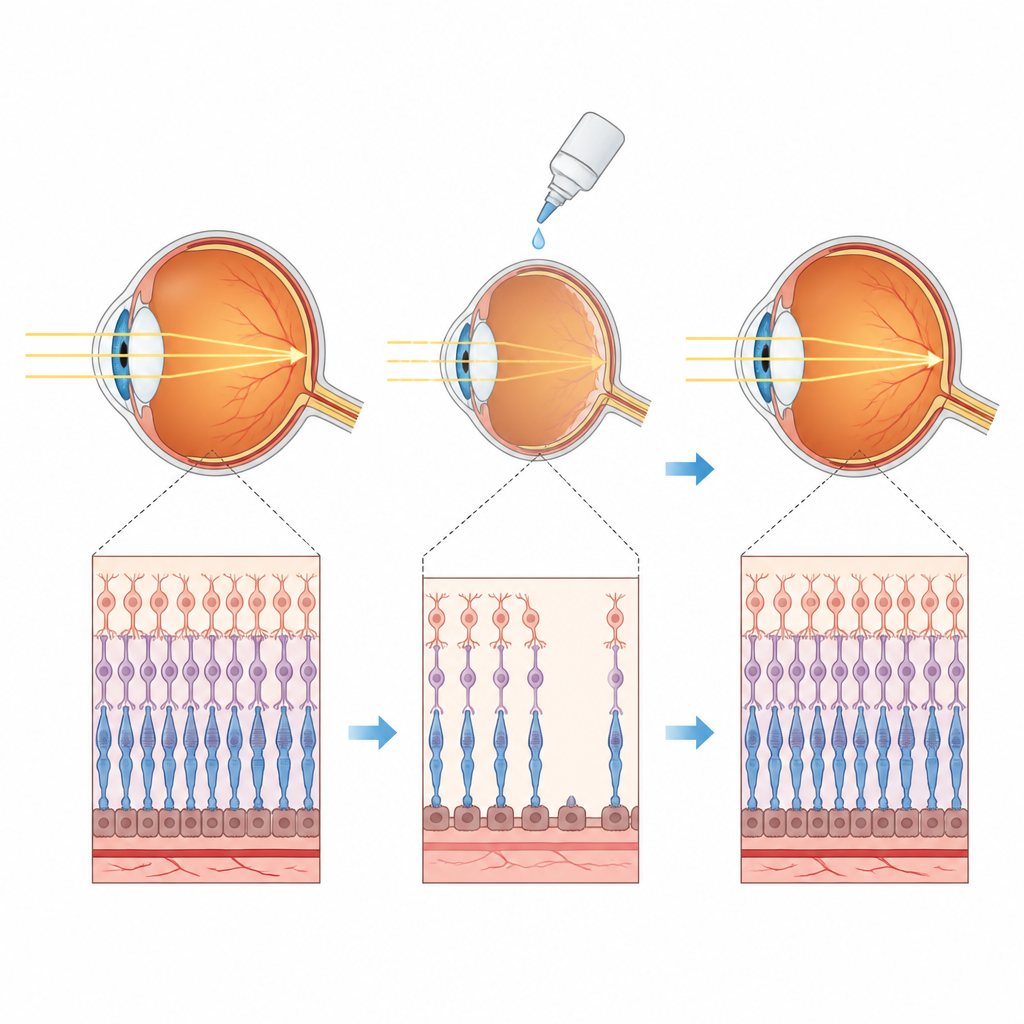
The problem with overloaded signals
At the heart of many brain and eye diseases is a common culprit: too much of the chemical messenger glutamate. In the retina, glutamate normally helps nerve cells pass visual information from the eye to the brain. When its levels become excessive, however, it can overstimulate cells and push them toward death, a process known as excitotoxicity. This is especially dangerous for retinal ganglion cells, the “output wires” that send signals along the optic nerve. Previous drugs tried to protect these cells by blocking glutamate receptors broadly, but that approach interfered with essential normal signaling and caused side effects, contributing to repeated clinical failures.
A new target in the retina’s communication hub
The researchers focused on a more specific weak point in this process, located at the presynaptic side of nerve connections, where glutamate is released. They had previously uncovered a self-amplifying loop they call a non-canonical presynaptic-induced glutamate spillover pathway. In this loop, overstimulation activates a protein called JNK2, which then modifies another protein, Syntaxin-1A. That change makes the release machinery more active, driving even more glutamate into the space between cells and worsening damage. The team reasoned that if they could interrupt the interaction between JNK2 and Syntaxin-1A, they might cool down this runaway cycle without shutting down healthy communication.
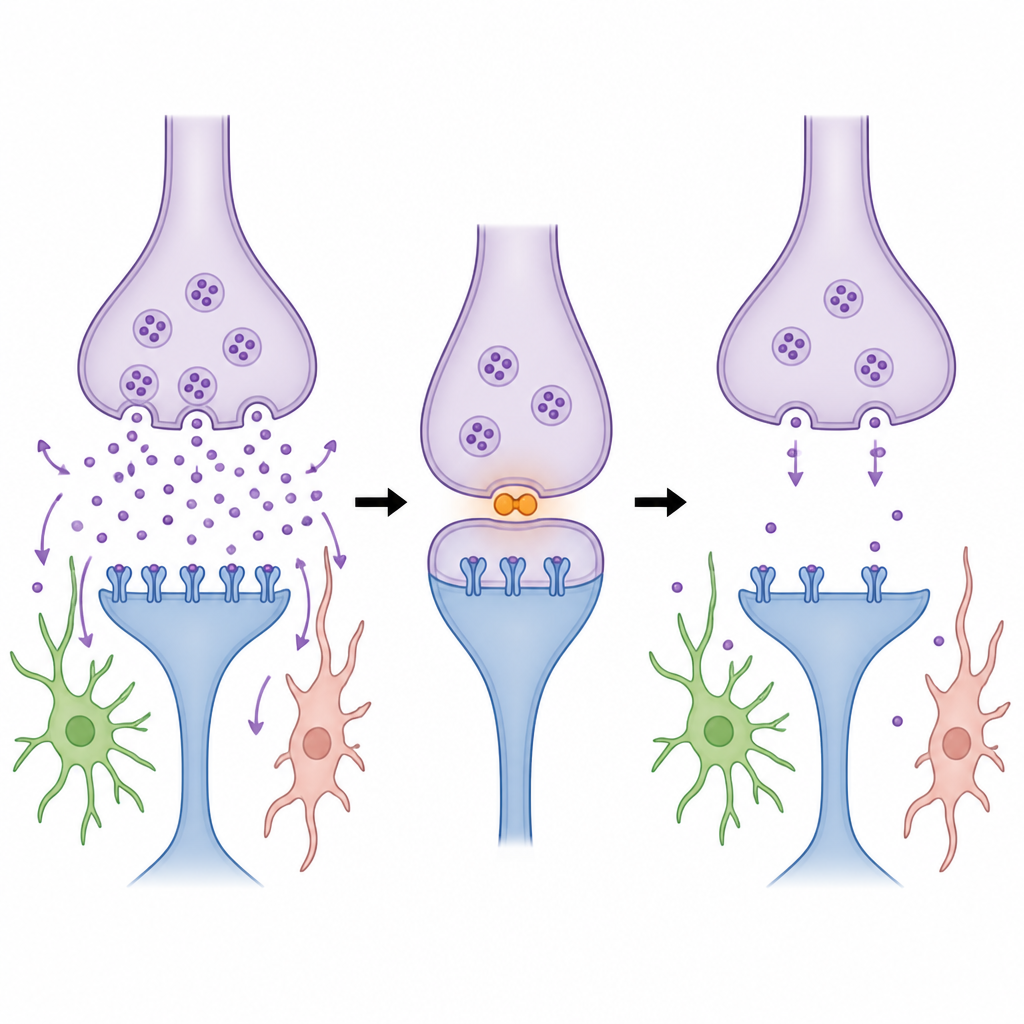
Designing a smart blocking peptide
To break this harmful interaction selectively, the team designed a short, cell-permeable peptide called JGRi1. It is engineered to fit into the contact site where JNK2 and Syntaxin-1A normally bind, acting like a wedge that keeps the two proteins apart. Earlier laboratory studies showed that JGRi1 can reduce glutamate spillover in cultured cells, but it was unknown whether the peptide could reach the retina in living animals or protect nerve cells in realistic disease-like conditions. The researchers also needed a delivery method that would be practical for patients, ideally something as simple as eye drops instead of injections or pills with body-wide effects.
Eye drops that reach the back of the eye
The team first asked whether JGRi1, tagged with a fluorescent marker, could penetrate the eye. In both isolated eyes and living mice, repeated topical administration allowed the peptide to travel from the eye surface to the retina, where it accumulated particularly in the ganglion cell layer and nearby synaptic regions. Importantly, when healthy mice received the active peptide at different doses, the normal patterns of key proteins and glutamate levels in the retina remained unchanged, suggesting that the treatment does not disturb everyday signaling in the absence of injury.
Rescuing damaged retinal cells in disease models
The researchers then tested JGRi1 in two models that mimic retinal degeneration. In an ex vivo optic nerve cut model, which rapidly injures ganglion cells, untreated tissue showed cell loss, structural disruption, increased markers of cell death, and excess glutamate. Pretreating animals with JGRi1 eye drops preserved retinal structure, kept more ganglion cells alive, reduced apoptotic markers, and lowered glutamate and synaptic release-complex formation. In a separate model, mice received an injection of NMDA, a compound that triggers glutamate-related damage. Here too, JGRi1 eye drops protected ganglion cells, preserved axon transport function, reduced glutamate buildup, and weakened the harmful partnership between JNK2 and Syntaxin-1A. The peptide also helped spare certain inner retinal cells important for night vision and reduced the infiltration of reactive microglial cells linked to inflammation.
What this could mean for future therapies
Together, these findings portray JGRi1 as a targeted tool that interrupts a key excitotoxic loop at its source, rather than blocking glutamate signaling everywhere. By reaching the retina through simple eye drops and acting mainly when stress activates the damaging pathway, the peptide offers a conceptual route toward safer neuroprotection. While this work was done in mice and ex vivo tissue, it supports the idea that precisely tuning how nerve cells release glutamate could help slow retinal degeneration and, potentially, other conditions in the nervous system that share similar mechanisms.
Citation: Cimino, M., Serkiz, J., Konstantopoulos, J.K. et al. Topical eye treatment with JGRi1, a protein/protein interaction inhibitor, mitigates retinal degeneration. Cell Death Dis 17, 504 (2026). https://doi.org/10.1038/s41419-026-08717-x
Keywords: retinal degeneration, glutamate excitotoxicity, neuroprotection, eye drops, retinal ganglion cells