Clear Sky Science · en
Therapy-induced senescent cancer cells as bidirectional regulators of antitumor immunity and resistance in the tumor microenvironment
Why some cancer cells stop growing but still matter
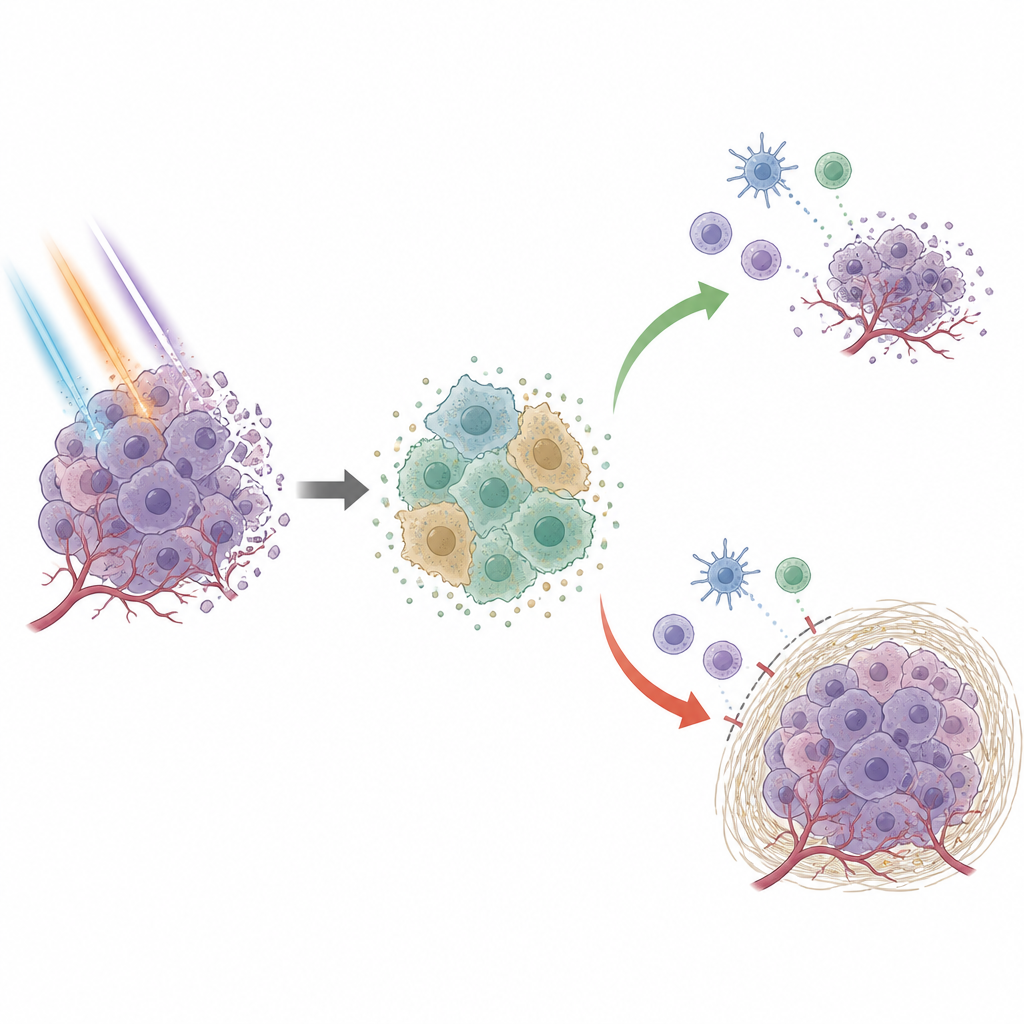
When people receive chemotherapy, radiation, or targeted drugs, we usually think of cancer cells either being killed or surviving. This article explores a third fate: some cancer cells stop dividing yet remain alive and active in the body. These "senescent" cancer cells can act like tiny chemical factories that first help the immune system attack tumors, then later help cancers escape and return. Understanding this double role could reshape how we combine standard cancer treatments with immunotherapy.
Cells that pause instead of die
After harsh cancer treatments, a portion of tumor cells enters a long-lasting growth arrest called senescence. These cells no longer multiply, but they are far from silent. They change their internal machinery, remodel their nuclei and recycling centers, and begin to pour out a mix of proteins, fats, and tiny vesicles into their surroundings. Collectively known as the senescence-associated secretory phenotype, this cocktail can strongly influence nearby immune cells, blood vessels, and other stromal cells in the tumor neighborhood.
How quiet tumor cells can rally immune defenders
In the early period after therapy, senescent cancer cells can be powerful allies for the immune system. They become more visible to immune surveillance by displaying more molecular "flags" on their surface that allow killer T cells and helper T cells to recognize tumor fragments. At the same time, they release signals that attract natural killer cells, macrophages, dendritic cells, and T cells into the tumor and can help open up blood vessels so immune cells can enter more easily. Senescent cells also shed tiny extracellular vesicles that carry immune-stimulating cargo, helping immune cells communicate more efficiently and coordinate an attack on the tumor.
When helpful signals turn into harmful noise
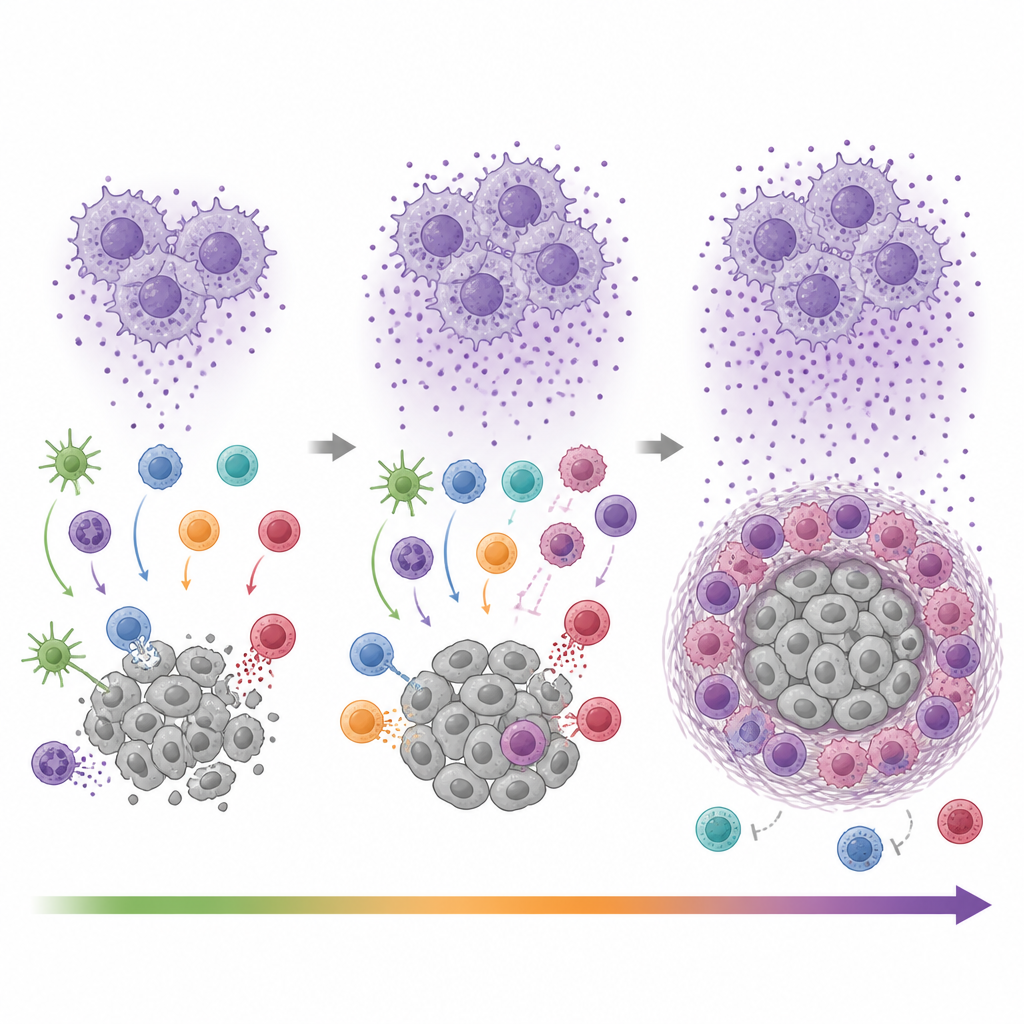
If senescent cancer cells linger, their constant stream of inflammatory signals can flip from helpful to harmful. Over time, the same molecules that once recruited immune fighters begin to attract and nurture suppressive myeloid cells and certain macrophages that dampen immune responses. Chemical "barriers" of chemokines and extracellular traps can physically and functionally keep killer T cells out of the tumor core. Senescent cells also encourage more invasive behavior and stem-like traits in nearby cancer cells, and they work with senescent fibroblasts to loosen the tissue matrix and prepare distant sites that favor invasion and metastasis.
How senescent cancer cells hide from attack
Senescent tumor cells are not passive targets; they actively protect themselves from being cleared. They can display a strong "do not eat me" signal that tells macrophages to ignore them. They also increase several immune checkpoint molecules that switch off T cells, including both surface proteins and soluble factors that circulate more broadly in the body. By boosting enzymes that make adenosine, a molecule that calms T cells, they create a biochemical fog that blunts immune activity. Together, these changes allow senescent cells to survive, shelter nearby dividing tumor cells, and contribute to resistance against checkpoint-blocking drugs.
Timing treatments to turn a double-edged sword
The authors argue that senescent cancer cells act like a time-sensitive dial on antitumor immunity: early on, they can be harnessed to make tumors more visible and responsive to vaccines and checkpoint inhibitors, while later they foster chronic suppression and relapse. They propose a "time-aware" treatment plan that first exploits the brief immune-boosting phase, then tempers harmful secretions, then blocks multiple checkpoints, and finally removes lingering senescent cells with senolytic drugs. By learning when to cooperate with, reshape, or eliminate these paused cells, clinicians may be able to improve the durability of cancer immunotherapy without assuming that all senescent cells are either purely good or purely bad.
Citation: Choi, M., Lee, D., Yang, WH. et al. Therapy-induced senescent cancer cells as bidirectional regulators of antitumor immunity and resistance in the tumor microenvironment. Cell Death Dis 17, 441 (2026). https://doi.org/10.1038/s41419-026-08688-z
Keywords: senescent cancer cells, tumor microenvironment, cancer immunotherapy, immune resistance, senolytic therapy