Clear Sky Science · en
Decoding the CAF–TAM axis: multi-omics dissection and therapeutic targeting of stromal–immune crosstalk in the tumor microenvironment
Why the Neighborhood Around a Tumor Matters
Cancer is more than just a mass of rogue cells. It grows inside a complex neighborhood of support cells, blood vessels, and immune defenders. This review article explores two key non‑cancer cell types that share this neighborhood and often help tumors thrive: cancer‑associated fibroblasts and tumor‑associated macrophages. By decoding how these cells talk to each other and reshape their surroundings, researchers hope to find new ways to make cancers more vulnerable to existing treatments such as chemotherapy and immunotherapy.
Two Cell Types That Quiet the Immune System
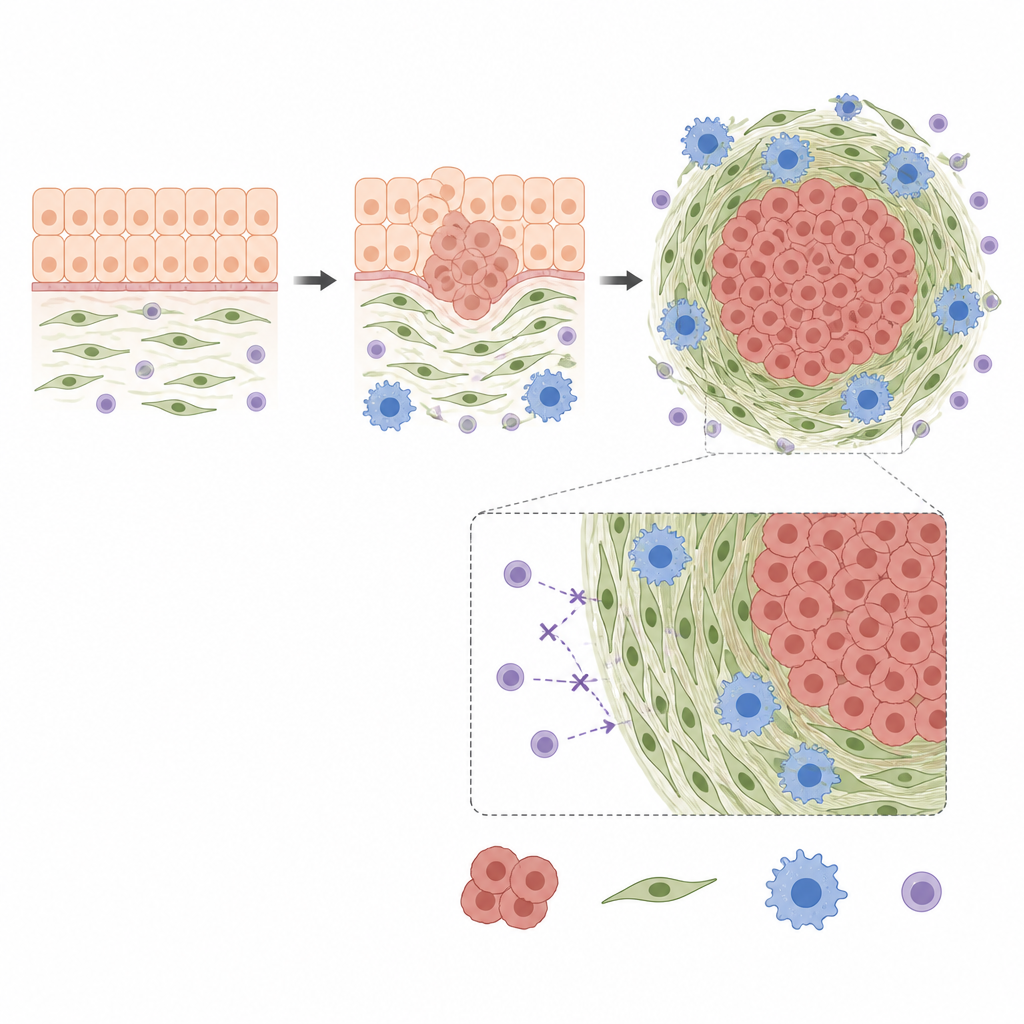
Fibroblasts are connective tissue cells that normally help repair wounds and maintain tissue structure. In tumors, they are rewired into cancer‑associated fibroblasts that lay down thick scaffolds of collagen, stiffen the tissue, and release growth and immune‑dampening signals. Macrophages are immune cells that can either attack threats or help with repair. Inside tumors, many of them shift into tumor‑associated macrophages that soothe inflammation, encourage new blood vessel growth, and blunt the activity of killer T cells. The article explains that areas packed with these fibroblasts are almost always filled with these macrophages as well, hinting at tight cooperation in building an “immune‑cold” tumor.
Hidden Variety and Shape‑Shifting Behavior
Using modern single‑cell and spatial tools, scientists can now examine thousands of individual cells at once, mapping which genes, proteins, and metabolites each one uses and where exactly it sits in the tumor. These studies reveal that fibroblasts and macrophages come in many flavors, not just one or two. Some fibroblast groups focus on making dense matrix, others secrete inflammatory molecules, and a few may even present tumor fragments to T cells. Likewise, macrophage groups can specialize in blood vessel growth, fat handling, or suppression of T cell activity. Importantly, some subtypes appear to restrain tumors under certain conditions, while others clearly help cancers grow and resist treatment.
A Conversation That Builds Barriers
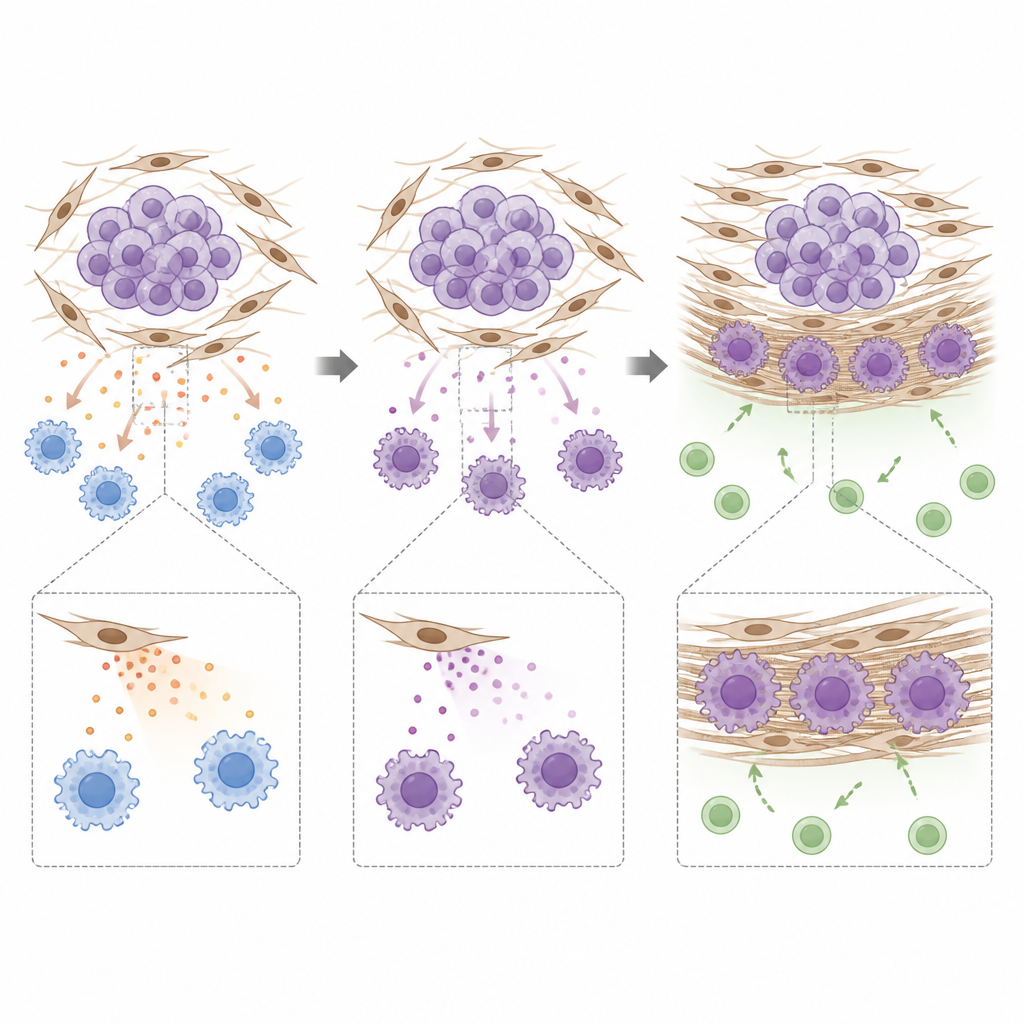
The review highlights a recurring pattern: specific fibroblast and macrophage subtypes gather together at the edges of tumors to form physical and chemical barriers. Fibroblasts pour out collagen and other fibers that create a tight, scar‑like shell. At the same time they release signals that draw in circulating monocytes and nudge them to become macrophages that calm immune responses. These macrophages, in turn, send signals back that further activate fibroblasts or, in some cases, even transform into fibroblast‑like cells themselves. Together, they thicken the surrounding matrix, remodel blood vessels, and create pockets where T cells struggle to enter or stay active. Spatial mapping across multiple cancers shows that such fibroblast–macrophage “micro‑niches” often predict poor patient outcomes and weak responses to immunotherapy.
New Ways to Interfere With the Tumor Support Network
Because this partnership is so central to tumor protection, the article reviews many experimental strategies aimed at breaking or re‑tuning it. Some drugs try to deplete or block the recruitment of macrophages by targeting growth‑factor or chemokine receptors. Others attempt to “re‑educate” them, pushing them back toward an attacking, T cell‑friendly state using antibodies, danger‑sensing receptor agonists, or engineered chimeric antigen receptor macrophages. On the fibroblast side, approaches include drugs that soften the matrix, inhibit key signaling pathways, or convert fibroblasts back toward a more quiet, repair‑like state. A newer direction is to aim directly at the communication lines between fibroblasts and macrophages, such as specific ligand–receptor pairs that drive matrix buildup and immune escape.
Looking Ahead: From Cell Catalogs to Smarter Therapies
The authors conclude that simply listing more fibroblast and macrophage subtypes is not enough. The real goal is to understand which states matter most for tumor growth, where they appear in space and time, and how they respond when treatments are applied. They argue that future work should combine single‑cell and spatial measurements with advanced imaging and artificial intelligence to build “dynamic maps” of the tumor microenvironment. These maps could help doctors choose drug combinations and timing that not only attack cancer cells directly but also dismantle the protective partnership between fibroblasts and macrophages, opening tumors up to the body’s own immune defenses.
Citation: Fu, Y., Li, M., Wu, S. et al. Decoding the CAF–TAM axis: multi-omics dissection and therapeutic targeting of stromal–immune crosstalk in the tumor microenvironment. Cell Death Dis 17, 515 (2026). https://doi.org/10.1038/s41419-026-08685-2
Keywords: tumor microenvironment, cancer-associated fibroblasts, tumor-associated macrophages, immune evasion, single-cell analysis