Clear Sky Science · en
Effect of the cardiac long non-coding RNA Charme depletion on the maturation and paracrine signaling of resident cardiac fibroblasts
Why the Heart’s Support Cells Matter
The heart is more than a pump made of beating muscle. It is a community of different cell types that must talk to each other to keep blood flowing smoothly. This study looks at how a little-known genetic message, called Charme, shapes the behavior of supporting cells in the heart. By examining what happens in mice that lack Charme, the researchers reveal how subtle changes in the heart’s “background” cells can ripple outward to affect tissue structure, blood vessels, and the maturation of heart muscle cells.
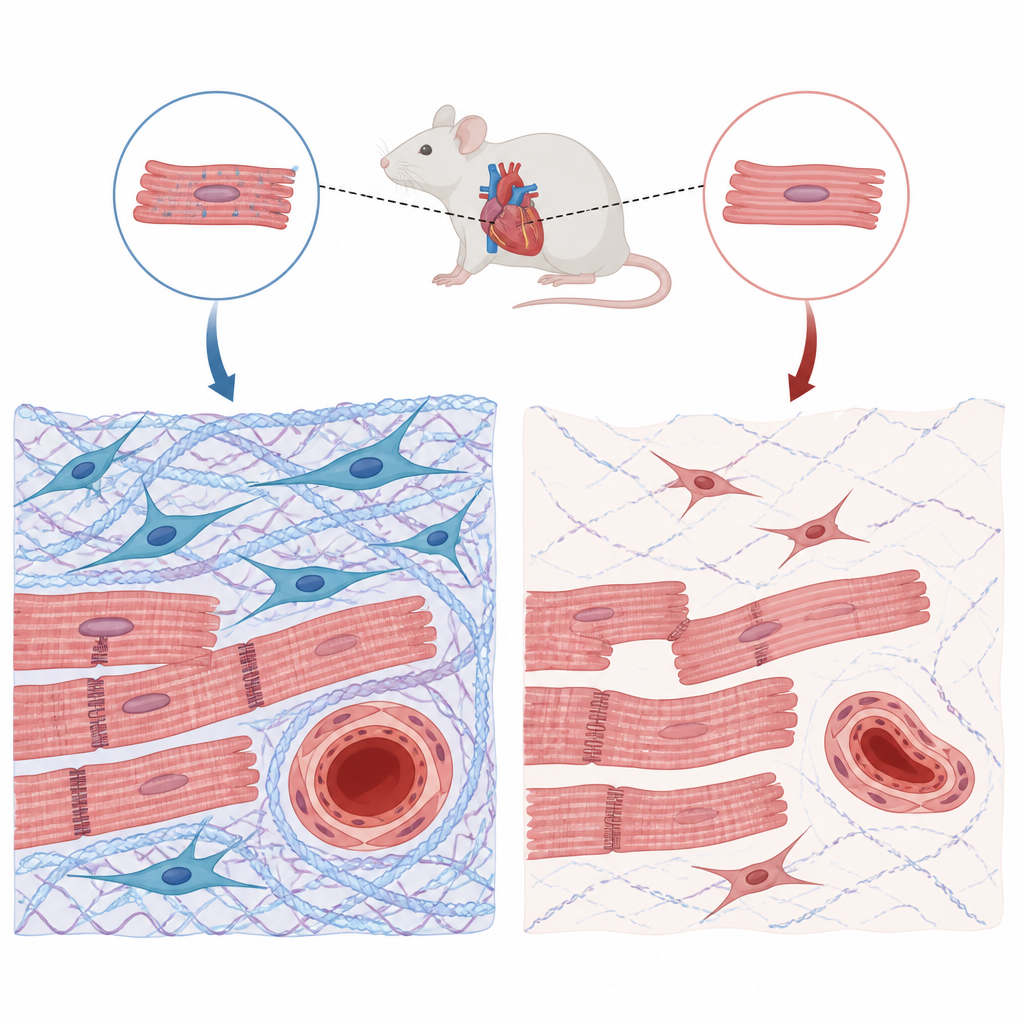
Setting the Stage Inside the Beating Heart
Heart muscle cells do not work alone. They are surrounded by cardiac fibroblasts, a type of support cell that builds and remodels the scaffold between cells, known as the extracellular matrix. This scaffold, rich in proteins like collagen, gives the heart its strength and elasticity and helps guide how heart muscle cells grow and mature. Fibroblasts also release signaling molecules that influence blood vessel growth, stress responses, and how well heart muscle cells survive. Because Charme is known to be important for heart development, the authors asked whether its loss alters not just the muscle cells, but also these resident support cells and the overall heart microenvironment.
Weaker Scaffolding in Charme-Deficient Hearts
By isolating fibroblasts from normal mice and from mice lacking Charme, the team compared which genes were active in these cells and how the heart tissue looked. They found that Charme-deficient hearts contained fewer fibroblasts and significantly less collagen type I, a key structural component, while collagen type III stayed roughly the same. This shifted the balance of collagen types and was confirmed both at the gene level and by protein measurements in heart tissue. Fibroblasts from Charme-deficient hearts showed reduced activity of many genes involved in building and organizing the matrix, and they were less efficient at digesting and remodeling collagen in three-dimensional tests. Together, these changes point to a weaker, less well-tuned supporting scaffold in the heart.
Support Cells Stuck in an Immature State
Healthy fibroblasts can switch into a more active form, called myofibroblasts, when the heart needs repair or reinforcement. In culture, fibroblasts from Charme-deficient hearts were less likely to adopt this mature, activated identity, even when exposed to the powerful trigger molecule TGF-beta. They expressed fewer surface markers of activation, produced less collagen type I in response to stimulation, and showed lower levels of key signaling components in the TGF-beta pathway. At the same time, these cells behaved more like immature mesenchymal cells: they formed more spheroid clusters, generated more colonies from single cells, and migrated faster in scratch-wound tests. These traits suggest that, without Charme during development, fibroblasts remain in an early, less committed state that cannot fully step into their adult repair role.
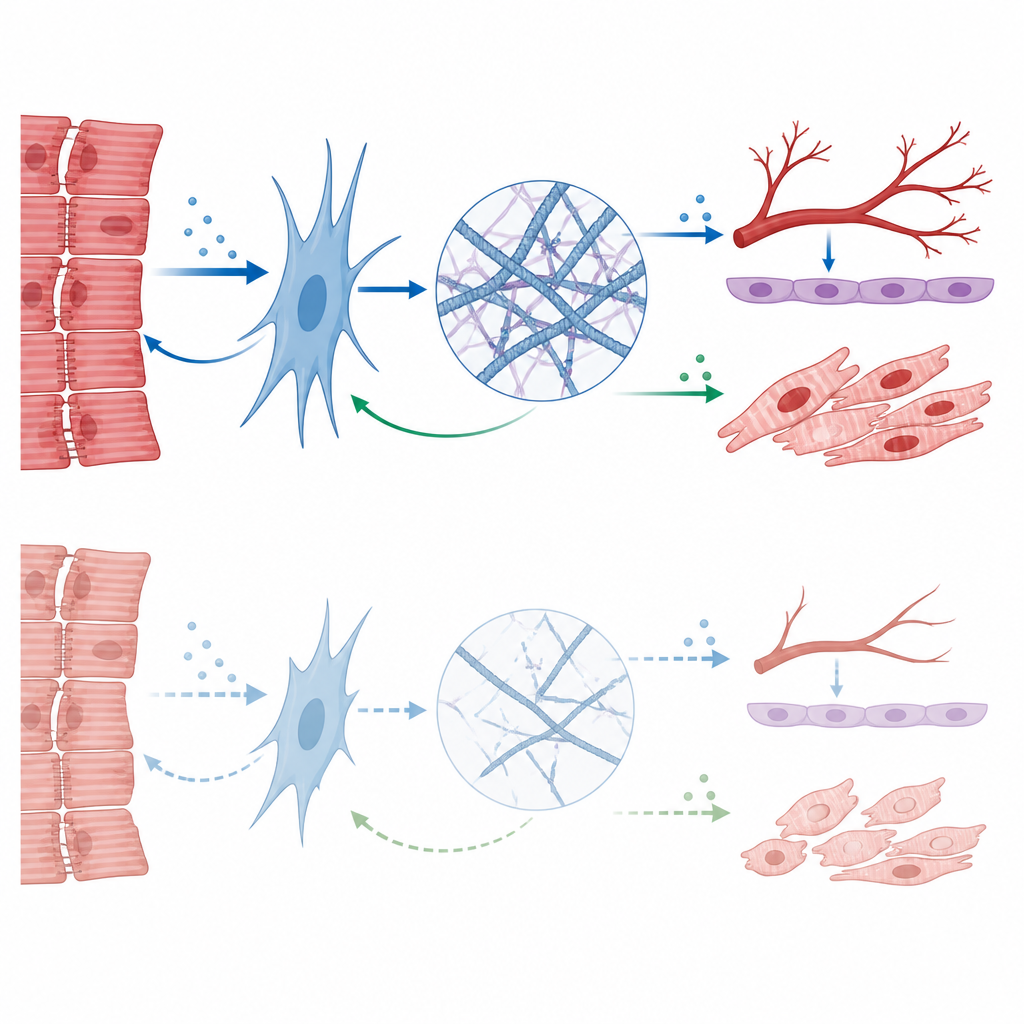
Quieter Chemical Signals and Slower Heart Cell Maturation
The researchers then explored how these altered fibroblasts affect their neighbors. When they analyzed the soup of proteins released by Charme-deficient fibroblasts, they found a broad drop in many secreted factors, including ones linked to heart protection and cell growth. In particular, molecules tied to the PI3K/Akt pathway, which helps heart muscle cells cope with stress, were reduced. When newborn rat heart cells were bathed in this secreted mixture, they showed weaker activation of Akt, hinting at lower protective signaling. Endothelial cells, which form blood vessels, also fared worse: they built fewer capillary-like tubes in a lab assay unless extra VEGF, a pro-angiogenic factor missing from the fibroblast secretions, was added back. Finally, when developing mouse stem-cell-derived heart cells were grown with Charme-deficient fibroblasts, they expressed lower levels of key maturation genes and proteins, and showed a reduced ratio of adult-type myosin, indicating poorer functional maturation.
What This Means for Heart Health
To a non-specialist, the main message is that Charme helps program not only heart muscle cells, but also the support cells that build and tune the heart’s internal environment. In mice that lack Charme, fibroblasts are fewer, less mature, and less capable of producing a strong collagen scaffold or sending out healthy chemical signals. This combination can weaken tissue structure, limit new vessel formation, and slow the transition of heart muscle cells into their fully adult state. Although Charme itself is not active in adult fibroblasts, its absence during development seems to leave a lasting imprint on how these cells behave. Because a similar RNA exists in humans, understanding this communication network between muscle cells and fibroblasts may shed light on how subtle developmental changes contribute to heart disease later in life.
Citation: Floris, E., Cozzolino, C., Buonaiuto, G. et al. Effect of the cardiac long non-coding RNA Charme depletion on the maturation and paracrine signaling of resident cardiac fibroblasts. Cell Death Dis 17, 507 (2026). https://doi.org/10.1038/s41419-026-08636-x
Keywords: cardiac fibroblasts, extracellular matrix, lncRNA Charme, cardiomyocyte maturation, paracrine signaling