Clear Sky Science · en
The endosteal niche regulates breast cancer cell dormancy in bone: identification of new molecular determinants
Why hidden cancer cells in bone matter
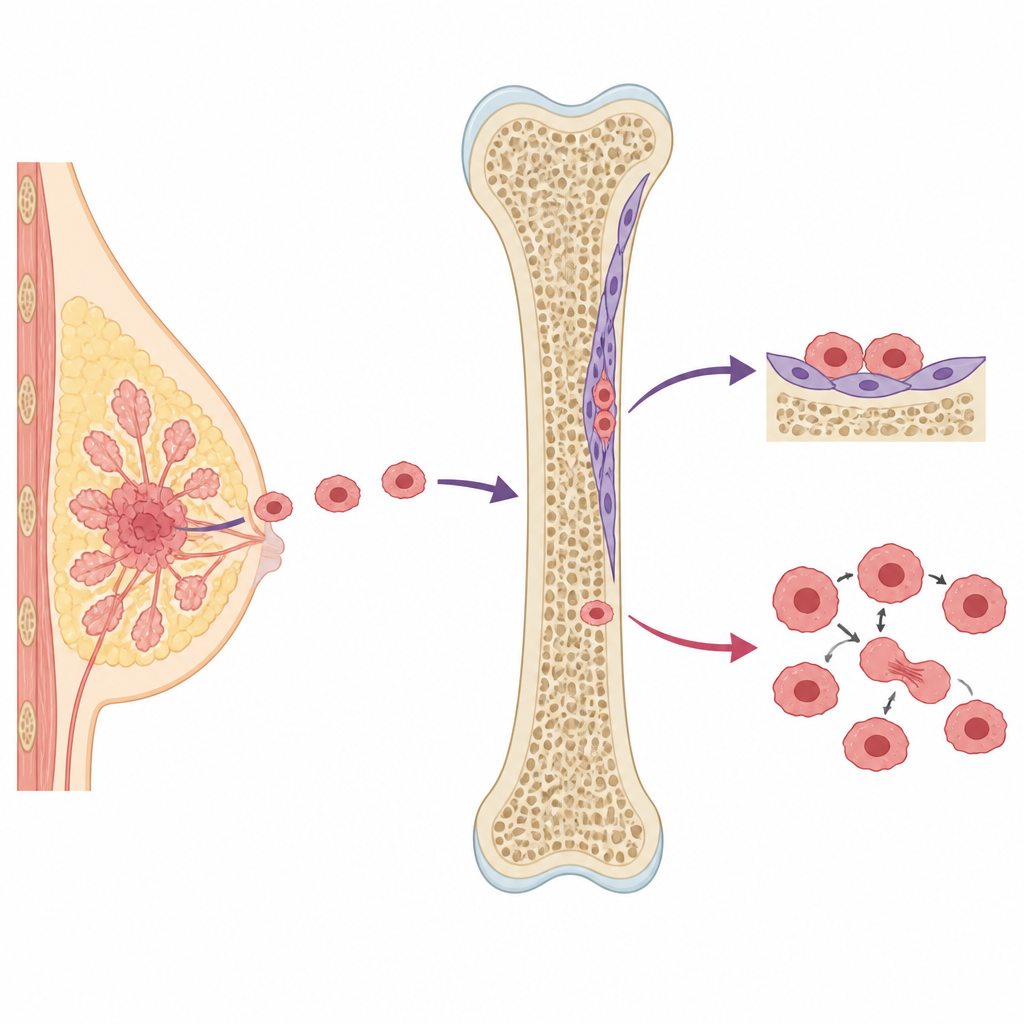
Many women treated for breast cancer remain at risk of the disease returning years or even decades later. One reason is that a small number of cancer cells can slip into a sleep-like state inside the bone, where they quietly survive treatments that kill actively dividing cells. This study explores how the inner surface of bone, known as the endosteal niche, helps keep breast cancer cells dormant and identifies key molecules that seem to control whether these cells sleep or grow.
A quiet corner inside our bones
Bone is not a solid rock but a living tissue with a busy inner cavity filled with bone marrow. Lining the inner surface of the bone are special bone-forming cells, some of which take on a spindle-like shape and support blood-forming stem cells. These cells, called SNOs, provide a protective niche that normally keeps blood stem cells in a resting state until they are needed. Earlier work showed that single breast cancer cells can compete with these stem cells for space in the same niche, settling near the inner bone surface and entering a similar quiet phase instead of forming obvious tumors. This makes them hard to detect and difficult to eliminate.
Sorting cancer cells by their communication switches
The team focused on two closely related molecules on breast cancer cells, Notch1 and Notch2, which act like communication switches receiving signals from neighboring cells. By examining human breast tumors and bone metastases, and by sorting cancer cell lines into groups with high or low levels of each switch, they asked which version was most tied to dormancy. Both Notch1 and Notch2 were present, but cells with high Notch2 were rare and often found near the bone surface. Detailed gene activity profiling revealed that Notch2-high cells, unlike Notch1-high cells, turned down many genes linked to cell division and turned up pathways associated with a resting state, matching the behavior expected for sleeping cancer cells.
Cancer cells that mimic blood stem cells
Strikingly, Notch2-high breast cancer cells also carried genetic signatures similar to blood-forming stem cells. They expressed surface markers such as CXCR4, CD34, TIE2 and CD177, which are normally seen in stem cells that live in bone marrow niches. The researchers isolated cancer cells with high or low levels of these markers and tested how fast they multiplied in dishes and how much bone damage they caused in mice. Cells rich in CXCR4 or TIE2 divided more slowly and produced fewer or smaller bone-eating lesions when placed directly into mouse leg bones, suggesting a less aggressive, more quiescent behavior. Overexpressing Notch2 pushed up CXCR4 levels, hinting that this switch helps steer cells into a stem cell–like, resting state.
Stress responses and a new docking system
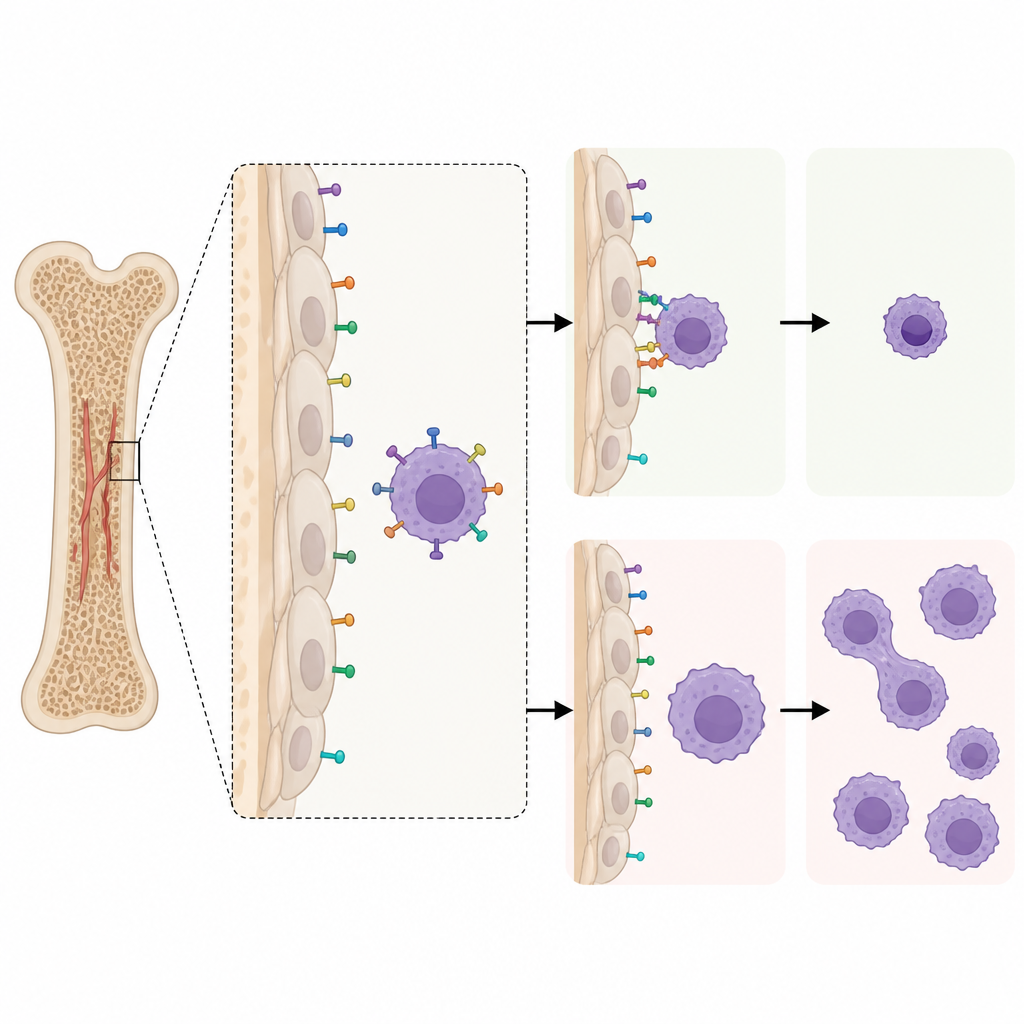
The study also found that Notch2-high cells showed signs of heightened stress within a cellular compartment called the endoplasmic reticulum. Rather than killing the cells, this stress response activated a survival program known as the unfolded protein response, especially through a branch controlled by a sensor called PERK. This pathway is known to support dormant cancer cells that withstand therapy. To understand how sleeping cancer cells cling to the bone niche, the researchers searched for surface molecules that might act as docking hooks. They identified CD177 on cancer cells and its partner molecules PLAUR, ITGAM and CEACAM1 on SNOs. Cancer cells with high CD177 were more often Notch2-high, carried more stem-like markers, and divided less, particularly when grown on SNOs. In patient data, higher levels of CD177, ITGAM and CEACAM1, but not PLAUR, were linked with better overall survival, supporting their possible role in restraining disease.
What this means for future breast cancer care
For a layperson, the take-home message is that some breast cancer cells avoid treatment by hiding in a specialized safe zone inside bone, where local bone-lining cells and specific molecular hooks encourage them to sleep rather than grow. This work shows that Notch2, together with molecules such as CXCR4, TIE2 and CD177 and their partners on bone cells, helps define this quiet state. Understanding these interactions may eventually guide strategies that either flush dormant cells out of their safe niche so they can be targeted, or keep them permanently asleep to prevent late relapse. While more research is needed before this can change clinical care, the study maps out key players in the long-term tug-of-war between breast cancer cells and the bone environment.
Citation: Maurizi, A., Salbini, M., Ciocca, M. et al. The endosteal niche regulates breast cancer cell dormancy in bone: identification of new molecular determinants. Bone Res 14, 51 (2026). https://doi.org/10.1038/s41413-026-00535-3
Keywords: breast cancer dormancy, bone metastasis, Notch2, bone marrow niche, cancer stem-like cells