Clear Sky Science · en
A RANKL+/CXCR4+ B cell population accumulates in bone marrow and causes age-related osteoporosis in mice
Why aging bones weaken
Many people assume that thinning bones are an unavoidable part of getting older, but this study reveals a surprising new player in age-related bone loss: a special group of immune cells in the bone marrow. By tracing how these cells change with age in mice, and how they interact with the bone’s support cells, the researchers uncover a chain of events that helps explain why bones become fragile and suggest new ways osteoporosis might one day be treated.
A new kind of bone-harming immune cell
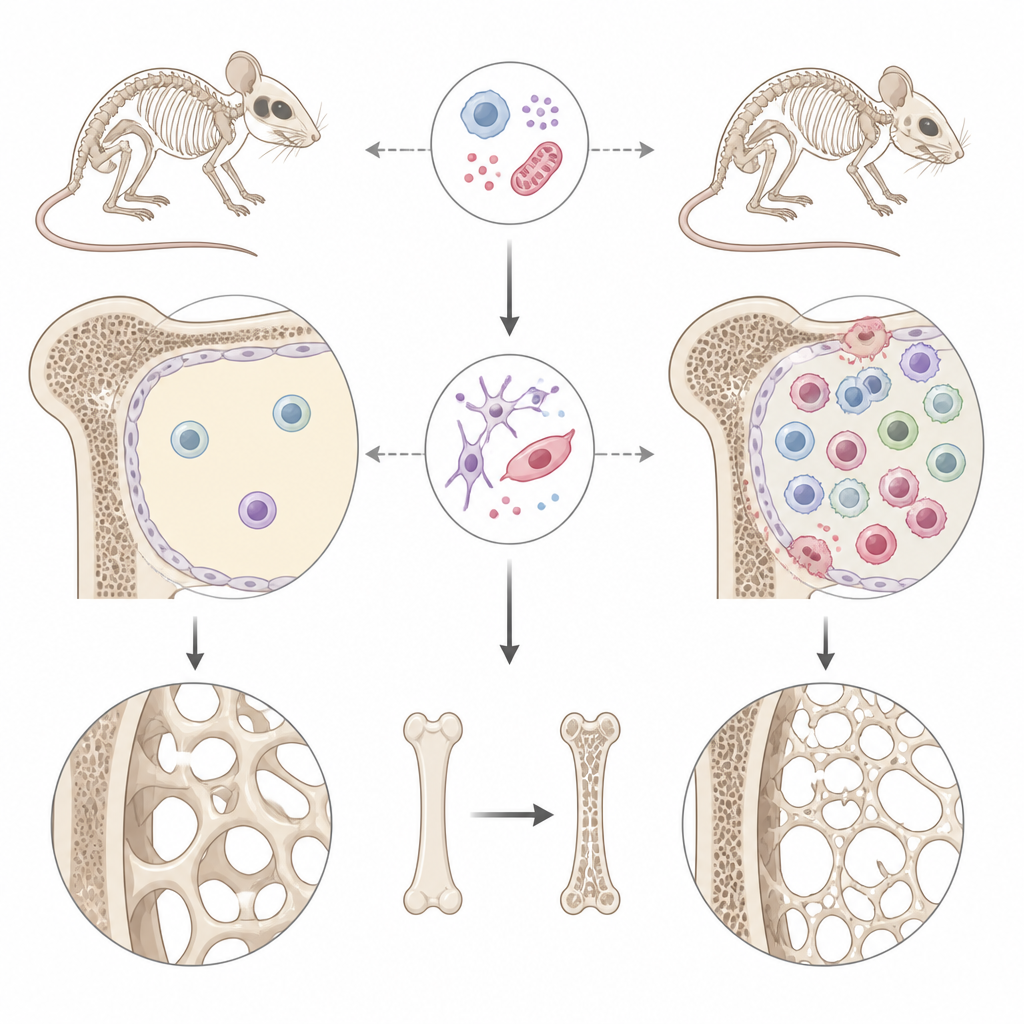
Inside our bones, the marrow is home to stem cells that form blood and immune cells, as well as cells that build and maintain bone. The team focused on a signaling protein called RANKL, long known to trigger the activity of bone-eating cells that hollow out old bone. They discovered that in the marrow of adult mice, most RANKL does not come from bone-lining cells, but from a distinct subset of B cells, a type of immune cell. These B cells carry both RANKL and a surface receptor called CXCR4, and they are found clustered close to bone surfaces. The researchers call them RCBs. Young mice have relatively few RCBs, but as mice age, these cells become far more numerous in the marrow.
How RCBs drive bone loss
To see whether RCBs actually damage bone, the scientists grew them together with immature bone-eating cells from young mice. Even without adding extra RANKL to the dish, RCBs strongly stimulated the formation of mature bone-eating cells, especially when the RCBs came from old mice. When RCBs were injected into young, immune-deficient mice, the recipients rapidly lost bone mass, while the number and function of bone-building cells remained largely unchanged. This showed that RCBs mainly tip the balance by boosting bone breakdown, not by directly shutting down bone formation.
Signals from support cells pull RCBs into place
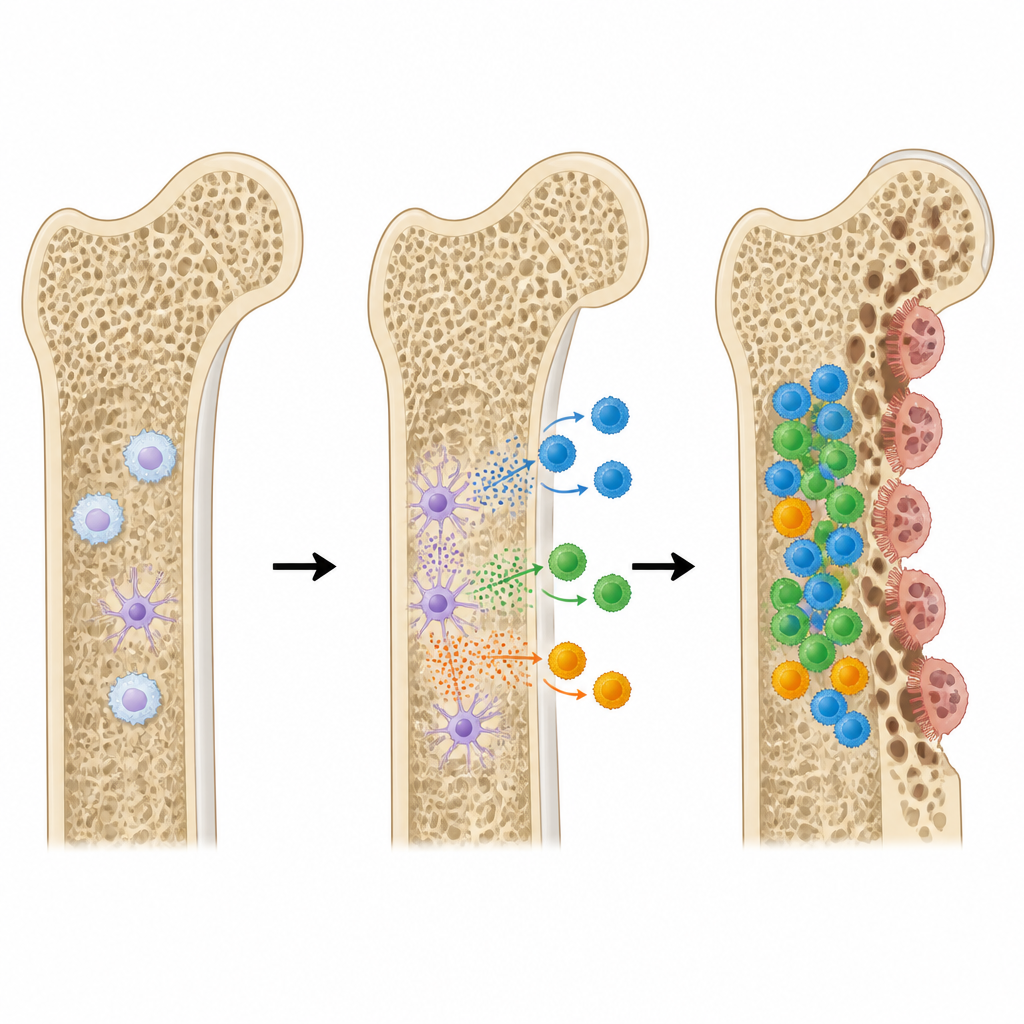
The study then asked why RCBs accumulate in the marrow with age. Attention turned to mesenchymal progenitor cells, a family of support cells that can become bone-forming cells and help organize the marrow environment. In young mice, a regulatory protein called TRAF3 keeps inflammatory signaling in check inside these support cells. With age, TRAF3 levels fall, and a common tissue signal, TGFβ1, helps drive its breakdown. As TRAF3 drops, a signaling switch called NF-κB turns on, leading these support cells to produce more of the chemical attractant CXCL12. Because RCBs carry the CXCR4 receptor that senses CXCL12, they are drawn into the marrow and toward bone surfaces, where they can release RANKL and spur bone erosion.
Blocking the harmful loop in aging and menopause
The researchers tested two drugs that interrupt this harmful loop in mice. One, SM-164, blocks proteins that normally help destroy TRAF3. In aged mice, SM-164 restored TRAF3 in support cells, reduced CXCL12 levels, lowered RCB numbers and increased bone mass by cutting bone breakdown and slightly boosting bone formation. The other drug, plerixafor, already approved to move stem cells into the blood in cancer care, blocks the CXCR4 receptor on RCBs. In naturally aged male mice and in females that had their ovaries removed to mimic menopause, plerixafor reduced RCB accumulation in marrow, lowered bone-eating cell activity and preserved or increased bone mass without directly affecting bone-forming or bone-eating cells in lab dishes.
What this means for fragile bones
Taken together, the findings draw a simple picture: as bones age or lose estrogen, support cells in marrow change their chemical messages, attracting a specialized set of B cells that carry strong bone-resorbing signals. These RCBs then sit near bone surfaces and drive excessive bone removal, contributing to osteoporosis. By either protecting the regulatory protein TRAF3 in support cells or blocking the CXCL12–CXCR4 attraction that pulls RCBs into the marrow, it may be possible to reduce bone loss without directly shutting down bone renewal. While these results are in mice and more work is needed before any new treatment reaches patients, they highlight a promising idea: targeting specific immune cells in the marrow could help keep aging bones stronger for longer.
Citation: Li, J., Fan, J., Yao, Z. et al. A RANKL+/CXCR4+ B cell population accumulates in bone marrow and causes age-related osteoporosis in mice. Bone Res 14, 53 (2026). https://doi.org/10.1038/s41413-026-00525-5
Keywords: osteoporosis, bone marrow, B cells, RANKL, CXCR4