Clear Sky Science · en
Safety and efficacy of ciltacabtagene autoleucel for relapsed/refractory multiple myeloma: a CIBMTR study
Why this matters for people living with cancer
For people with multiple myeloma whose cancer has come back many times, options can run out. This study looks at how well a new type of personalized cell therapy, already approved and used in regular clinics across the United States, is working and how safe it is for everyday patients, not just those healthy enough to join clinical trials.
A new way to train the immune system
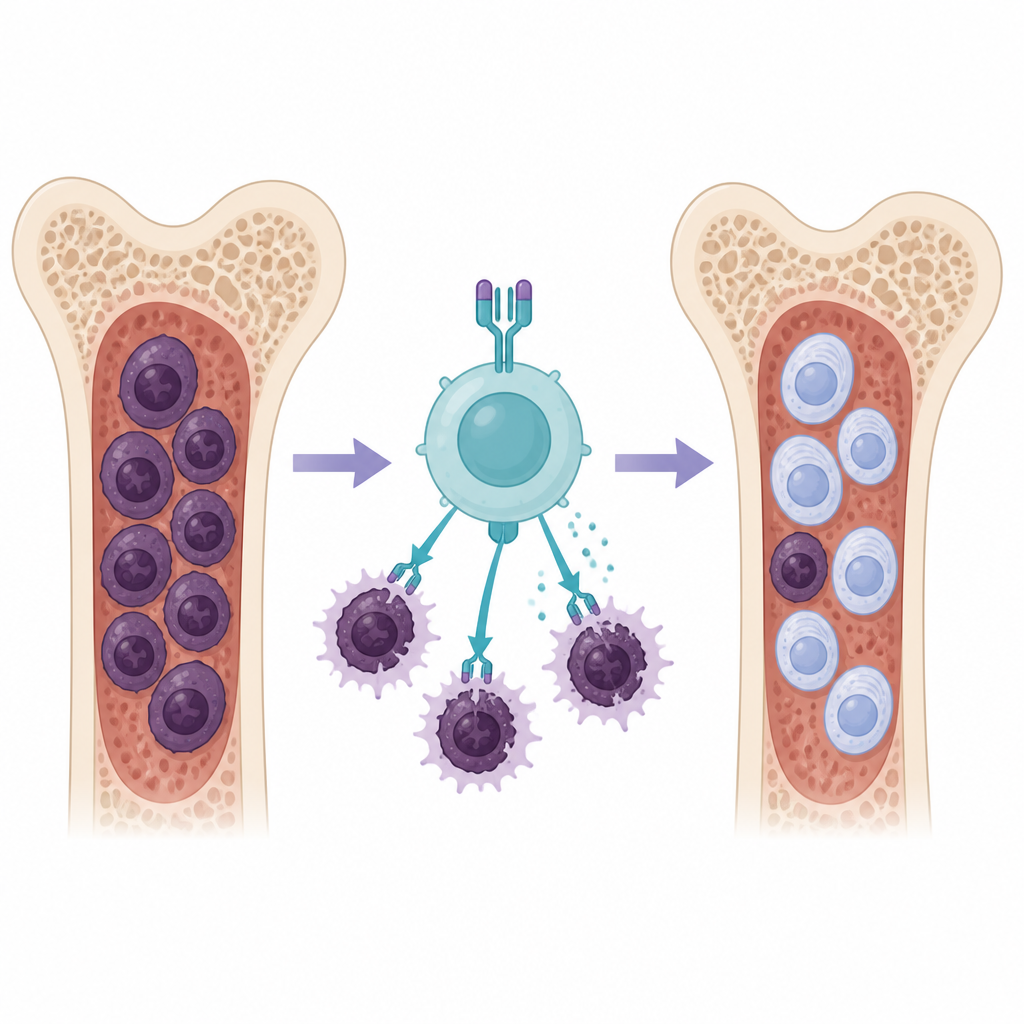
Ciltacabtagene autoleucel, often shortened to cilta-cel, is a treatment that reprograms a patient’s own immune cells so they can better recognize and attack myeloma cells. Earlier clinical trials showed very high response rates, but those trials enrolled carefully selected patients with fewer other health problems. The key question for doctors and patients has been whether similar benefits and acceptable risks would hold up when the treatment is used broadly in routine care, including in older people and those with serious medical conditions.

Who received this treatment in everyday practice
The researchers used a large international registry that tracks people receiving blood and cell therapies. They studied 595 adults with multiple myeloma whose disease had come back or stopped responding after a median of seven prior treatment courses. Most had already been exposed to many standard drugs, and seven in ten had at least one significant health problem such as heart or lung disease. Some had especially hard-to-treat disease features, including cancer outside the bone marrow, very high numbers of myeloma cells in the marrow, or high-risk genetic changes in their cancer cells.
How well patients responded
The results were encouraging, particularly given how advanced the cancers were. Overall, 87 percent of patients saw their myeloma shrink, and three quarters had a very large reduction in disease. About one in three reached what doctors call a complete response, where no myeloma is detected using standard tests. A year after receiving cilta-cel, about 73 percent of patients were alive without their disease having grown, and 85 percent were alive overall. Responses were somewhat weaker in people whose myeloma had already been treated with other drugs targeting the same protein, and in those with more aggressive disease features, but many in these harder-to-treat groups still benefited.
Side effects and who is most at risk
Like other powerful immune therapies, cilta-cel can cause serious side effects. About 80 percent of patients developed cytokine release syndrome, a whole-body inflammatory reaction, but only 4 percent had the most severe forms. Brain and nerve-related problems occurred in roughly one in five patients, with severe cases again around 4 percent. A smaller group, about 5 percent, developed delayed movement or nerve problems such as Parkinsonism or facial nerve weakness. Nearly half of patients had significant infections, and 5 percent died from treatment-related causes, most often due to infections or organ failure. People with a very high number of myeloma cells in their marrow, older age, anemia, or a high burden of other illnesses were more likely to have serious immune-related side effects and to have their cancer return earlier.
What this means for patients and doctors
This large real-world study shows that cilta-cel can provide deep and often long-lasting control of multiple myeloma even in patients who are older, heavily pretreated, or living with other medical problems. While the risks are real and include serious infections and nerve problems, they were generally similar to or slightly higher than those seen in earlier trials and were considered acceptable in light of the benefits. The findings support using cilta-cel as a major treatment option for people with multiple myeloma whose disease has returned after many prior therapies, while underscoring the need for close monitoring, strong infection prevention, and ongoing research to better protect those at highest risk of side effects.
Citation: Hansen, D.K., Dima, D., Mian, H. et al. Safety and efficacy of ciltacabtagene autoleucel for relapsed/refractory multiple myeloma: a CIBMTR study. Blood Cancer J. 16, 80 (2026). https://doi.org/10.1038/s41408-026-01496-w
Keywords: multiple myeloma, CAR T-cell therapy, ciltacabtagene autoleucel, real-world outcomes, cancer immunotherapy