Clear Sky Science · en
CPX-351 (Liposomal Cytarabine and Daunorubicin) versus venetoclax plus hypomethylating agent therapy in newly diagnosed acute myeloid leukemia: a retrospective comparison involving 600 Mayo Clinic patients
Two Treatment Paths for a Serious Blood Cancer
For older adults diagnosed with acute myeloid leukemia, a fast-growing cancer of the blood and bone marrow, choosing a first treatment is a high-stakes decision. Doctors now have more than one standard option, but it has been unclear which path offers better chances of benefit and safer side effects in everyday practice. This study looks back at real patients treated at Mayo Clinic to compare two widely used approaches and to see whether certain patient or disease features tilt the balance toward one or the other.

Who Was Studied and What Was Compared
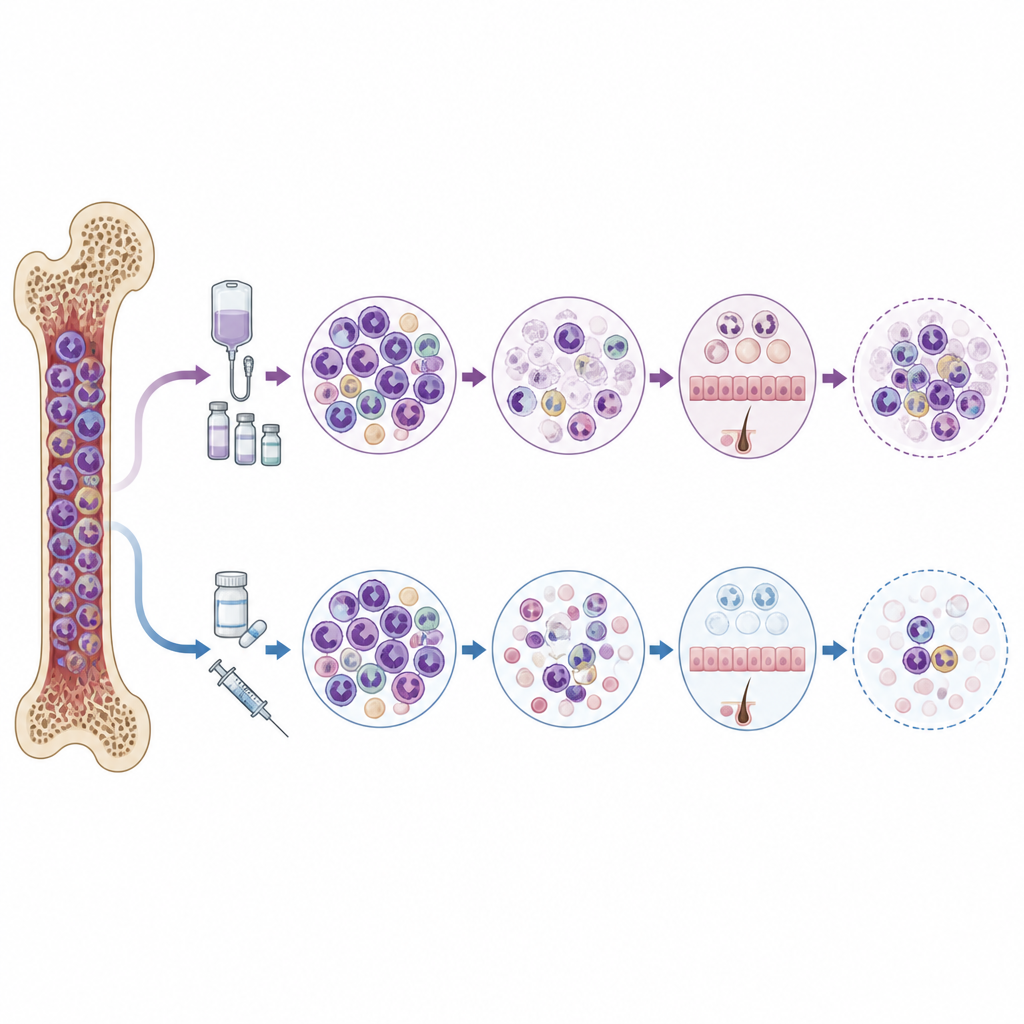
The researchers reviewed records from 600 adults newly diagnosed with acute myeloid leukemia who were treated outside of clinical trials between 2017 and 2024 at three Mayo Clinic sites. One group received an intensive chemotherapy packaged in a tiny fat bubble called CPX-351, which delivers two classic anti-leukemia drugs together. The other, much larger group received a less intensive combination of the targeted drug venetoclax plus a so-called hypomethylating agent, often used when patients are older or not fit enough for standard chemotherapy. Many of the patients had forms of leukemia that arose from prior bone marrow disorders or earlier treatments, which are often harder to cure.
Similar Success in Controlling the Cancer
Overall, both treatment approaches produced very similar chances of putting the leukemia into remission, meaning that the cancer became undetectable by routine tests. Just over half of patients in each group reached this goal, and this held true even in people whose leukemia carried high-risk chromosome changes or several commonly mutated genes. When the team looked only at patients whose leukemia showed features linked to earlier bone marrow damage, the remission rates again looked nearly the same. In certain subgroups, such as men and people whose disease began without a known prior disorder, the venetoclax-based approach achieved higher remission rates than CPX-351.
Side Effects and Length of Benefit
Where the two treatments differed more was in their side effect patterns and how long control of the disease tended to last. Serious infections were more frequent in patients getting CPX-351, while kidney-related problems were somewhat more common with the venetoclax combinations, likely reflecting the older age and other health issues in that group. When the scientists measured event-free survival, a yardstick that counts the time until the leukemia comes back, worsens, or the patient dies, the venetoclax-based treatment came out ahead. Patients on this regimen also more often had no measurable residual cancer when checked with very sensitive tests, a sign that the leukemia had been more deeply suppressed.
Survival and the Role of Genetic Makeup
Despite these differences, the overall length of life after treatment, when accounting for whether patients later received a stem cell transplant, was broadly similar between the two strategies. In some specific situations, one approach seemed to have an edge. For example, people whose leukemia developed after a prior myelodysplastic syndrome tended to live longer when treated with venetoclax plus a hypomethylating agent. In contrast, patients whose leukemia carried changes in a gene called SF3B1 appeared to fare better with CPX-351 and were also more likely to proceed to a stem cell transplant. To delve deeper, the team used machine learning methods to build simple scoring systems that combine clinical features and genetic changes to sort patients into low, intermediate, or high risk groups for each treatment type.
What This Means for Patients and Doctors
For a layperson facing acute myeloid leukemia, the key message from this study is that the less intensive venetoclax-based combinations can work at least as well as the more intensive CPX-351 regimen in many real-world patients, and may bring fewer infections and longer periods before the disease gets worse. At the same time, certain genetic signatures within the leukemia may make one option more favorable than the other, underscoring the value of detailed testing at diagnosis. While this research cannot replace randomized trials, it supports the growing use of venetoclax plus a hypomethylating agent as a first choice for many older or less fit patients, while hinting that CPX-351 may still be the better fit for select individuals based on the biological fingerprints of their disease.
Citation: Fathima, S., Rokach, L., Ghosoun, N. et al. CPX-351 (Liposomal Cytarabine and Daunorubicin) versus venetoclax plus hypomethylating agent therapy in newly diagnosed acute myeloid leukemia: a retrospective comparison involving 600 Mayo Clinic patients. Blood Cancer J. 16, 78 (2026). https://doi.org/10.1038/s41408-026-01495-x
Keywords: acute myeloid leukemia, venetoclax, CPX-351, hypomethylating agents, leukemia treatment outcomes