Clear Sky Science · en
Prognostic implications of genetic and transcriptomic abnormalities in MDS according to IPSS-R, IPSS-M, and the International Consensus Classification
Why this matters for people with tired blood
Many older adults live with low blood counts that cause fatigue, infections, or easy bruising. These problems can stem from myelodysplastic syndromes, or MDS, a group of bone marrow disorders that sometimes progress to leukemia. Modern tests can scan a patient’s DNA and chromosomes in great detail, but doctors still struggle to predict who will do well and who will not. This study followed 758 people with MDS and asked a deceptively simple question: what happens to patients who show no detectable genetic or chromosomal defects, even though they clearly have the disease?
A closer look at patients with quiet genomes
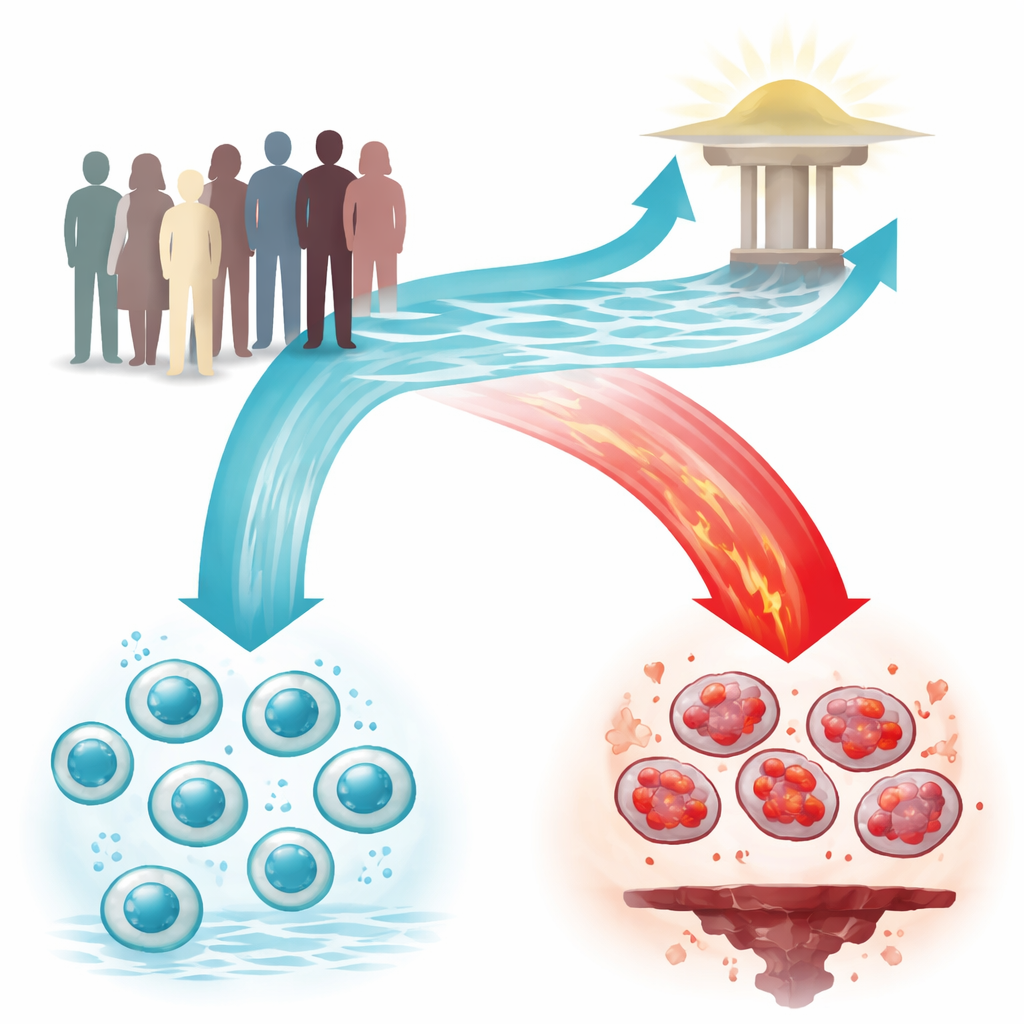
The researchers divided patients into four groups based on lab findings: those with neither gene mutations nor chromosomal changes, those with mutations only, those with chromosomal changes only, and those with both. Surprisingly, about one in five patients fell into the “double‑negative” group with no detectable genomic abnormalities. These patients tended to be younger and more often women. Standard risk scores, which draw heavily on lab values and chromosomal patterns, already placed many of them in low‑risk categories. Clinically, they had fewer abnormal blast cells in the marrow and required less intensive treatment, often managing with transfusions or immune‑modulating drugs instead of chemotherapy‑like agents.
Genetic damage tracks closely with outcomes
When the team examined survival, the contrast between groups was striking. Double‑negative patients lived the longest and rarely transformed to acute leukemia, with median survival times measured in decades rather than years. Patients who carried both gene mutations and chromosomal abnormalities fared worst, with typical survival of only a year or two. Those with either mutations alone or chromosomal changes alone landed in the middle. The more mutated genes a person carried, the shorter their survival, forming a stepwise curve: zero mutations did best, one was worse, and many mutations were worst of all. Notably, having a “good” chromosome pattern could not fully offset the negative impact of mutations, underscoring how strongly accumulated genetic damage shapes the disease course.
Distinct inner workings in the bone marrow
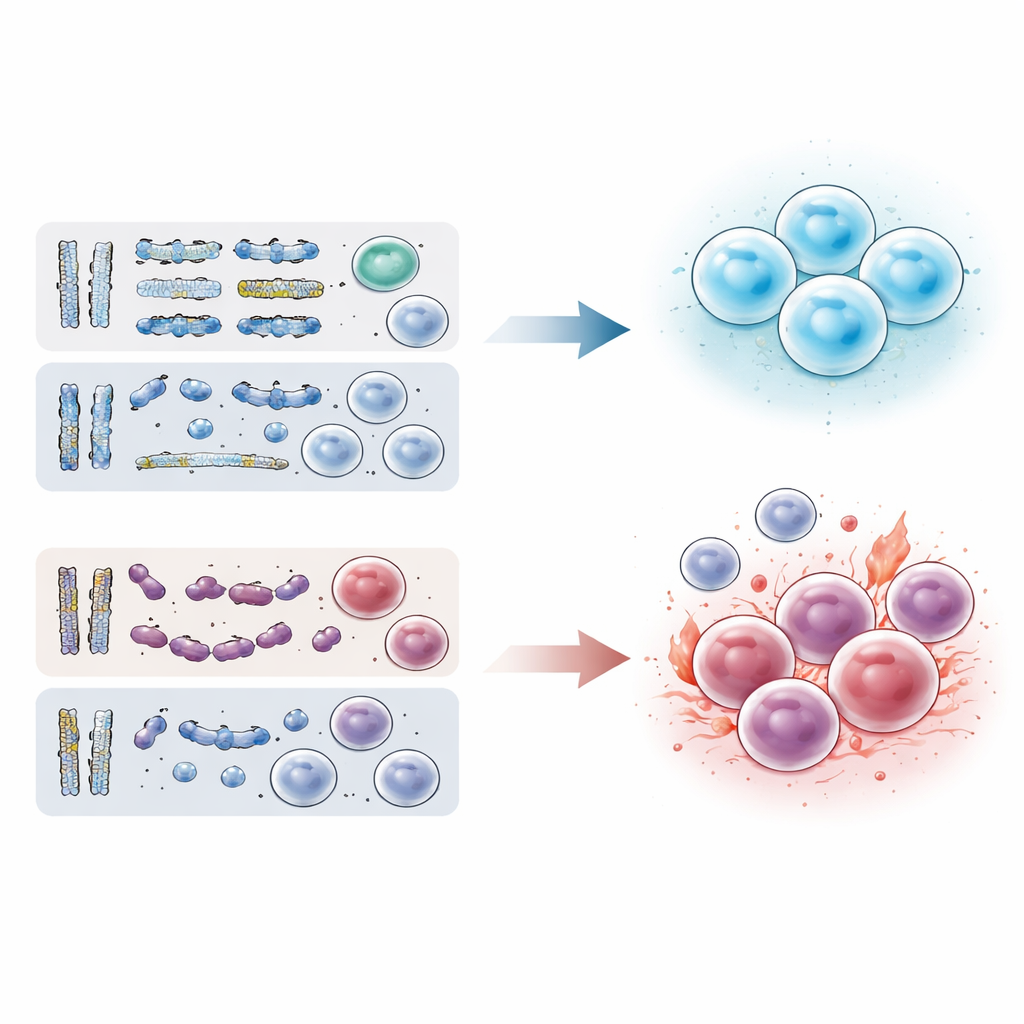
To peer under the hood, the researchers performed RNA sequencing, a method that reads which genes are actively “on” or “off” in bone marrow cells. They found that double‑negative MDS showed a very different activity pattern from genomically altered disease. In mutation‑free patients, genes linked to energy production and orderly cell structures were more active, suggesting relatively preserved cell health. By contrast, patients with mutations or chromosomal changes showed heightened activity in inflammation, stress, and growth‑driving pathways. Their cells appeared to live in a constant state of alarm, with signals similar to those seen in more aggressive blood cancers. This molecular portrait supports the idea that double‑negative MDS is not simply an early version of the same disease, but a biologically milder, more stable state.
Building a more personal risk calculator
Existing scoring systems such as the IPSS‑R and the newer IPSS‑M combine blood counts, chromosome findings, and selected mutations to estimate risk. However, these tools could not meaningfully separate outcomes among the very low‑risk, double‑negative patients: nearly all did well regardless of the category assigned. To fine‑tune predictions, the authors created a new risk “nomogram” that blends age, iron overload (measured by ferritin), a blood enzyme linked to cell turnover (LDH), scarring in the bone marrow, and the IPSS‑M group. This simple point‑based chart better distinguished who was likely to live longer or shorter, even after accounting for molecular risk, and can be used at the bedside to estimate 12‑ and 36‑month survival for individual patients.
What this means for patients and doctors
For people newly diagnosed with MDS, these findings offer both reassurance and guidance. Patients whose tests show neither gene mutations nor chromosomal changes appear to form a genuinely low‑risk subgroup with excellent long‑term outcomes and slow disease progression, even when traditional scores label them as higher risk. At the same time, the study warns against relying on genetic data alone: both clinical features and simple blood‑based markers still add important information. By integrating these layers—clinical, genomic, and gene‑activity patterns—the work points toward more personalized care, where treatment intensity is matched not just to what is seen under the microscope, but to how quietly or chaotically the marrow’s inner machinery is running.
Citation: Lee, WH., Hou, HA., Lin, CC. et al. Prognostic implications of genetic and transcriptomic abnormalities in MDS according to IPSS-R, IPSS-M, and the International Consensus Classification. Blood Cancer J. 16, 34 (2026). https://doi.org/10.1038/s41408-026-01456-4
Keywords: myelodysplastic syndromes, genetic risk in blood disorders, bone marrow failure, leukemia progression, personalized cancer prognosis