Clear Sky Science · en
Identifying neurophenotypes of major depressive disorder through normative model of regional homogeneity
Why this study matters
Depression is not the same for everyone: some people feel drained and emotionally numb, while others are plagued by anxiety and physical discomfort. This study used brain scans from more than 2,000 people to ask a basic question that matters for future care: are there recognizable brain-based versions of depression that could one day guide more personalized treatment?
Looking at resting brains
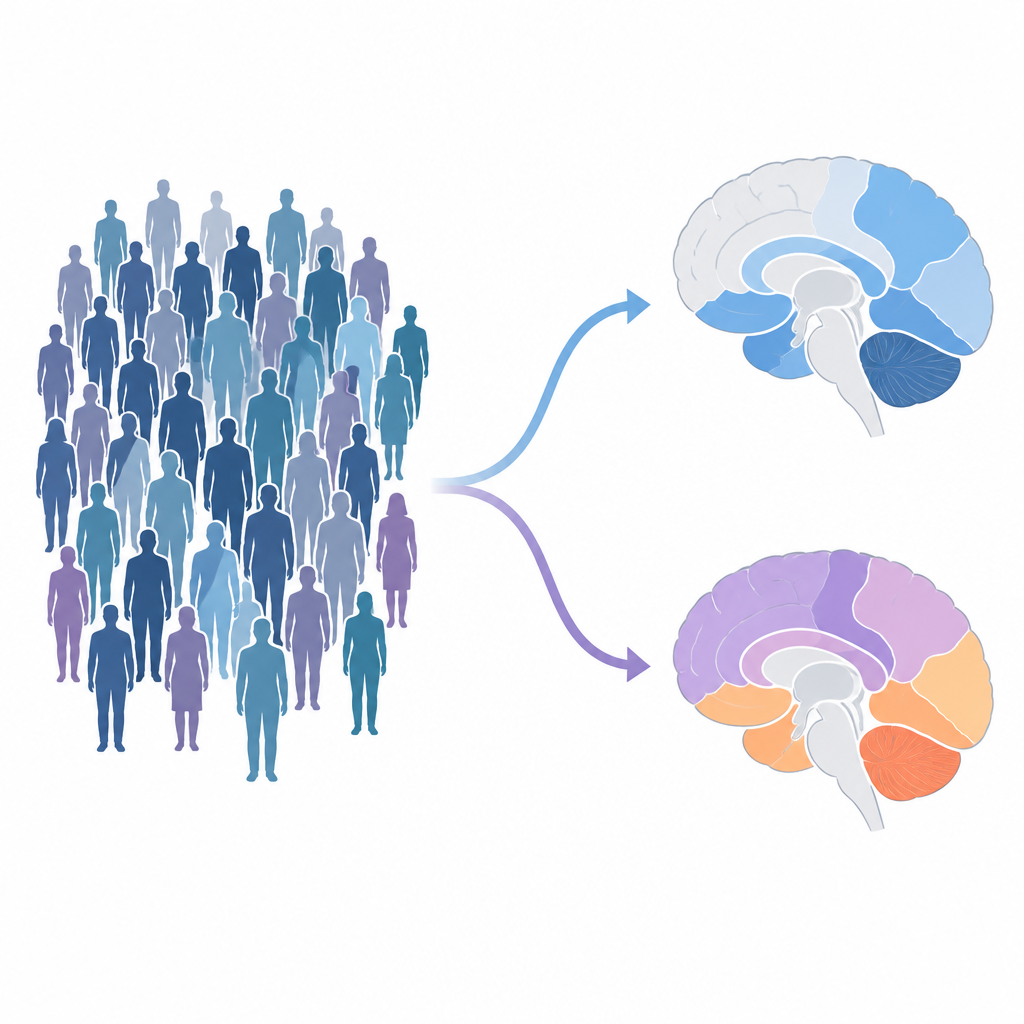
To explore this, researchers analyzed resting-state functional MRI scans, which measure how different parts of the brain quietly “pulse” together when a person is not doing a task. They focused on a measure called regional homogeneity, which reflects how well neighboring brain areas fire in sync. Using data from over 1,000 adults without depression, they built a kind of brain “growth chart” that described how this local synchrony normally changes with age and differs between men and women.
Building a brain growth chart
The team used a statistical method that can capture complex, curved patterns across the lifespan rather than just straight-line trends. This allowed them to map which brain regions tend to become more locally synchronized with age and which become less so. For example, areas involved in memory and certain visual and temporal regions generally showed increasing local coordination, while parts of the prefrontal and parietal cortex, as well as movement-related regions, tended to show decreasing synchrony, reflecting a shift toward broader, long-distance communication in the healthy brain.
How depression breaks from the norm
Next, the researchers compared more than 1,100 people with major depressive disorder to this normative chart. For each person with depression, they calculated where local brain activity strongly deviated from what would be expected given their age and sex. Many patients showed marked departures from the typical pattern, but not all in the same way. In some, brain regions tied to emotional control and internal thought were especially disrupted; in others, areas supporting sensation, movement, and visual processing were more affected. This widespread but uneven pattern highlighted why average case-control comparisons often miss the full story of depression.
Two brain-based versions of depression
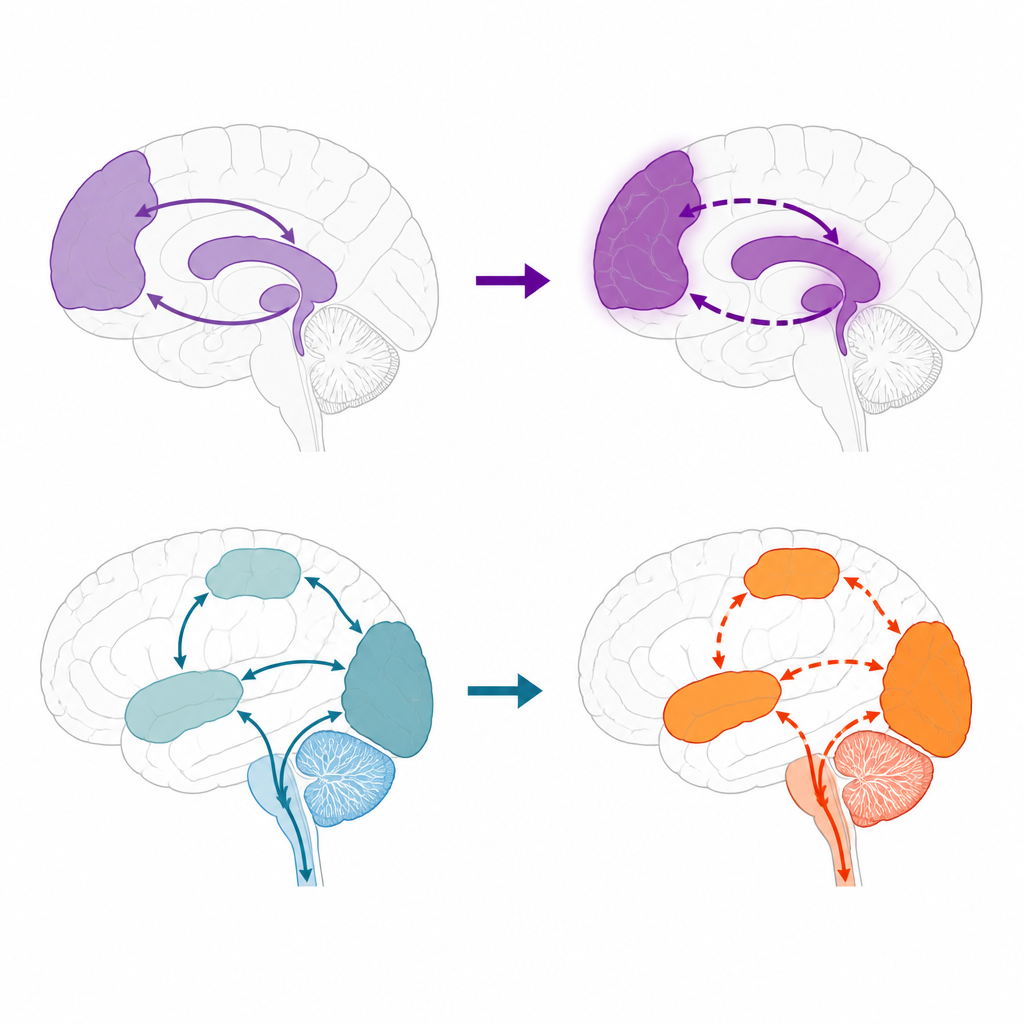
By grouping individuals according to their personal deviation patterns, the team uncovered two main neurophenotypes, or brain-based profiles. One, called the emotional dysregulation subtype, showed weakened local coordination in networks involved in attention, self-reflection, and emotional control, along with parts of the limbic system that process feelings. People in this group tended to be younger, had more severe depressive symptoms but better awareness of their condition, and were less likely to be taking medication. Their brain scans suggested more widespread and intense functional disruption, implying greater neural vulnerability.
When perception and body signals go awry
The second profile, termed the perceptual dysregulation subtype, showed greater disruption in networks that handle bodily sensations, movement, vision, and spatial attention. These individuals were older on average, more often medicated, and reported stronger anxiety and physical complaints such as bodily discomfort. Their brain deviations appeared more focused and stable rather than broadly extreme. Together, the two profiles map onto a broader hierarchy in the brain, from lower-level systems that process incoming sights, sounds, and body signals up to higher-level systems that shape thoughts, emotions, and self-awareness.
What this means for future care
In plain terms, this work suggests that depression may arise from at least two different kinds of brain disturbance: one centered on emotion and thought control, and another rooted in how the body and senses are processed. While these scans are not yet ready to guide everyday treatment, they point to a future in which doctors could match therapies to a person’s specific brain pattern, tailoring care rather than treating all depression as a single, uniform illness.
Citation: Luo, Z., Li, W., Xu, Y. et al. Identifying neurophenotypes of major depressive disorder through normative model of regional homogeneity. Transl Psychiatry 16, 261 (2026). https://doi.org/10.1038/s41398-026-04003-8
Keywords: major depressive disorder, brain networks, resting state fMRI, depression subtypes, precision psychiatry