Clear Sky Science · en
Integrated clinical and postmortem profiling in schizophrenia reveals a cognitive subtype linked to cerebrovascular disease
Why brain health in schizophrenia matters in later life
People living with schizophrenia often struggle with thinking and memory, but doctors still do not fully understand what happens inside the brain to cause these problems, especially in older age. This study followed a group of elderly patients with long-term schizophrenia during life and then carefully examined their brains after death, linking detailed cognitive testing to what was actually seen in brain tissue. The work sheds new light on why some patients lose more thinking skills than others and points to a hidden role for blood vessel damage in the brain.
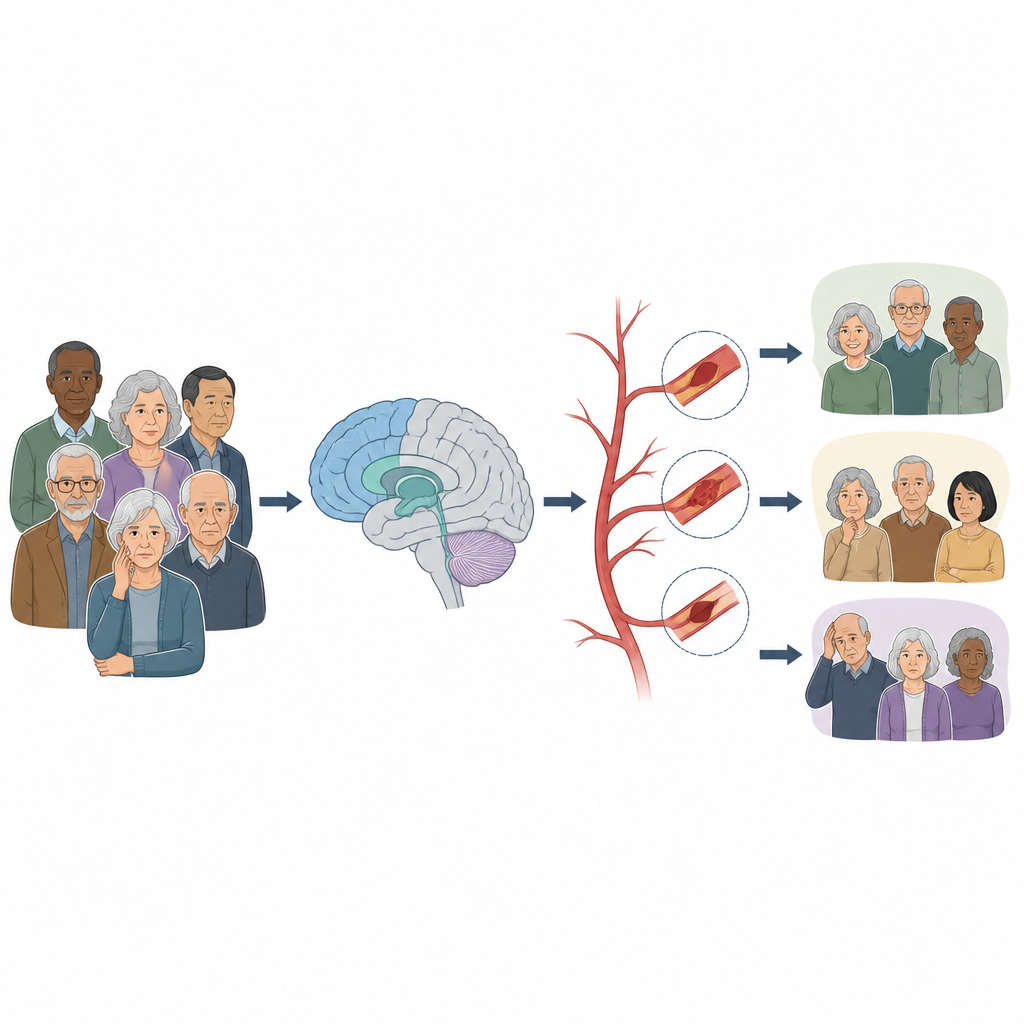
Looking inside the brains of older patients
The researchers studied 55 older adults with long-standing schizophrenia, most of whom were in their late seventies when they died. During life, the patients regularly completed standard thinking and memory tests, including a widely used screening tool that scores cognitive function out of 30 points. After death, their brains were collected through a donation program and examined with modern methods that can detect changes linked to Alzheimer’s disease, damage to brain blood vessels, and other age-related conditions. This rare combination of careful clinical follow-up and thorough autopsy allowed the team to ask which specific brain changes, if any, matched the cognitive problems seen while the patients were alive.
Alzheimer plaques tell only part of the story
Because Alzheimer’s disease is the leading cause of dementia in the general population, one might expect its telltale plaques and tangles to explain thinking problems in older people with schizophrenia. Instead, the researchers found that only about one third of the group showed Alzheimer-type pathology, a rate similar to that seen in elderly people without schizophrenia. When they compared the amount and spread of Alzheimer-related changes to test scores, there was no meaningful link: patients with more plaques and tangles did not reliably perform worse on cognitive tests. A combined score that was supposed to estimate the overall likelihood of dementia based on all visible pathologies also failed to line up with who was actually impaired, leaving many patients with clear cognitive problems but no obvious explanation from classic aging diseases.
Blood vessel damage and a hidden thinking subtype
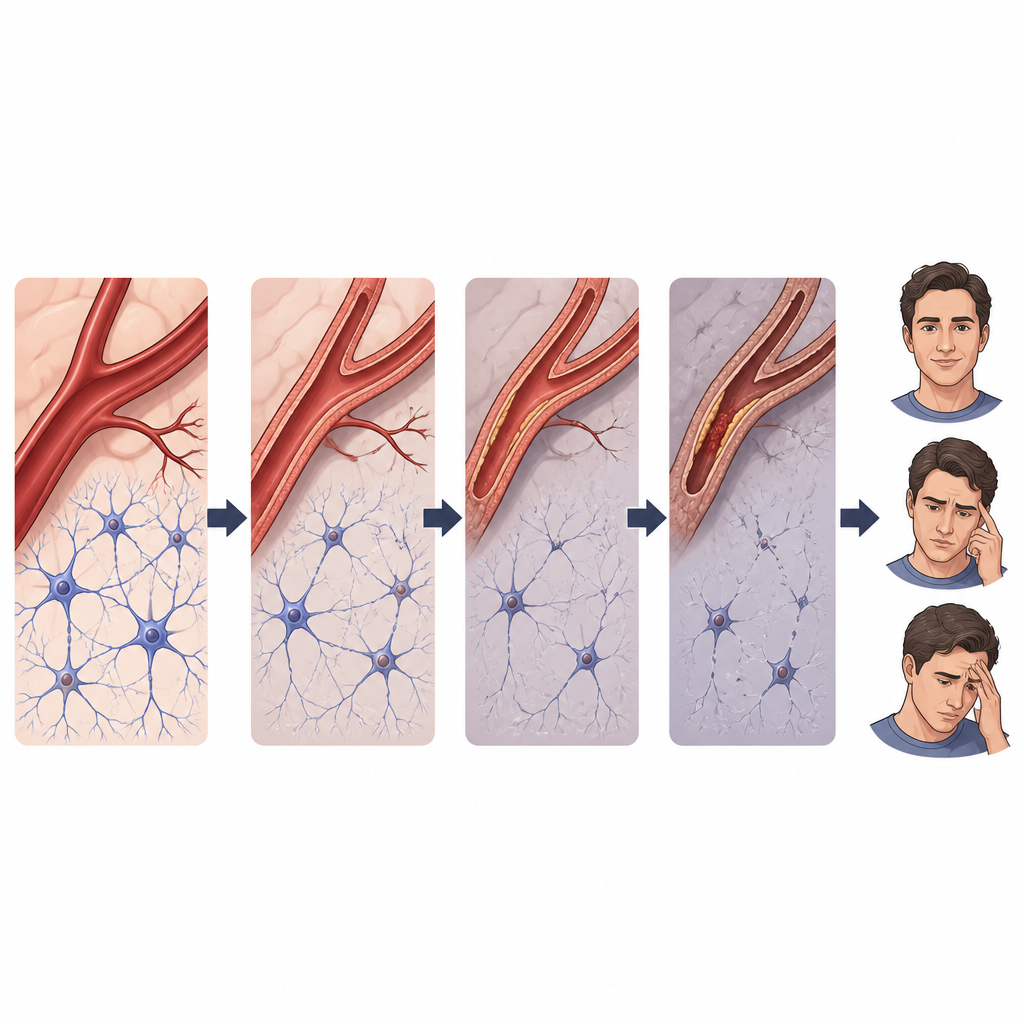
In contrast, injury to the brain’s blood vessels was both common and informative. More than four out of five patients showed signs of cerebrovascular disease, such as thickened or narrowed vessels and small areas of dead tissue. When the researchers graded how severe this vascular damage was and compared it to cognitive scores, a clear pattern emerged: worse blood vessel disease was linked to lower overall thinking scores and weaker performance on tasks that tap word fluency and other higher-order abilities. Using a data-driven clustering method, the team then grouped patients based solely on their cognitive profiles into three subtypes: one with severe global impairment, one with relatively preserved cognition, and a large middle group with selective problems in areas like verbal learning and processing speed. It was this intermediate group in particular where blood vessel damage most strongly tracked with poorer cognition and with more severe negative symptoms such as apathy and social withdrawal.
What these patterns mean for patients
The findings suggest that schizophrenia in later life is not a single cognitive fate but a collection of different paths. One subgroup showed profound thinking problems without a clear structural cause, another remained relatively resilient, and a third displayed a mix of selective cognitive weaknesses that seemed closely tied to vascular injury in the brain. Because Alzheimer-type changes did not explain these patterns, the study points away from traditional dementia as the main driver of decline and toward blood vessel health as a key factor for at least some patients.
How this could shape future care
For families and clinicians, this work underscores that managing heart and blood vessel health may be especially important for preserving cognition in older adults with schizophrenia. While the study cannot prove cause and effect, it raises the possibility that treating common cardiovascular risks such as high blood pressure, diabetes, and smoking could help protect thinking abilities in a vulnerable subgroup. More broadly, the results argue for viewing schizophrenia not just as a disorder of thoughts and perceptions, but also as a condition whose long-term brain outcomes depend on how the mind and the body’s circulation system interact over a lifetime.
Citation: Futhey, N.C., Vila-Rodriguez, F., Stochmanski, S.J. et al. Integrated clinical and postmortem profiling in schizophrenia reveals a cognitive subtype linked to cerebrovascular disease. Transl Psychiatry 16, 262 (2026). https://doi.org/10.1038/s41398-026-03984-w
Keywords: schizophrenia, cognitive impairment, cerebrovascular disease, brain aging, neuropsychology