Clear Sky Science · en
An oncostatin M receptor and chloride intracellular channel 1 crosstalk drives key oncogenic pathways in glioblastoma
Why this brain cancer study matters
Glioblastoma is one of the deadliest brain cancers, with current treatments offering patients only a short extension of life. This study uncovers how two little-known molecules on the surface of glioblastoma stem cells team up to fuel tumor growth and treatment resistance. By revealing this hidden partnership, the work points to a new way to weaken these aggressive tumors without needing to hit every mutation inside them.
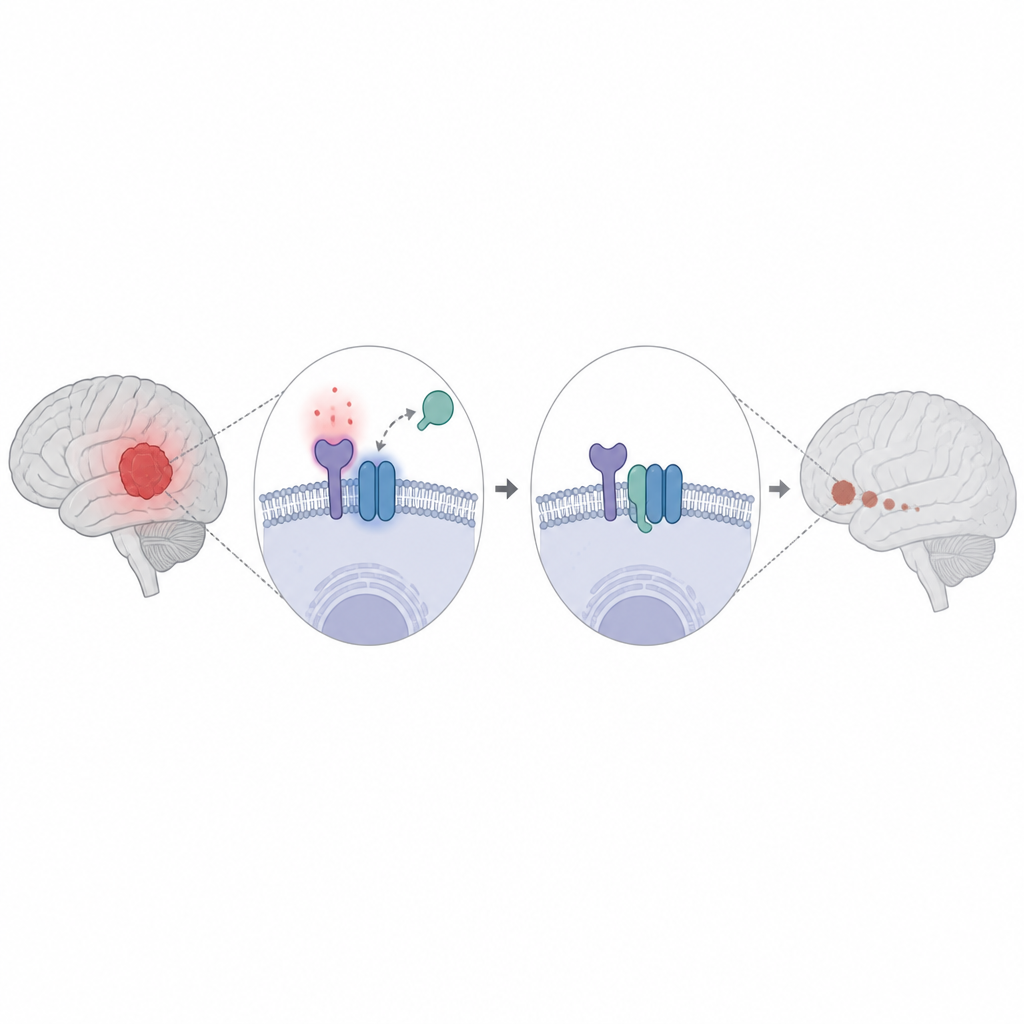
A deadly brain tumor and its hidden engines
Glioblastoma tumors are driven by a small population of stem-like cells that can self-renew, resist therapy, and repopulate the tumor after treatment. Many of these cells carry a hyperactive version of a growth receptor called EGFRvIII, which keeps growth signals switched on even without external triggers. Another surface protein, the oncostatin M receptor (OSMR), is known to support these signals and help the cells survive radiation and other stresses. Yet exactly how OSMR connects outside signals, energy use, and the tumor environment has not been fully understood.
Building a map of key partners on the cell surface
To answer this, the researchers used a large-scale screening method called MaMTH-HTS to search thousands of human proteins for those that physically interact with OSMR in living cells. They performed the screen both with and without EGFRvIII present. This produced a detailed “interaction map” showing hundreds of candidate partners, many involved in metabolism, signaling, and immune responses. Among a small group of proteins that appeared in both conditions, one stood out: chloride intracellular channel 1 (CLIC1), a protein that can move between the inside of the cell and the cell membrane, where it acts as a chloride ion channel. CLIC1 is highly expressed in various cancers and is particularly abundant in aggressive glioblastoma subtypes.
A tight partnership that powers tumor stem cells
The team then tested CLIC1 in patient-derived brain tumor stem cells grown in the laboratory. When they reduced CLIC1 levels with RNA interference or permanently disrupted its gene using CRISPR, the stem cells lost much of their ability to divide, form spheres, and maintain their stem-like state. Imaging and biochemical tests showed that CLIC1 sits at the cell surface together with OSMR and EGFRvIII, and that all three proteins form a large complex through their outer segments. Removing CLIC1 sharply weakened the physical interaction between OSMR and EGFRvIII, reduced activity of the key growth regulator STAT3 inside the cell, and lowered the amount of EGFRvIII packaged into tiny extracellular vesicles that tumors use to influence neighboring cells.
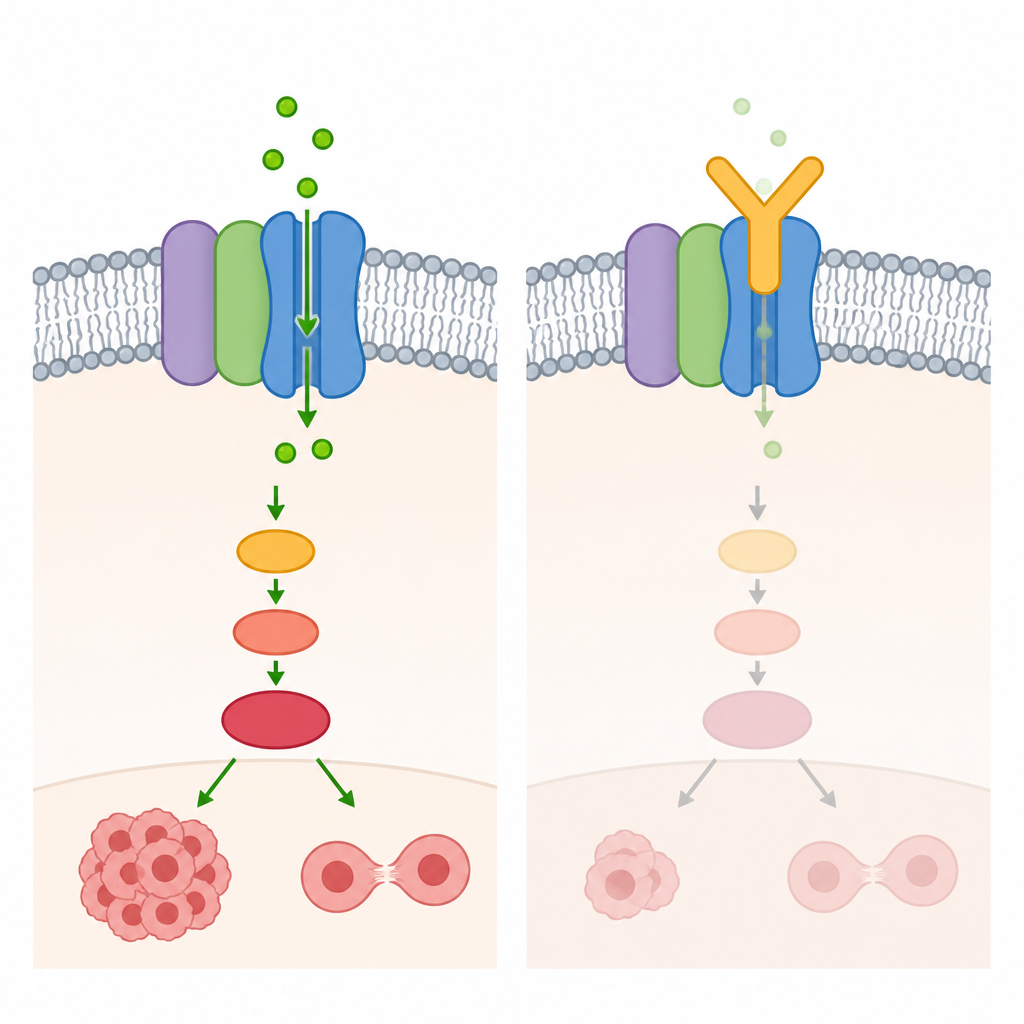
Ions, electrical currents, and growth signals
Because CLIC1 can form an ion channel, the researchers asked whether its electrical activity is tied to growth signaling. Using patch-clamp recordings, they measured a distinct chloride current in tumor stem cells that was sensitive to a CLIC1 blocker. When they lowered OSMR levels, this current dropped, showing that OSMR helps maintain CLIC1 function at the membrane. To target the channel more precisely, they developed a monoclonal antibody, tmCLIC1omab, that binds the membrane form of CLIC1 and inhibits its ion flow. Treating glioblastoma cells with this antibody reduced chloride currents, slowed cell growth, and markedly decreased the activating phosphorylation of both EGFRvIII and STAT3, but only in cells that actually carried the EGFRvIII mutation.
From cell culture to animal models
The team next tested CLIC1’s role in living animals. When brain tumor stem cells lacking CLIC1 were implanted into the brains of mice, the resulting tumors grew more slowly and the animals survived longer than those receiving unmodified cells. Tumor samples from the CLIC1-deficient group showed much lower activation of EGFR and EGFRvIII, and reduced STAT3 activity, mirroring the cell-culture results. In a separate experiment, treating tumor-bearing mice with the tmCLIC1omab antibody shrank tumor size without obvious toxicity, supporting the idea that blocking membrane CLIC1 can dampen the signaling circuits that drive glioblastoma progression.
What this means for future treatment
In simple terms, this work shows that a receptor for an inflammatory signal (OSMR) and a shape-shifting ion channel (CLIC1) cooperate on the surface of glioblastoma stem cells to keep powerful growth switches turned on. Their partnership stabilizes a larger complex that includes EGFRvIII, maintains electrical and ionic balance across the cell membrane, and boosts signals that help tumors grow, spread, and resist therapy. By disrupting CLIC1, either genetically or with a targeted antibody, the researchers were able to weaken these signals, reduce tumor stem cell fitness, and slow tumor growth in mice. This suggests that drugs or small peptides designed to block the OSMR–CLIC1 interaction, or to inhibit membrane CLIC1, could one day complement existing treatments and offer glioblastoma patients a new line of attack.
Citation: Mansourabadi, A.H., Qu, D., Cianci, F. et al. An oncostatin M receptor and chloride intracellular channel 1 crosstalk drives key oncogenic pathways in glioblastoma. Sig Transduct Target Ther 11, 194 (2026). https://doi.org/10.1038/s41392-026-02723-3
Keywords: glioblastoma, brain tumor stem cells, ion channels, EGFRvIII, STAT3 signaling