Clear Sky Science · en
Myeloid Mas drives pyruvate kinase M2-mediated Spi1 lactylation to fuel inflammatory senescence in MASLD
Why this liver story matters
Fatty liver disease linked to metabolic problems, now called MASLD, affects more than a third of adults and can quietly progress to serious liver damage. This study looks beyond fat itself to ask why inflammation in the liver does not switch off, and how certain immune cells and their energy use may be driving long term harm. By uncovering this hidden control system and testing a targeted treatment in mice, the researchers outline a fresh way to calm damaging liver inflammation without shutting down the entire immune system.
The quiet rise of a common liver disease
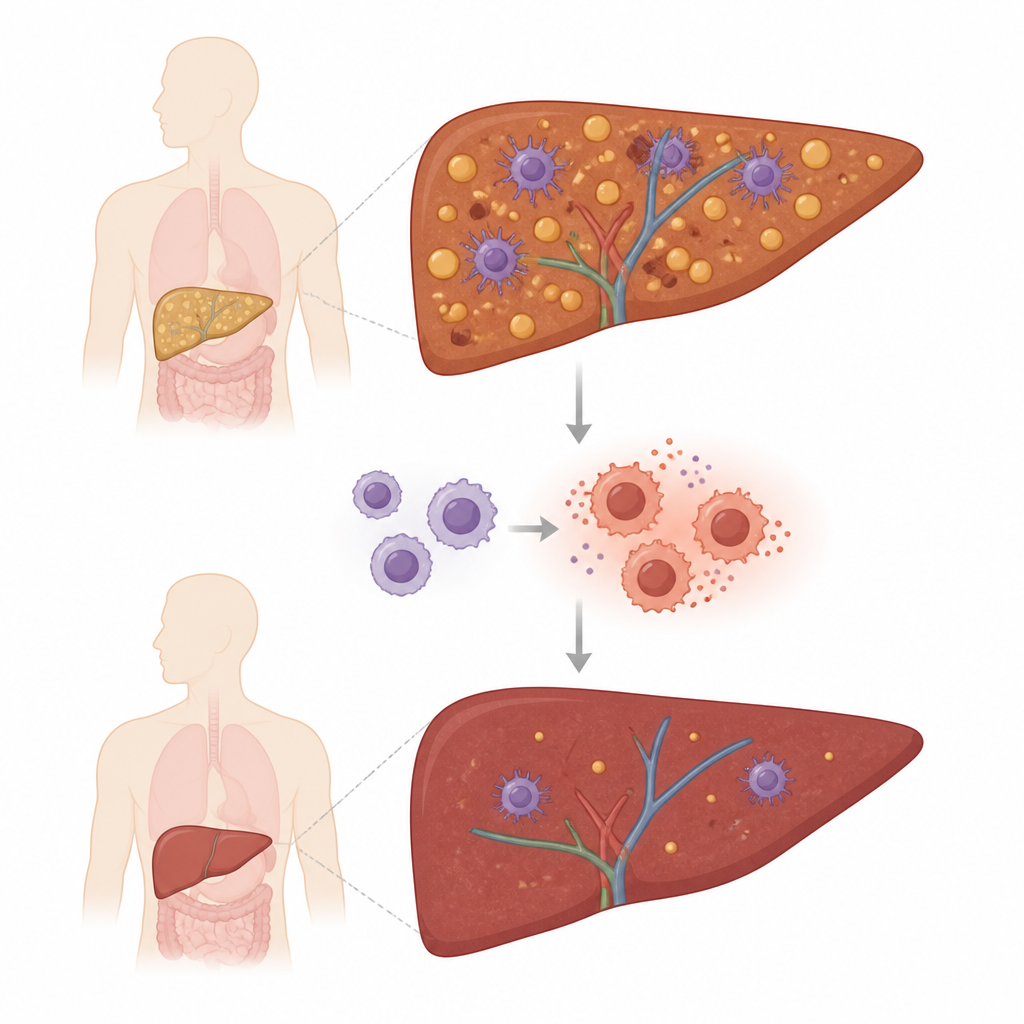
Metabolic dysfunction associated steatotic liver disease, or MASLD, ranges from simple fat build up in the liver to scarring, cirrhosis, and liver cancer. It is tightly linked to obesity, insulin resistance, and other features of modern lifestyles. Yet medicines that safely halt or reverse MASLD remain limited. A growing body of work points to immune cells in the liver, especially a family called myeloid cells, as key players that sustain low level inflammation over many years. This study focuses on a receptor protein called Mas found on these cells, asking whether it acts as a switch that links how immune cells burn fuel to how much inflammatory damage they cause.
Immune cells, sugar burning, and a hidden switch
The team examined liver samples from people with MASLD and from mouse models fed fat rich diets. They found that Mas levels were consistently higher in myeloid cells from diseased livers, and that more Mas went hand in hand with worse measures of liver injury and fat buildup. To test cause and effect, they bred mice that lacked Mas only in myeloid cells. When these mice were placed on liver damaging diets, they showed less weight gain, less fat within the liver, lower blood markers of liver injury, and fewer inflammatory molecules in the bloodstream and liver. At the same time, their liver immune cells burned less glucose through fast "Warburg like" pathways and produced less lactate, a metabolic byproduct that can also act as a signal.
How a molecular chain reaction feeds senescent inflammation
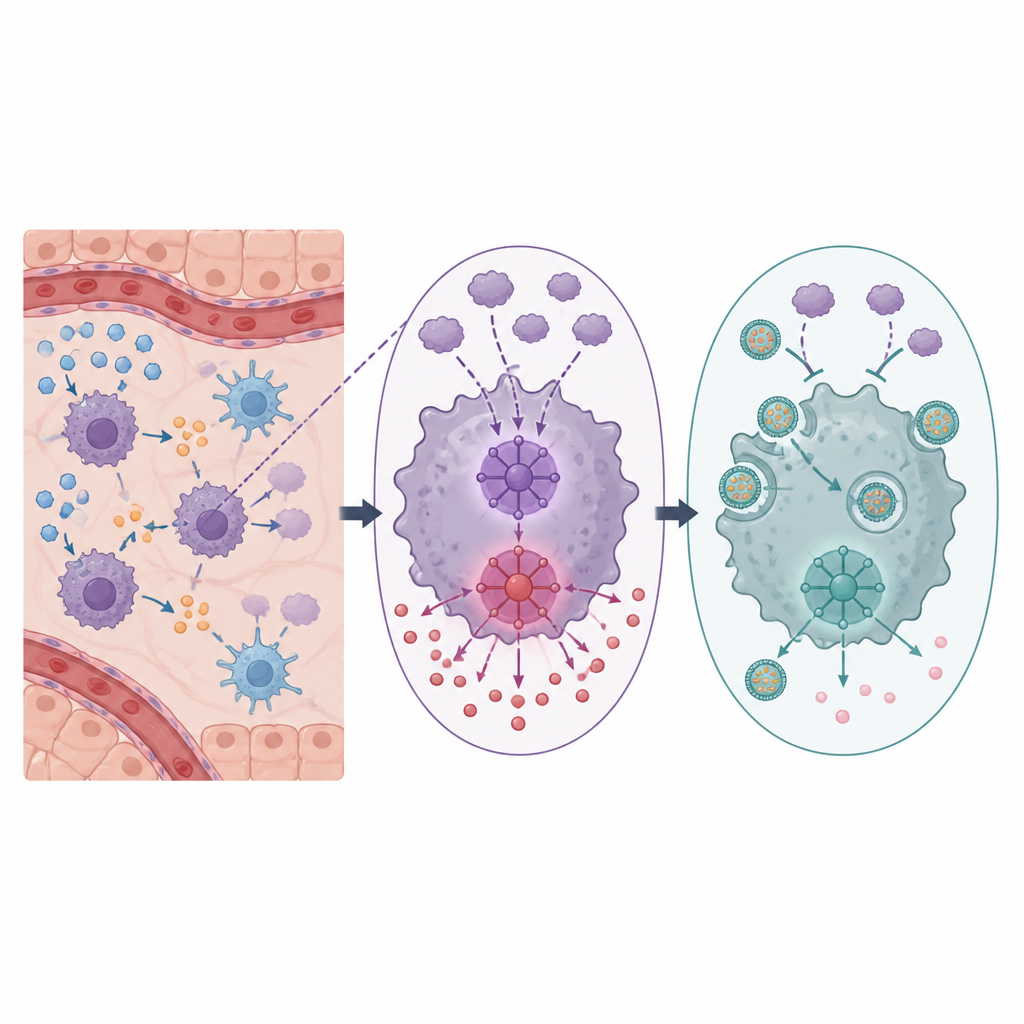
Using single cell sequencing and detailed cell biology, the researchers traced this effect to a particular subgroup of liver monocytes marked by the protein FN1 and the receptor CCR2. In normal MASLD mice, these cells are highly active, shift their metabolism toward rapid sugar burning, and mature into inflammatory macrophages that sit near liver cells. Mas physically binds to an enzyme called pyruvate kinase M2, or PKM2, which sits at a key step in breaking down glucose. This partnership boosts lactate production and encourages PKM2 to move into the cell nucleus, where it helps trigger a form of cellular aging known as senescence. In senescent immune cells, a master regulator protein called Spi1 becomes decorated by lactate at a particular site, which improves its entry into the nucleus and its grip on DNA. As a result, Spi1 turns on a suite of senescence associated secretory phenotype, or SASP, genes that release waves of inflammatory and tissue remodeling factors into the liver environment.
Turning off the harmful pathway with a smart delivery system
To see whether this chain could be broken, the team removed PKM2 from myeloid cells in mice and saw a protection pattern similar to Mas loss, tying PKM2 firmly to disease progression. They then screened tens of thousands of compounds by computer and lab tests to find molecules that interfere with Mas. One natural candidate, the tea derived molecule theaflavin 3,3′ digallate (TFDG), reduced the Mas PKM2 interaction, lowered nuclear PKM2, cut lactate levels, and eased signs of DNA damage and senescence in immune cells. Because free TFDG is cleared quickly from the body, the scientists packaged it inside biodegradable nanoparticles cloaked with membranes from macrophages. These "camouflaged" particles homed to liver macrophages in mice, where they strongly dampened the Mas PKM2 Spi1 pathway, reduced inflammatory and senescence markers, and improved liver fat, injury scores, and inflammatory signals without obvious toxicity.
What the findings mean for patients
For non specialists, the main message is that this work connects how liver immune cells use sugar to a self reinforcing loop of inflammatory aging that drives MASLD forward. Mas acts like a master dial on these cells, tuning an enzyme, a metabolic byproduct, and a gene switch to keep senescent, inflammatory macrophages active. Blocking this axis in mice, either genetically or with a precisely targeted TFDG nanoparticle, eased fatty liver damage and cooled inflammatory signals. While much remains to be done before such an approach could be tested in people, the study offers a clear mechanistic roadmap and a concrete starting point for therapies that aim to calm liver inflammation by rewiring immune cell metabolism rather than broadly suppressing immunity.
Citation: Zhao, L., Xu, S., Qiao, S. et al. Myeloid Mas drives pyruvate kinase M2-mediated Spi1 lactylation to fuel inflammatory senescence in MASLD. Sig Transduct Target Ther 11, 186 (2026). https://doi.org/10.1038/s41392-026-02704-6
Keywords: MASLD, liver inflammation, macrophages, cellular senescence, immune metabolism