Clear Sky Science · en
Disrupting SOX2 self-association and condensate formation to overcome chemotherapeutic drug resistance in lung squamous cell carcinoma
Why drug resistance in lung cancer matters
Chemotherapy is still a mainstay treatment for many people with lung squamous cell carcinoma, a common and deadly type of lung cancer. Yet even when drugs initially shrink tumors, cancer cells often learn to survive, leaving patients with fewer options. This study uncovers an unexpected physical trick that lung cancer cells use to dodge chemotherapy and introduces a designer peptide that may help restore the power of standard drugs.
A protein that marks a vulnerable lung cancer
Researchers began by exploring why lung squamous cell tumors so often resist treatment compared with other lung cancers. They focused on a protein called SOX2, frequently found at abnormally high levels in this cancer type. By examining patient data and lung cancer cell lines, the team showed that SOX2 is commonly amplified and overexpressed in these tumors, while remaining low or undetectable in normal airway cells. When they artificially increased SOX2 in cancer cells, the cells became less sensitive to multiple chemotherapy agents, including cisplatin, a widely used drug. Knocking down SOX2 had the opposite effect, making cancer cells easier to kill. Notably, SOX2 did not speed up cell growth under normal conditions; instead, it specifically blunted drug-induced cell death by limiting the DNA damage that chemotherapy is meant to cause.
Drug-protective droplets inside cancer cell nuclei
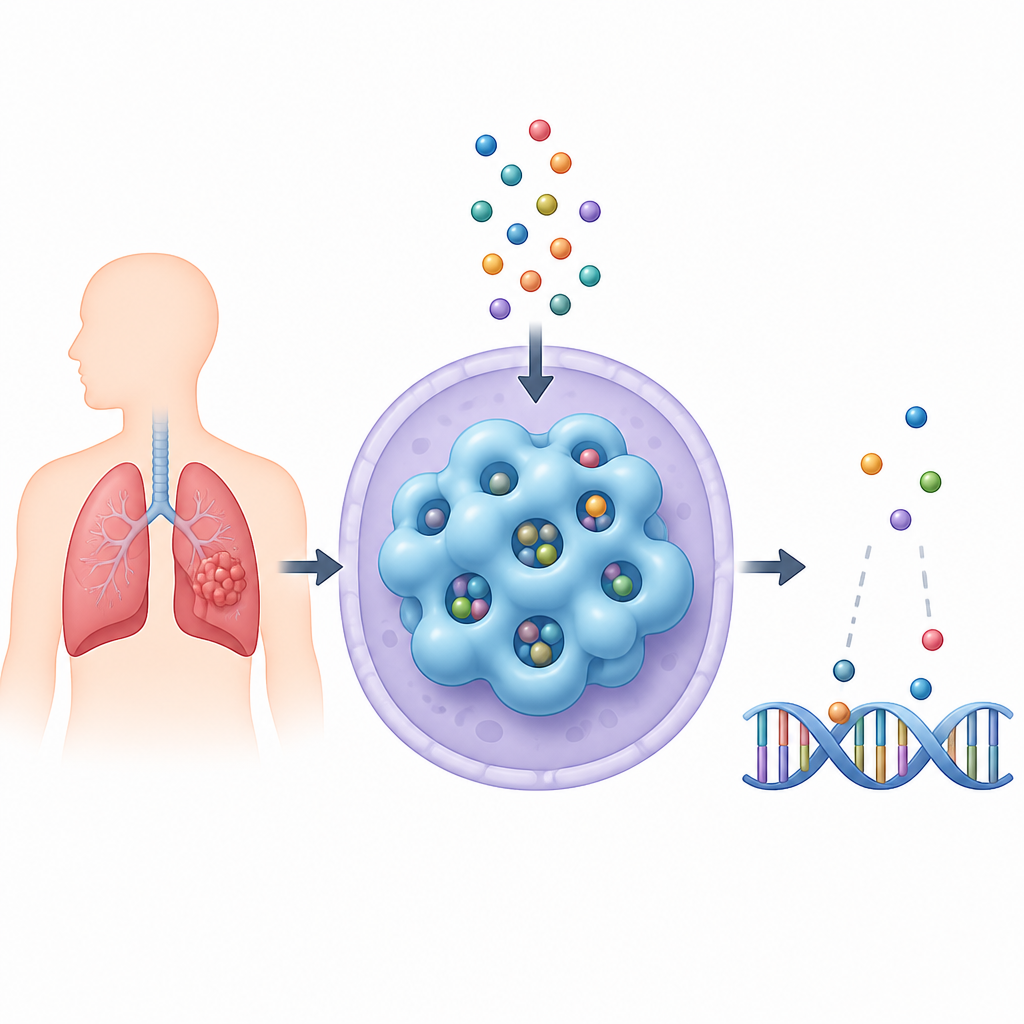
The team then asked how SOX2 could shield cancer cells from chemotherapy. Advances in cell biology have revealed that many proteins can assemble into tiny, droplet-like compartments inside cells, similar to oil droplets in water. The researchers found that SOX2 behaves this way in lung squamous cell carcinoma: in test tubes, in cancer cell lines, and in tumor samples from patients, SOX2 formed liquid-like condensates within the nucleus. These droplets grew larger and more numerous as SOX2 levels rose. Crucially, chemotherapy drugs such as cisplatin, carboplatin, paclitaxel, etoposide, and mitoxantrone further boosted the formation of SOX2 droplets and stabilized the protein, even though SOX2’s genetic activity as a transcription factor stayed largely intact. Using fluorescent drug analogs and binding assays, the authors showed that these condensates pull chemotherapeutic molecules into themselves, acting like molecular sponges. As a result, fewer drug molecules reach the cell’s DNA, leading to fewer DNA crosslinks and less activation of damage signals that would normally trigger cancer cell death.
Pinpointing the droplet-forming region of SOX2
To dissect which parts of SOX2 drive droplet formation, the scientists mapped flexible and prion-like segments of the protein. They found that a prion-like domain, together with three disordered regions, was essential for SOX2 to separate into droplets in simple solutions. Inside cells, the prion-like segment emerged as the key driver: removing it abolished condensate formation while leaving SOX2’s ability to switch genes on largely intact. Cells expressing SOX2 without this region no longer became resistant to cisplatin or other chemotherapy drugs, and DNA damage levels returned to normal. Further experiments showed that this same prion-like stretch provides the main binding surface for cisplatin, tying the drug-sequestering and droplet-forming behaviors to a single physical region of the protein rather than to its usual gene-regulating role.
A designer peptide that breaks the shield
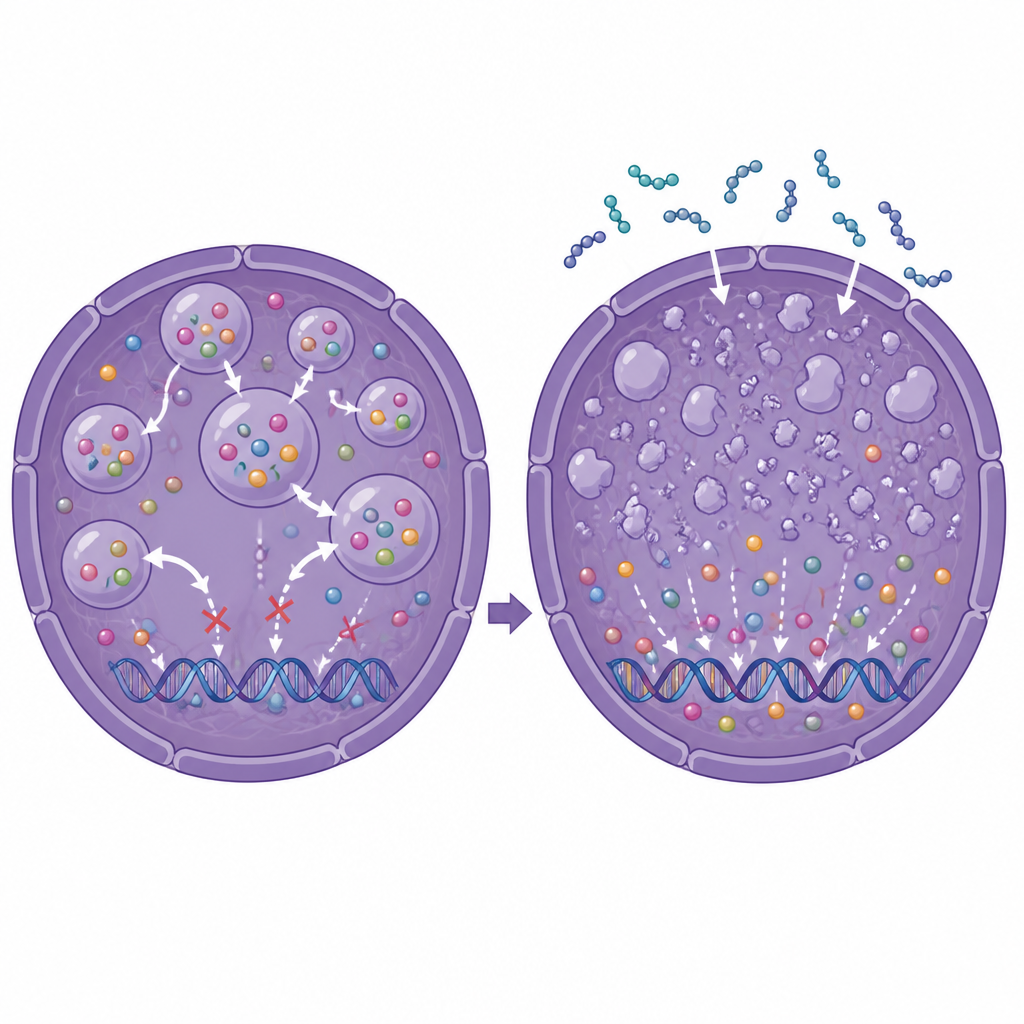
Having established that SOX2 droplets act as protective shelters for chemotherapy drugs, the researchers set out to dismantle them without disabling SOX2’s normal functions in healthy tissues. They homed in on a structured portion of the protein, known as an alpha-helix within the HMG domain, that mediates SOX2 molecules sticking to each other. Based on this segment, they engineered a short, positively charged peptide called Hx1R8 that can cross cell membranes and enter the nucleus. This peptide binds selectively to the SOX2 helix and disrupts SOX2 self-association, thereby preventing condensate formation. Importantly, Hx1R8 did not interfere with SOX2’s ability to bind DNA or regulate its target genes. In cancer cells, Hx1R8 dissolved SOX2 droplets, blocked further droplet growth triggered by chemotherapy, reduced the trapping of drug molecules inside these compartments, and lowered SOX2 protein levels over time.
Restoring chemotherapy sensitivity in tumors
The final tests took place in mice bearing human lung squamous cell tumors with high SOX2 levels. When treated with cisplatin alone, tumors slowed but continued to grow, and SOX2 droplets in tumor cell nuclei became more abundant. Adding the Hx1R8 peptide to cisplatin therapy led to smaller tumors, more cell death, and a marked drop in SOX2 condensates, while a control peptide without proper structure had no benefit. The combined treatment did not produce obvious damage in key organs such as the brain, liver, or kidneys in these short-term studies, suggesting a favorable initial safety profile. Together, the experiments support a model in which SOX2 condensates create a physical barrier that captures chemotherapy agents and that this barrier can be weakened by targeting the protein’s self-association rather than its core gene-regulating activity.
What this means for future cancer treatment
To a non-specialist, the key message is that some lung cancers resist chemotherapy not only through genetic changes but also by building tiny internal shelters that soak up drugs before they can reach vital targets. This work shows that SOX2, long viewed as a difficult protein to drug, can be tackled indirectly by breaking apart its droplets. The custom peptide Hx1R8 restored chemotherapy sensitivity in cell and animal models by disabling this physical shield while leaving SOX2’s normal gene-control roles largely untouched. If approaches like this can be refined and made safe in humans, they may offer new ways to improve standard chemotherapy for lung squamous cell carcinoma and potentially other cancers that rely on similar protein condensates.
Citation: Wang, J., Wen, Y., Huang, S. et al. Disrupting SOX2 self-association and condensate formation to overcome chemotherapeutic drug resistance in lung squamous cell carcinoma. Sig Transduct Target Ther 11, 183 (2026). https://doi.org/10.1038/s41392-026-02696-3
Keywords: lung squamous cell carcinoma, SOX2, chemotherapy resistance, protein condensates, therapeutic peptides