Clear Sky Science · en
Targeting EHMT2 overcomes 5-fluorouracil resistance in colorectal cancer by modulating cell cycle and apoptosis
Why some colon cancers stop responding to a key drug
Many people with colorectal cancer receive the long-used chemotherapy drug 5-fluorouracil, or 5-FU. While this medicine can slow or shrink tumors, cancers often adapt and stop responding, leaving patients with fewer treatment options. This study explores why that resistance develops and tests a way to make resistant tumors vulnerable to 5-FU again.
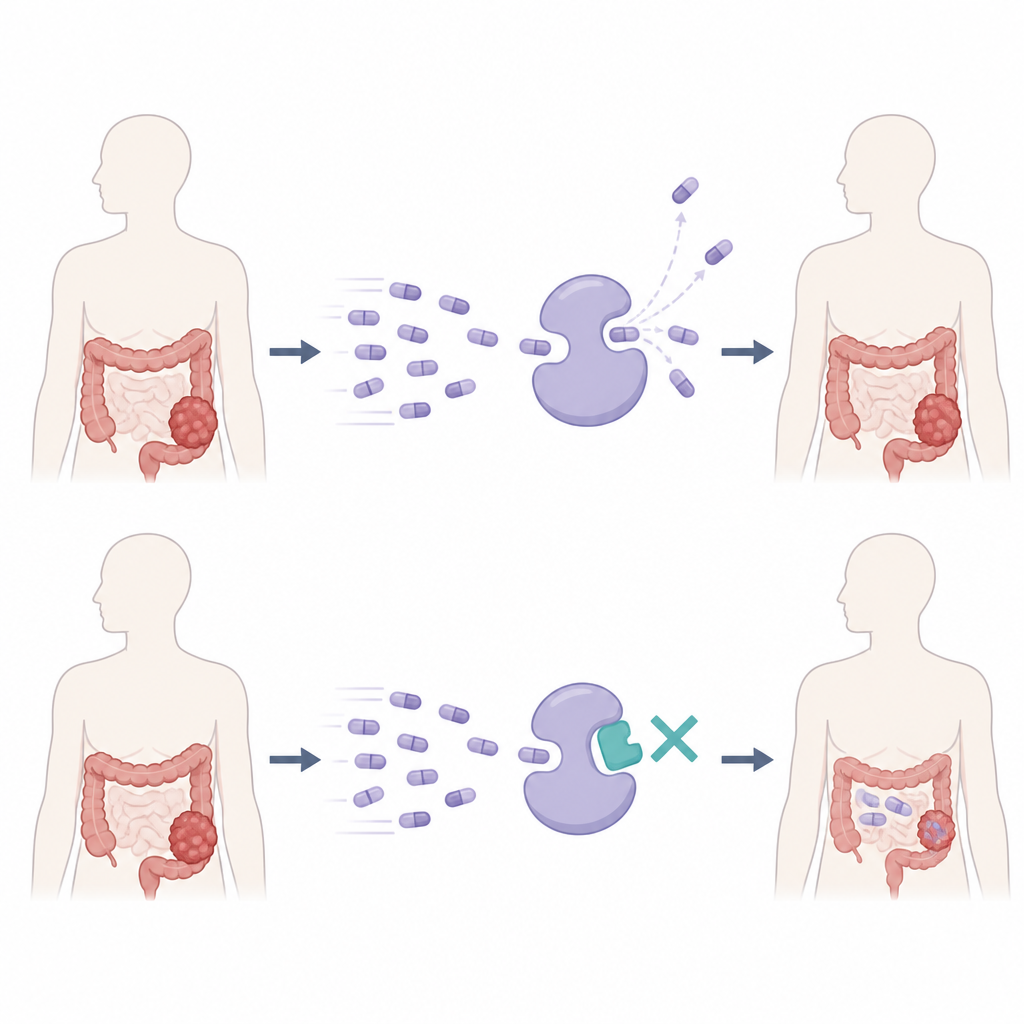
A common treatment that loses its power
Colorectal cancer is one of the most common cancers worldwide, and 5-FU remains a mainstay of therapy. The drug works by damaging the DNA and RNA of fast-growing cells, causing them to stop dividing and die. Unfortunately, many advanced tumors either do not respond well from the start or gradually become resistant after repeated exposure. In metastatic disease, most patients eventually show poor responses to 5-FU, which is closely tied to low long-term survival. Researchers have suspected that changes in how genes are switched on and off, rather than changes in the DNA code itself, play an important role in this escape.
An epigenetic switch that tilts the balance
The team focused on a protein called EHMT2, a gene-control enzyme that chemically marks DNA-packaging proteins and usually silences nearby genes. When they compared ordinary colorectal cancer cells with versions that had been made resistant to 5-FU, they found that EHMT2 levels were much higher in resistant cells. Patient data told a similar story: people whose tumors had more EHMT2 tended to respond poorly to 5-FU and had shorter survival. In lab dishes, forcing cancer cells to make extra EHMT2 made them harder to kill with 5-FU, while lowering EHMT2 levels reduced growth and restored the drug’s impact.
How blocking the switch halts growth and triggers cell death
To understand what EHMT2 was doing inside resistant cells, the scientists examined changes in thousands of genes after shutting it down. They saw strong activation of pathways linked to cell cycle control and programmed cell death. Resistant cells with reduced EHMT2 stopped in the G1 phase, an early checkpoint in the division cycle, and showed clear signs of apoptosis, including increased activity of key executioner enzymes and cleavage of PARP, a marker of cell death. One crucial player emerged: a phosphatase enzyme called PPM1B. EHMT2 directly suppressed PPM1B by placing chemical marks near its control region. When EHMT2 was lowered, PPM1B levels rose, leading to less activity of CDK2, a driver of cell division, more of the brake protein p21, stronger G1 arrest, and more cell death.
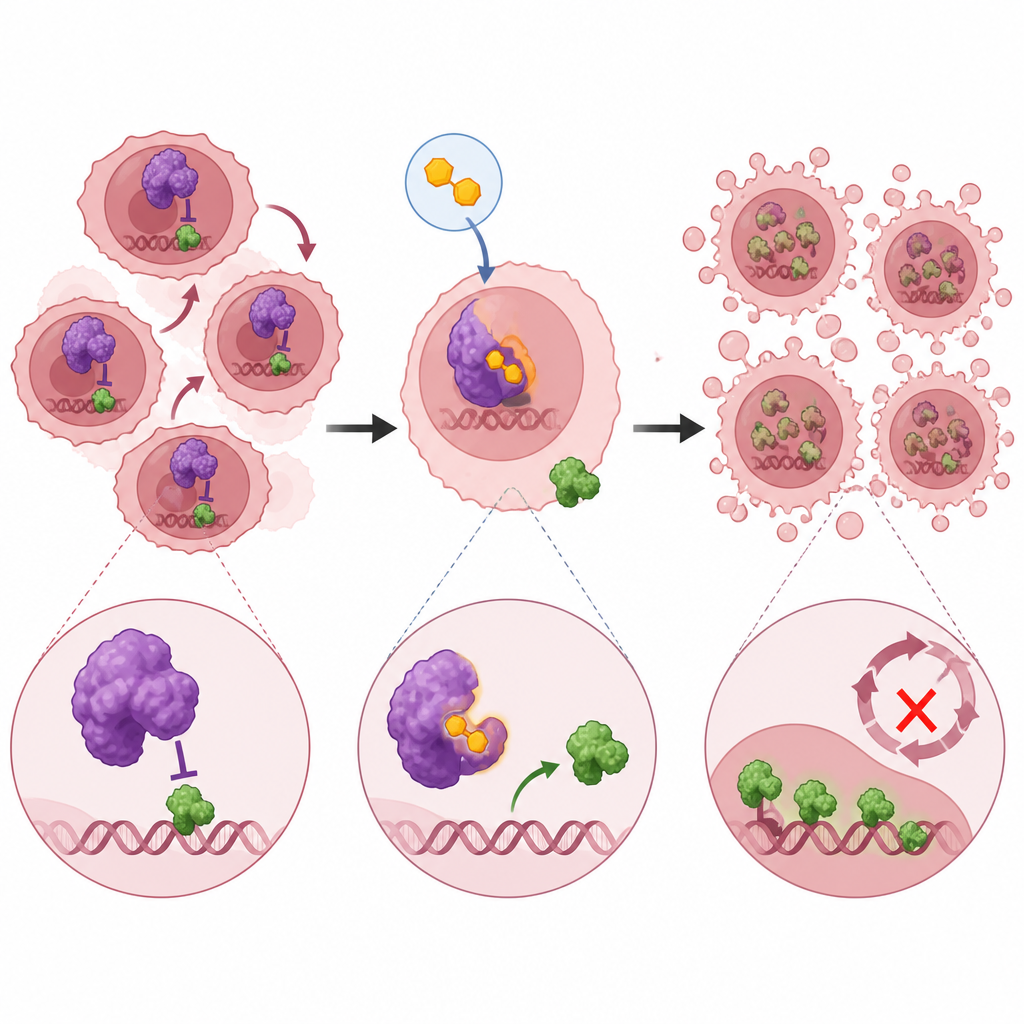
A drug that reawakens a hidden defender
The researchers then tested a small-molecule inhibitor of EHMT2 called BIX-01294. In resistant colorectal cancer cell lines, this compound slowed growth, increased PPM1B, boosted p21, and reduced the signals that push cells through the division cycle. It also lowered the silencing marks on the PPM1B gene, mirroring the effects of genetic knockdown of EHMT2. In mice carrying tumors grown from resistant cells, BIX-01294 alone shrank tumors, and its combination with 5-FU worked even better than either treatment by itself, without obvious extra toxicity. The same pattern appeared in three-dimensional mini-tumors, or organoids, grown from patient colorectal cancers: organoids that no longer responded to 5-FU became sensitive again when EHMT2 was blocked, especially when combined with 5-FU.
What this work could mean for patients
Together, these findings reveal that an overactive epigenetic switch, EHMT2, helps colorectal cancer cells resist 5-FU by keeping a natural brake, PPM1B, turned off. When EHMT2 is blocked, PPM1B can rise, slowing the cell cycle and allowing cancer cells to undergo controlled death in response to treatment. While more research is needed to test safety and effectiveness in people, the results suggest that adding an EHMT2 inhibitor to standard 5-FU chemotherapy might one day help overcome resistance and extend the usefulness of a long-standing cancer drug.
Citation: Tae, I.H., Kang, Y., Lee, J. et al. Targeting EHMT2 overcomes 5-fluorouracil resistance in colorectal cancer by modulating cell cycle and apoptosis. Sig Transduct Target Ther 11, 184 (2026). https://doi.org/10.1038/s41392-026-02692-7
Keywords: colorectal cancer, drug resistance, 5-fluorouracil, epigenetic therapy, EHMT2