Clear Sky Science · en
Stereoselective, sex-dependent 5-HT2A receptor modulation of cortical plasticity by MDMA in mice
Why This Study Matters
MDMA, often known as ecstasy, is moving from the nightclub to the clinic as researchers test it alongside psychotherapy for stubborn conditions like post-traumatic stress disorder. Yet we still do not fully understand how this drug reshapes the brain, why its effects can differ between men and women, or how its two mirror-image forms behave. This mouse study digs into those questions, revealing that MDMA’s impact on brain cells depends both on the drug’s exact 3D shape and on biological sex, with important lessons for designing safer, more precise treatments.
Two Mirror Drugs and the Role of Serotonin
Many drugs come in two mirror-image versions, or enantiomers, that can act very differently in the body. The researchers compared the standard 50–50 mix of MDMA with its individual S(+) and R(–) forms. They focused on a serotonin receptor in the brain called 5-HT2A, which is central to the action of classic psychedelics and to changes in brain wiring. In human cells engineered to carry this receptor, the racemic mixture and S(+)-MDMA acted as very weak activators, while R(–)-MDMA hardly activated the receptor at all, even though it stuck to it more tightly. This suggested that any powerful effects in the living brain might not come from simple direct stimulation of this receptor.
Behavioral Signals of Psychedelic-Like Action
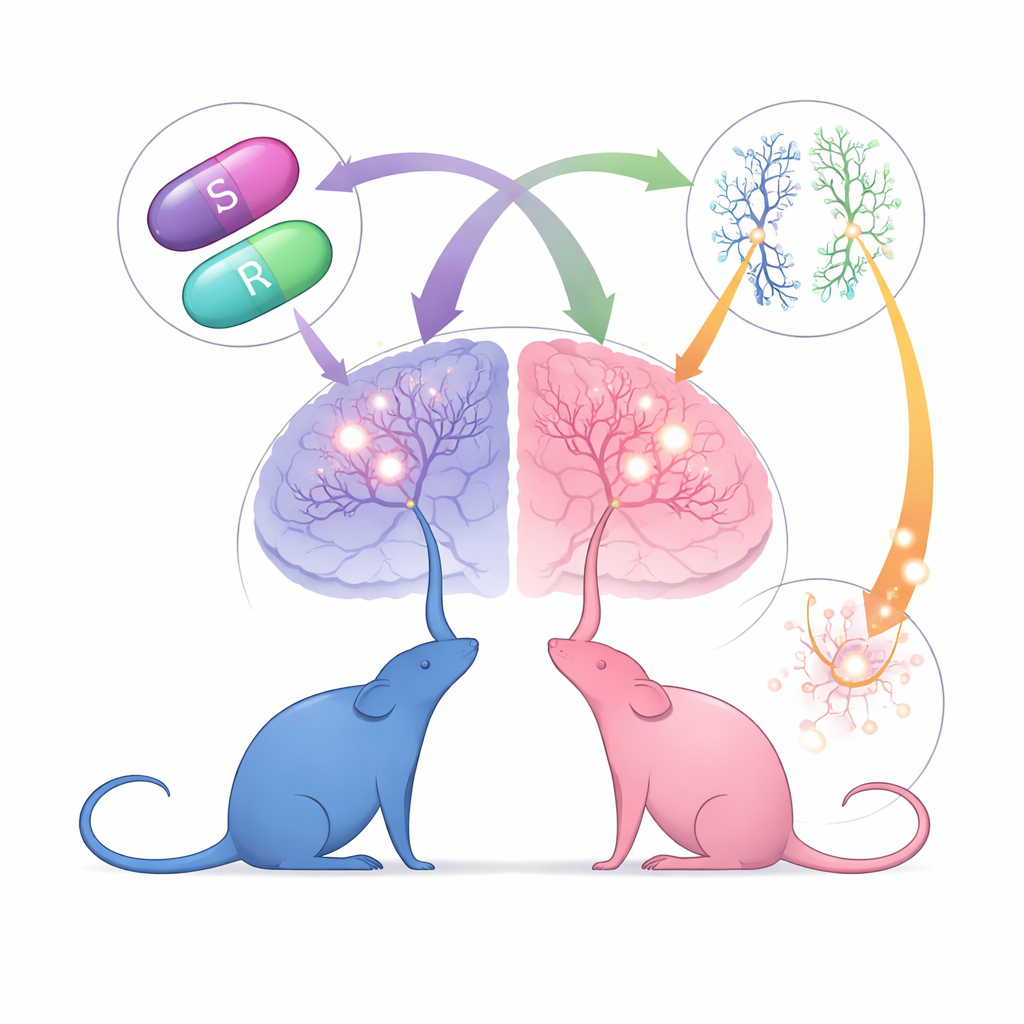
To probe MDMA’s psychedelic-like actions in living animals, the team used the “head-twitch response,” a rapid side-to-side movement in mice that depends strongly on 5-HT2A receptors and mirrors psychedelic activity in humans. S(+)-MDMA triggered this behavior in both male and female mice, whereas R(–)-MDMA did so only in females. Blocking 5-HT2A receptors eliminated these head twitches, confirming that this receptor was required. The researchers also measured a chemical signal (IP1) that reflects activation of the receptor’s main signaling pathway in the frontal cortex. Again, S(+)-MDMA boosted this signal in both sexes, while R(–)-MDMA produced little to no effect. Together, these results show that the two mirror forms of MDMA differ in how strongly they engage 5-HT2A-linked signaling, and that these effects are filtered by sex.
Changing the Shape of Brain Cells
Because lasting therapeutic benefits may depend on how drugs reshape brain circuits, the scientists examined tiny bumps on nerve cell branches called dendritic spines, which are physical sites of synapses and a hallmark of plasticity. They labeled frontal cortex neurons with a fluorescent marker and counted spines a day after a single MDMA dose. In male mice, S(+)-MDMA increased spine density on frontal cortex neurons, a change partly reduced but not fully removed in animals lacking 5-HT2A receptors. R(–)-MDMA had no detectable effect on spine density in males, and neither form altered spines in females, which already showed higher baseline spine density. These findings suggest that one specific mirror form of MDMA can promote structural remodeling in the male frontal cortex, with 5-HT2A receptors playing a contributory but not exclusive role.
Serotonin Transporters as the Hidden Switch
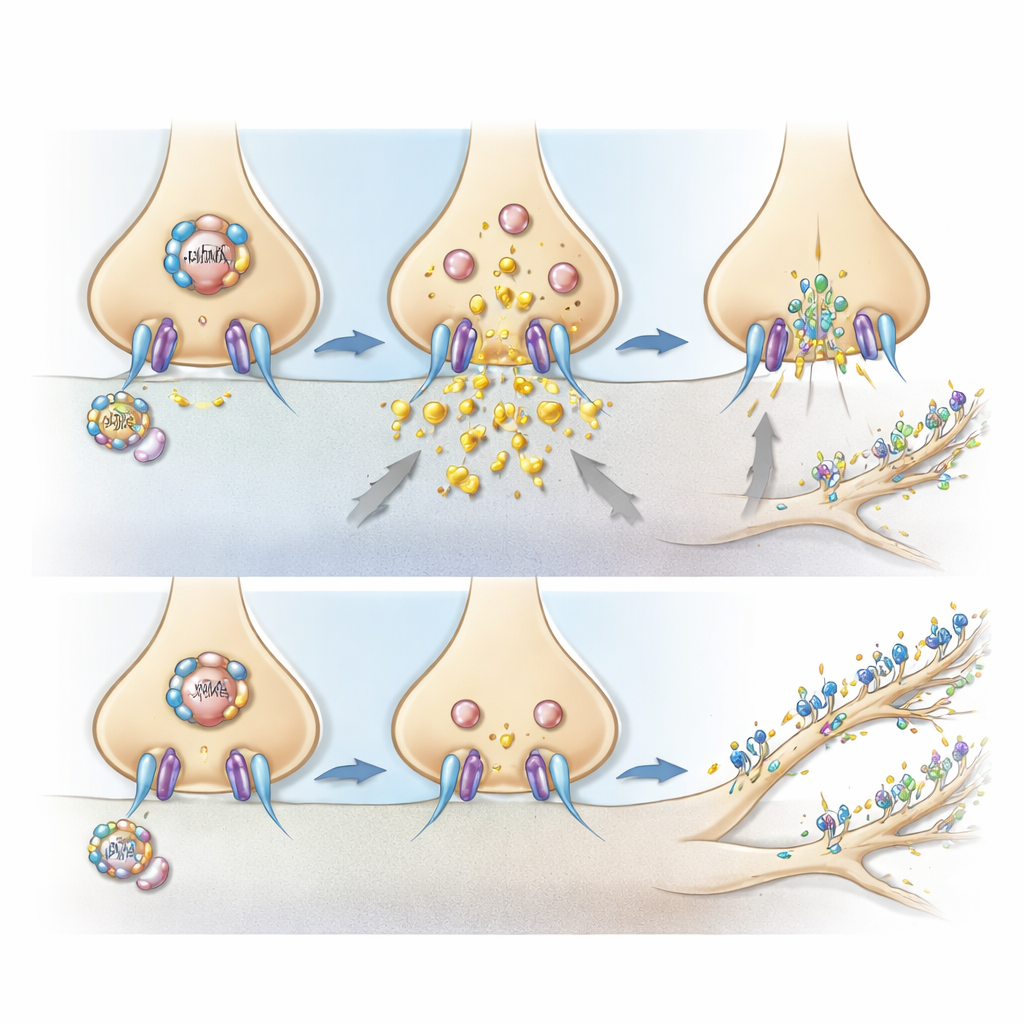
The team then asked how MDMA actually turns on 5-HT2A receptors in the brain. MDMA is known to reverse the function of the serotonin transporter (SERT), causing serotonin to gush out of nerve terminals. When the researchers blocked this transporter with the antidepressant fluoxetine before giving MDMA, both the head-twitch behavior and the IP1 signaling boost from S(+)-MDMA vanished, in males and females alike. Fluoxetine did not blunt the effects of a classic direct 5-HT2A agonist, showing that the blockade was specific to MDMA’s reliance on serotonin release. This means MDMA does not primarily act as a direct 5-HT2A stimulant in the brain; instead, it floods the synapses with serotonin, which then activates the receptor and downstream plasticity in a sex- and stereoisomer-dependent way.
What This Means for Future MDMA Therapies
In everyday terms, this study shows that MDMA’s ability to reshape frontal brain circuits depends on a three-way interaction between the drug’s exact 3D form, the serotonin system, and biological sex. The S(+) form is better at driving serotonin-dependent signaling and structural changes in male mouse cortex, whereas the R(–) form is weaker and behaves differently across sexes. Because clinical MDMA is a mixture of both forms, these findings suggest that fine-tuning future treatments may require choosing the right stereoisomer, dose, and perhaps even sex-specific protocols. More broadly, the work underscores that some of the therapeutic promise of MDMA and related compounds may arise less from acting like classic psychedelics at a single receptor, and more from how they mobilize the brain’s own serotonin to promote flexible, rewired neural networks.
Citation: Gaines-Smith, M.C., Silverman, J.M., Fiorillo, M. et al. Stereoselective, sex-dependent 5-HT2A receptor modulation of cortical plasticity by MDMA in mice. Neuropsychopharmacol. 51, 1011–1022 (2026). https://doi.org/10.1038/s41386-025-02313-x
Keywords: MDMA, serotonin, cortical plasticity, sex differences, 5-HT2A receptor