Clear Sky Science · en
Positive bias in brain and behaviour as a mechanism of transcranial magnetic stimulation depression treatment
Why this matters for people living with depression
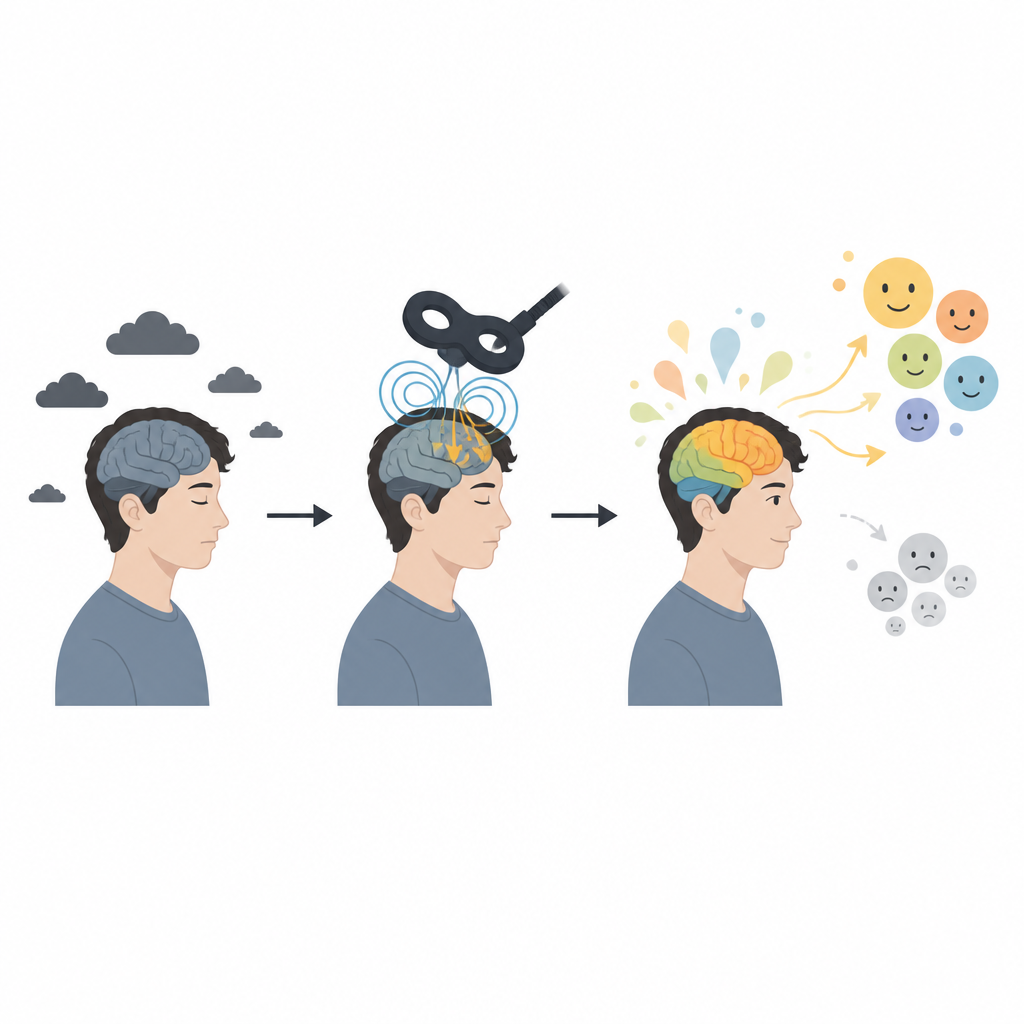
Depression often feels like wearing dark glasses that tint everything in a negative light. This study asks whether a noninvasive brain treatment called transcranial magnetic stimulation, or TMS, helps by subtly swapping those glasses for a more balanced, slightly more positive lens. By tracking both behavior and brain activity while people looked at emotional faces, the researchers explored how early shifts in emotional focus might forecast who will feel better after a full course of TMS.
How brain stimulation fits into current depression care
Many people with depression do not get enough relief from standard treatments such as medication or talk therapy. TMS offers another route: a magnetic coil placed on the scalp delivers brief pulses that influence activity in targeted brain regions, particularly an area behind the forehead involved in thinking and emotion control. In this study, 49 adults with major depression received 20 weekday sessions of a fast TMS pattern over four weeks. The team wanted to know whether changes in how these patients processed emotional information during the first two weeks could predict their mood at the end of treatment.
Watching how people read emotional faces
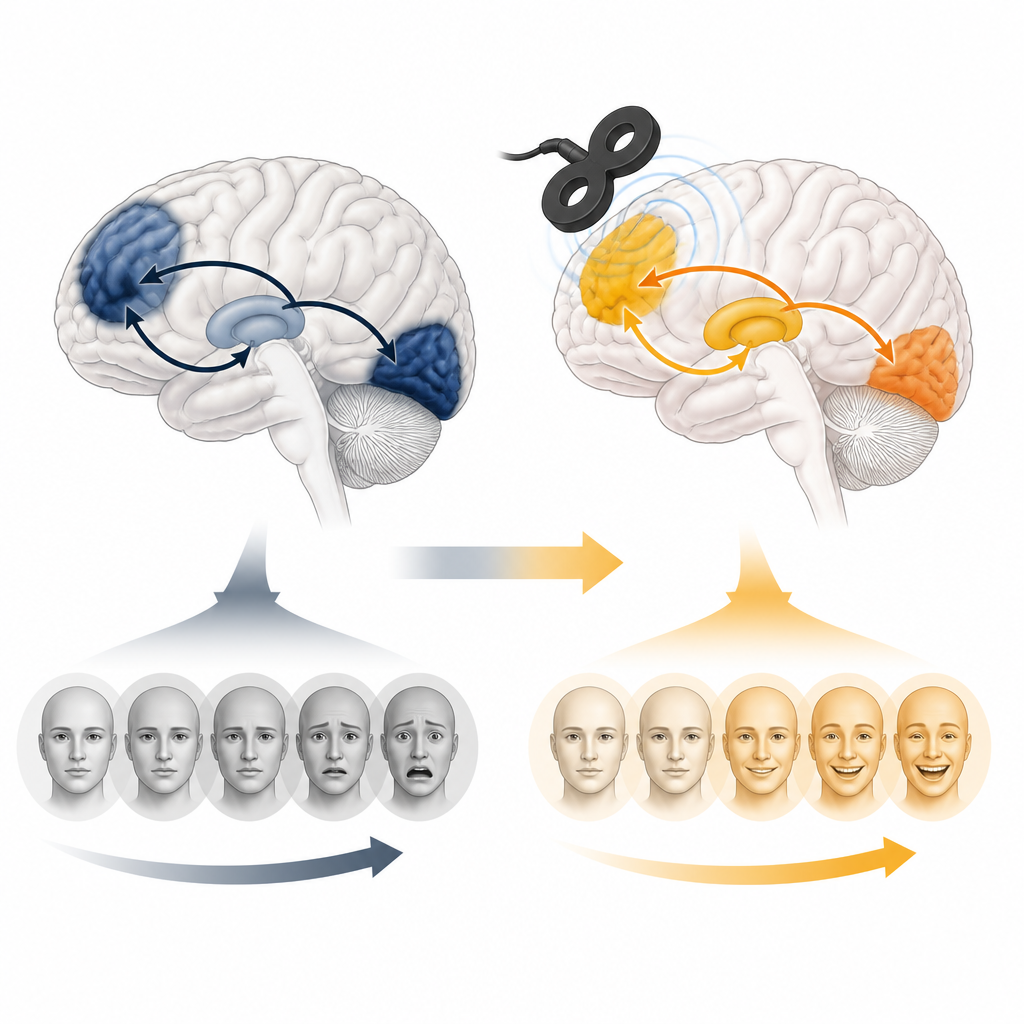
To capture emotional bias in daily-like decisions, participants completed a facial expression recognition task. They saw faces showing a range of emotions, including happiness, fear, anger, sadness and disgust, and had to choose which feeling they thought each face showed. The researchers focused on whether people tended to misread unclear expressions as positive or negative. After about eight TMS sessions, those who later showed strong mood improvement became more likely to categorize ambiguous faces as positive rather than negative. This shift did not simply reflect being faster or more accurate overall; it specifically reflected a changed tendency to “lean positive” when the expression could go either way.
Peering into the brain while it responds to emotion
The same volunteers also underwent brain scans while they viewed very brief flashes of happy or fearful faces and performed a simple gender decision task. Although the emotional content was not required for the task, it reliably activated brain circuits involved in feeling and evaluating emotion. The researchers looked for changes in the balance of brain responses to happy versus fearful faces between the start of treatment and week two, and then related these changes to how much each person’s depression scores dropped by week four.
Key brain circuits that tilted toward the positive
People whose mood improved more showed a stronger shift toward responding to happy faces in a network of regions that usually quiets down when we focus outward, sometimes called the brain’s “default mode.” This included a midline region involved in monitoring internal states and several areas near the back of the brain that help integrate visual and self-related information. These regions became more strongly turned down during happy faces relative to fearful ones, a pattern that earlier work suggests may reflect healthier engagement with positive cues. At the same time, communication between this midline region and other parts of the default mode and sensory systems became more biased toward happy faces. Behaviorally, some participants also grew slower when happy faces appeared, as if those faces grabbed more of their attention; this change tracked with the brain shifts toward positive processing.
Early brain and behavior changes as a guide to treatment
The team used statistical models to test whether these emotional processing changes simply mirrored early symptom relief or added unique information. When they combined early mood scores with the measures of positive bias in behavior and brain activity, they could account for much more of the variation in final treatment outcome than mood scores alone. This suggests that early shifts in how the brain and mind handle positive versus negative information may be a distinct hallmark of effective TMS treatment.
What this means for understanding TMS
In plain terms, this study indicates that successful TMS for depression is linked to a subtle rebalancing of attention and brain activity toward positive emotional cues, detectable within the first two weeks of treatment. While the work cannot prove that this shift causes recovery, it supports the idea that helping the brain notice and respond more to positive information may be an important pathway by which TMS eases depressive symptoms, and it hints that future clinicians might one day use such early changes to tailor and improve treatment.
Citation: Sarrazin, V., Suen, P., Cavendish, B. et al. Positive bias in brain and behaviour as a mechanism of transcranial magnetic stimulation depression treatment. Mol Psychiatry 31, 3425–3434 (2026). https://doi.org/10.1038/s41380-026-03485-8
Keywords: transcranial magnetic stimulation, depression, emotional bias, brain networks, functional MRI