Clear Sky Science · en
Postpartum psychosis is associated with elevated neuromelanin-MRI signal in the midbrain
Why mothers and families should care
After childbirth, a small number of women develop postpartum psychosis, a severe mental health emergency that can involve hallucinations, delusions, and intense mood swings. This study asks a simple but important question: does the brain still look different years later in women who have recovered from such an episode, and could those differences help doctors spot lingering risk early?
Looking inside the brain’s motivation hub
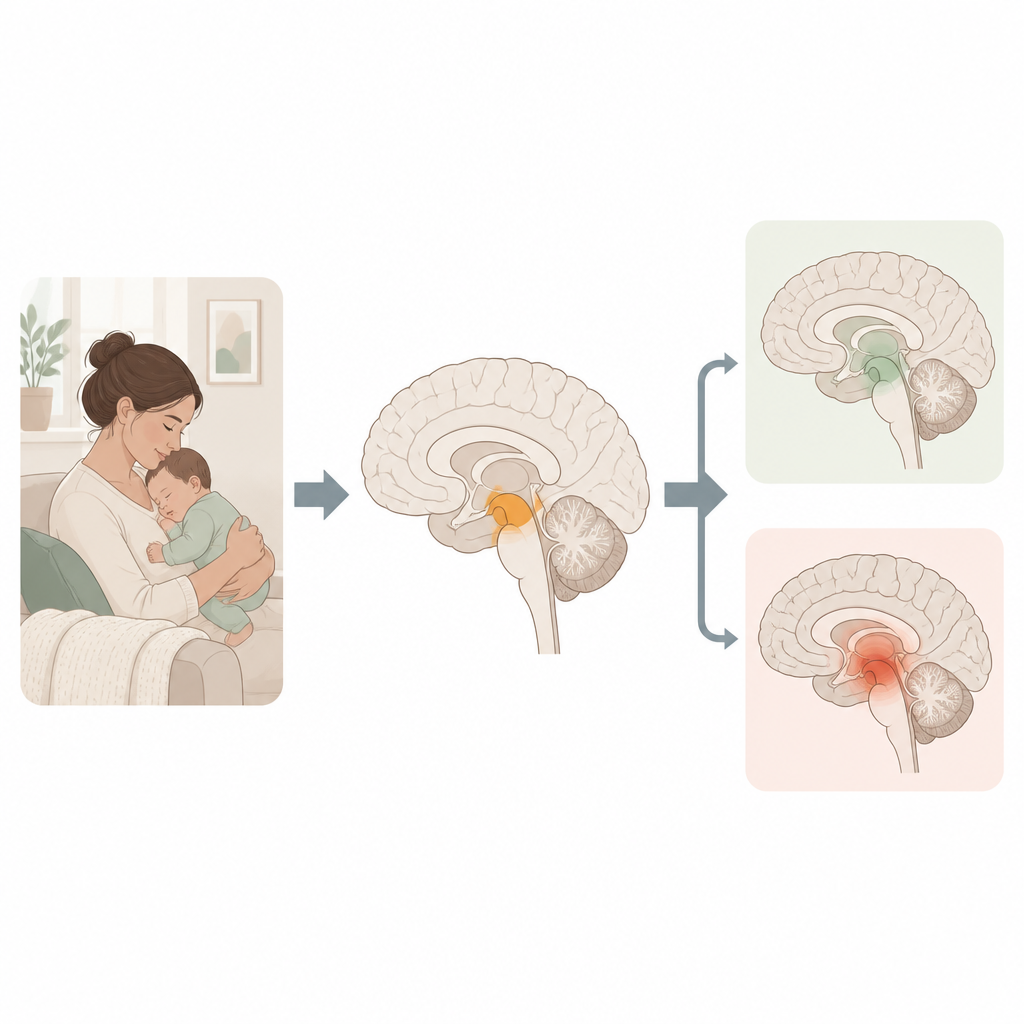
The researchers focused on a deep brain region rich in dopamine, a chemical that helps us assign importance to sights, sounds, and thoughts. They used a special type of MRI scan that picks up neuromelanin, a dark pigment that slowly accumulates in dopamine-producing cells over time. Higher neuromelanin signal is thought to reflect greater dopamine activity or turnover. By comparing 30 women who had experienced postpartum psychosis within the past decade with 24 healthy mothers who had never had psychosis, the team could look for lasting differences in this dopamine system.
Who took part and what was measured
All participants completed detailed interviews and questionnaires about mood, anxiety, and subtle psychotic-like experiences, such as fleeting suspicious thoughts or unusual perceptions. The women with a history of postpartum psychosis were, on average, doing reasonably well in daily life, but still reported more mild psychotic-like experiences, greater emotional reactivity, and somewhat higher anxiety than the comparison group. None were in the midst of a full-blown episode. They then underwent MRI scans that captured both neuromelanin signal in the midbrain and the natural resting communication between brain regions.
Stronger pigment signal and weaker brain links
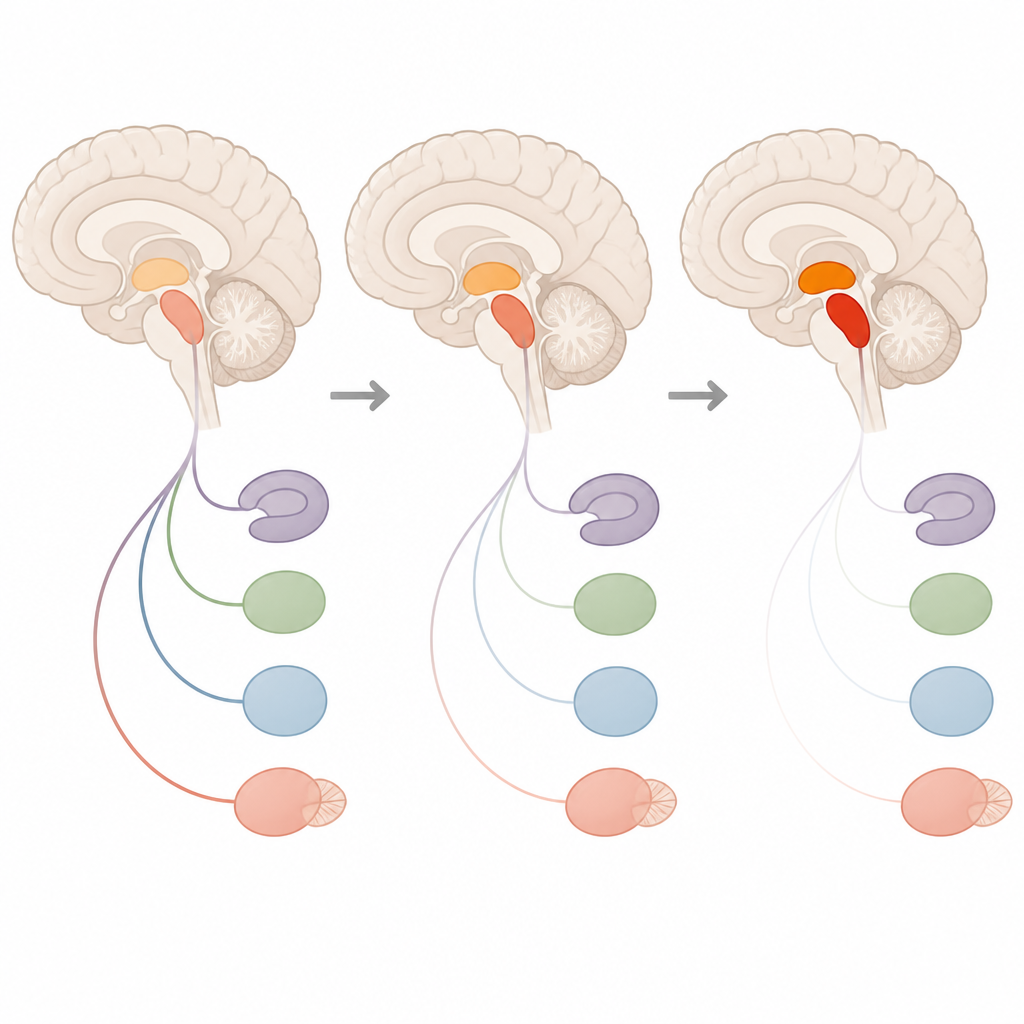
In the women with past postpartum psychosis, the neuromelanin-sensitive scans showed higher signal in several dopamine-rich midbrain areas, including the substantia nigra and the nearby ventral tegmental area. The greater this signal, the more subclinical psychotic symptoms a woman reported over the past year, particularly unusual thoughts, feelings of being watched or persecuted, and odd perceptual experiences. At the same time, the functional “chatter” between the substantia nigra and a wider network of regions involved in motivation, emotion, and alertness was weaker in the postpartum psychosis group than in the healthy mothers. Reduced connectivity with areas such as the thalamus, hippocampus, and parts of the basal ganglia was tied both to higher neuromelanin signal and to more psychotic-like experiences.
What this might mean for hormones and risk
The findings fit with a broader picture in which sudden hormone shifts around childbirth may disturb dopamine circuits in women who are biologically vulnerable. Estrogen is known to support the health and stability of dopamine-producing cells, and sharp drops in estrogen after delivery could temporarily unbalance these cells. The elevated neuromelanin signal years later suggests that dopamine cells in affected women may have gone through periods of unusually high activity, leaving a lasting pigment “footprint.” Even after major symptoms resolve, a quieter, chronic disturbance in this system could show up as mild psychotic-like experiences and altered communication within the brain’s salience and reward networks.
How this could help mothers in the future
This work does not yet offer a test that doctors can use in day-to-day practice, and it cannot prove cause and effect. However, it is the first to show that women with a history of postpartum psychosis have a measurable change in a specific midbrain signal linked to dopamine, and that this change tracks with subtle ongoing symptoms. In the future, neuromelanin-sensitive MRI might become part of a toolkit to identify women who are at higher risk, monitor them after childbirth, and intervene earlier if troubling signs appear. For families, the key message is that postpartum psychosis has biological roots in brain systems that can now be visualized, opening the door to more informed, targeted care.
Citation: McKenna, F., Vinke, L.N., Williams, M. et al. Postpartum psychosis is associated with elevated neuromelanin-MRI signal in the midbrain. Mol Psychiatry 31, 3524–3532 (2026). https://doi.org/10.1038/s41380-026-03476-9
Keywords: postpartum psychosis, dopamine, neuromelanin MRI, midbrain, psychotic symptoms