Clear Sky Science · en
Connectome-based growth models reveal individual heterogeneity and neurophysiological subtypes of subthreshold depression
Why early mood changes matter
Many people experience low mood and loss of interest without meeting the full criteria for major depression. This state, called subthreshold depression, is common and raises the risk of later, more severe illness. Yet these individuals do not all look or feel the same, and doctors have struggled to understand why some are more impaired or respond differently to treatment. This study uses brain scans, big data, and genetics to show that there are hidden brain-based subtypes of subthreshold depression that may help tailor care in the future.
Looking at quiet brain activity
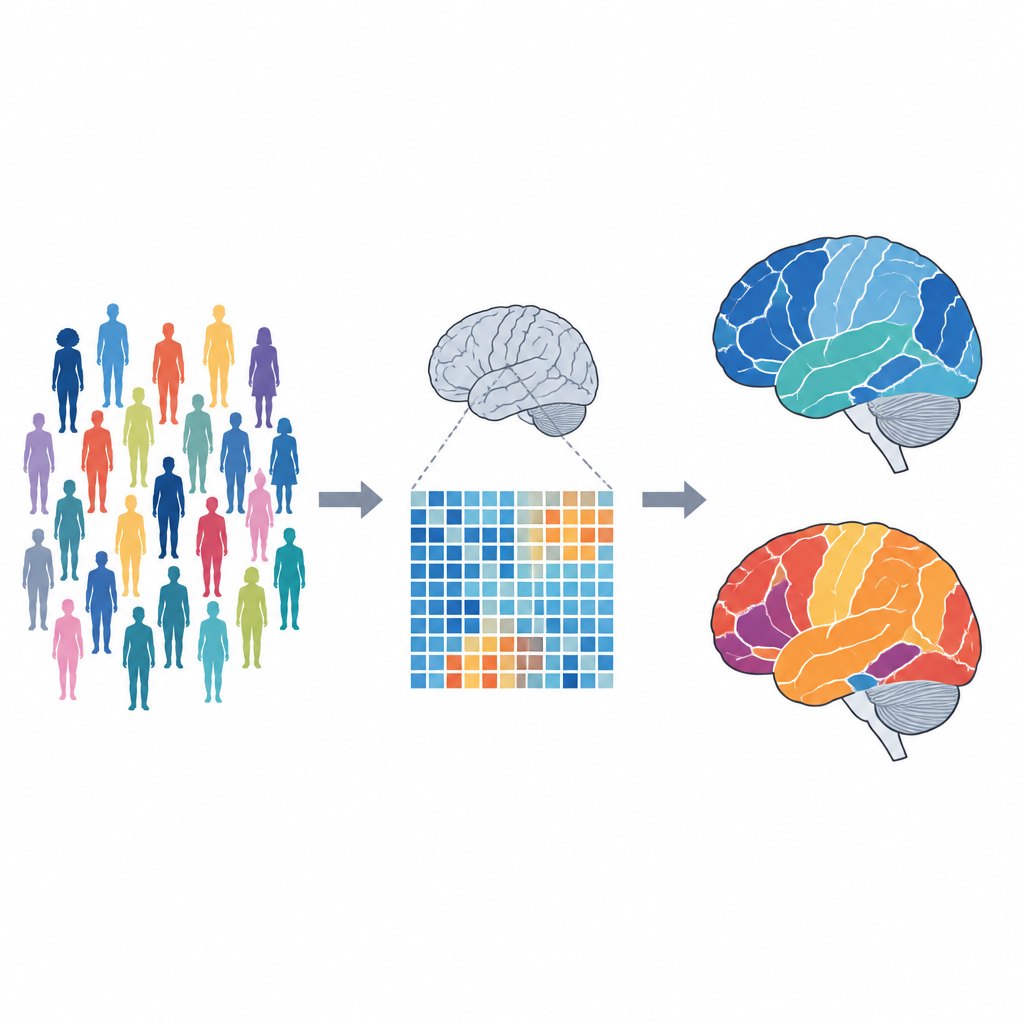
The researchers collected resting brain scans from more than 1,200 healthy volunteers and nearly 200 people with subthreshold depression. During these scans, participants simply lay still, allowing scientists to measure how strongly different brain regions "talk" to one another. From the healthy group, the team built reference charts describing how brain connectivity typically varies with age and sex, much like growth charts for children’s height. They then compared each depressed individual’s brain to this healthy range to see where their connectivity was unusually high or low.
Hidden differences from person to person
This individualized approach revealed that most people with subthreshold depression had strong departures from the healthy pattern in at least one brain region, but the exact locations differed greatly between individuals. Some showed unusually strong connections in areas linked to self-focused thought and emotion, while others showed unusually weak connections in regions that process movement, sights, and sounds. No single brain region was abnormal in more than a small fraction of participants, highlighting how misleading simple group averages can be and underscoring the wide diversity of brain changes that can underlie similar mood symptoms.
Two brain-based mood subtypes
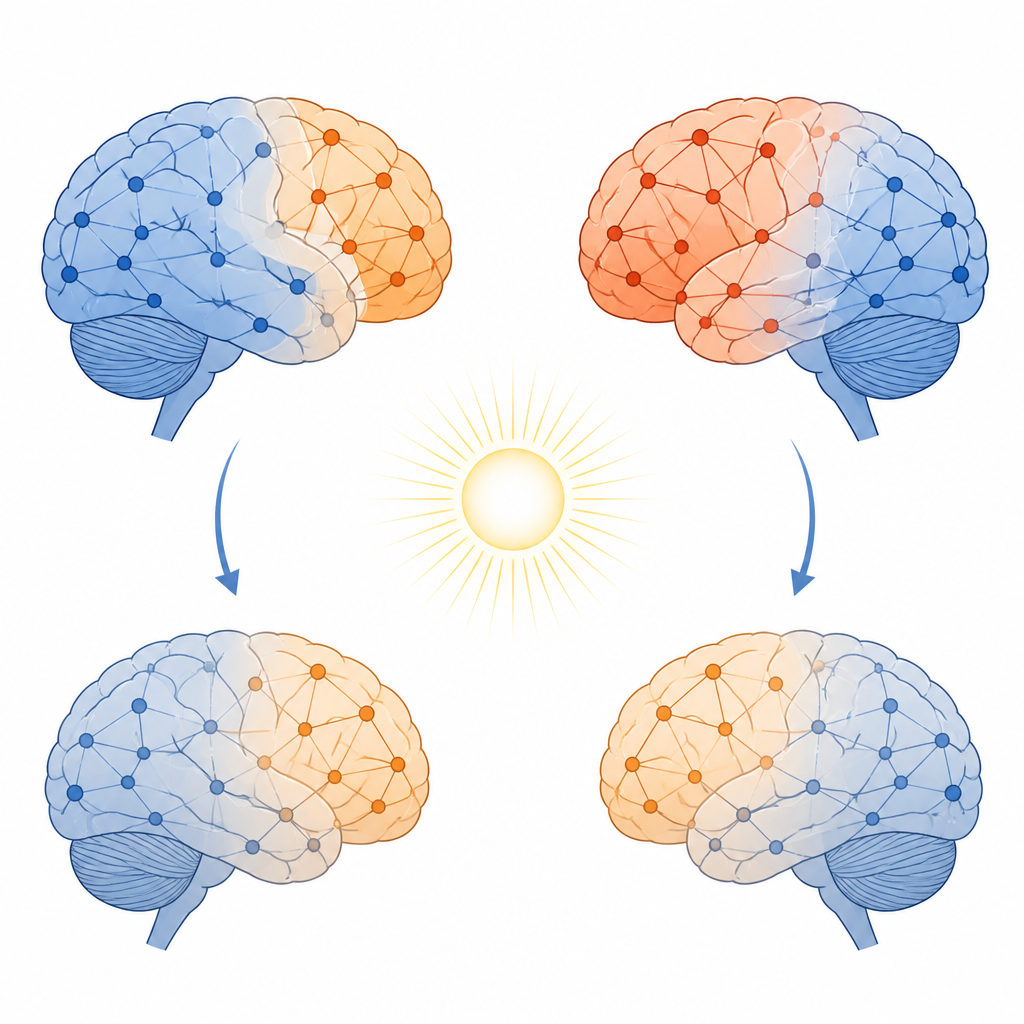
To make sense of this diversity, the team used a clustering method to group people according to their personal pattern of brain deviations. Two clear subtypes emerged. In subtype 1, individuals tended to show stronger than normal connections in the so-called default mode and limbic areas involved in inner thoughts and emotions, but weaker connections in sensorimotor and attention areas. Subtype 2 showed the opposite but milder pattern, with slightly reduced connectivity in the emotional and internal thought regions and relatively stronger sensorimotor and attention networks. People in the first subtype reported more severe symptoms on a key suicide-related item and had slower performance on a test of mental processing speed, suggesting that these brain patterns align with meaningful clinical differences.
Links to genes and response to light therapy
The scientists next asked whether these subtypes reflected different underlying biology. Using a detailed map of gene activity from donated human brains, they checked which genes were more active in regions that were most altered in each subtype. Only subtype 1 showed a strong and specific link to sets of genes involved in brain development, communication between nerve cells, and calcium signaling within neurons. This suggests that people in subtype 1 may carry a greater built-in biological vulnerability. The researchers also studied a group of participants who received eight weeks of bright light therapy, a simple, non-drug treatment for mood. Both subtypes improved overall, and their brain connectivity patterns shifted toward the healthy range, but the exact brain regions involved and the symptom changes that drove improvement differed between subtypes. Moreover, in subtype 1, the pretreatment brain pattern could predict how much a person’s symptoms would improve with light therapy, whereas in subtype 2 it could not.
What this means for people at risk
For a lay reader, the main message is that early, mild depression is not one uniform condition. Instead, there appear to be at least two brain-based forms that differ in how networks for inner thought, emotion, movement, and attention are wired, in how closely they tie to gene activity, and in how they respond to bright light treatment. Recognizing these subtypes could eventually help clinicians identify who is at higher risk for serious problems, such as suicidal thinking, and who is most likely to benefit from specific therapies. While more work and independent testing are needed before this can guide everyday care, the study offers a path toward more personalized approaches for people struggling with early mood changes.
Citation: Chen, G., Sun, X., Chen, P. et al. Connectome-based growth models reveal individual heterogeneity and neurophysiological subtypes of subthreshold depression. Mol Psychiatry 31, 3243–3253 (2026). https://doi.org/10.1038/s41380-026-03457-y
Keywords: subthreshold depression, brain connectivity, resting state fMRI, bright light therapy, depression subtypes