Clear Sky Science · en
Spatiotemporal mapping of brain organisation following the administration of 2C-B and psilocybin
Why this research matters
Psychedelic drugs are being explored as new tools to treat mental health conditions, but not all psychedelics feel or act the same. This study compares two such substances, psilocybin and 2C-B, to see how each one reshapes the brain’s communication patterns in real time. Understanding these differences could help design treatments that are both effective and easier for patients to tolerate.
Two psychedelics under the microscope
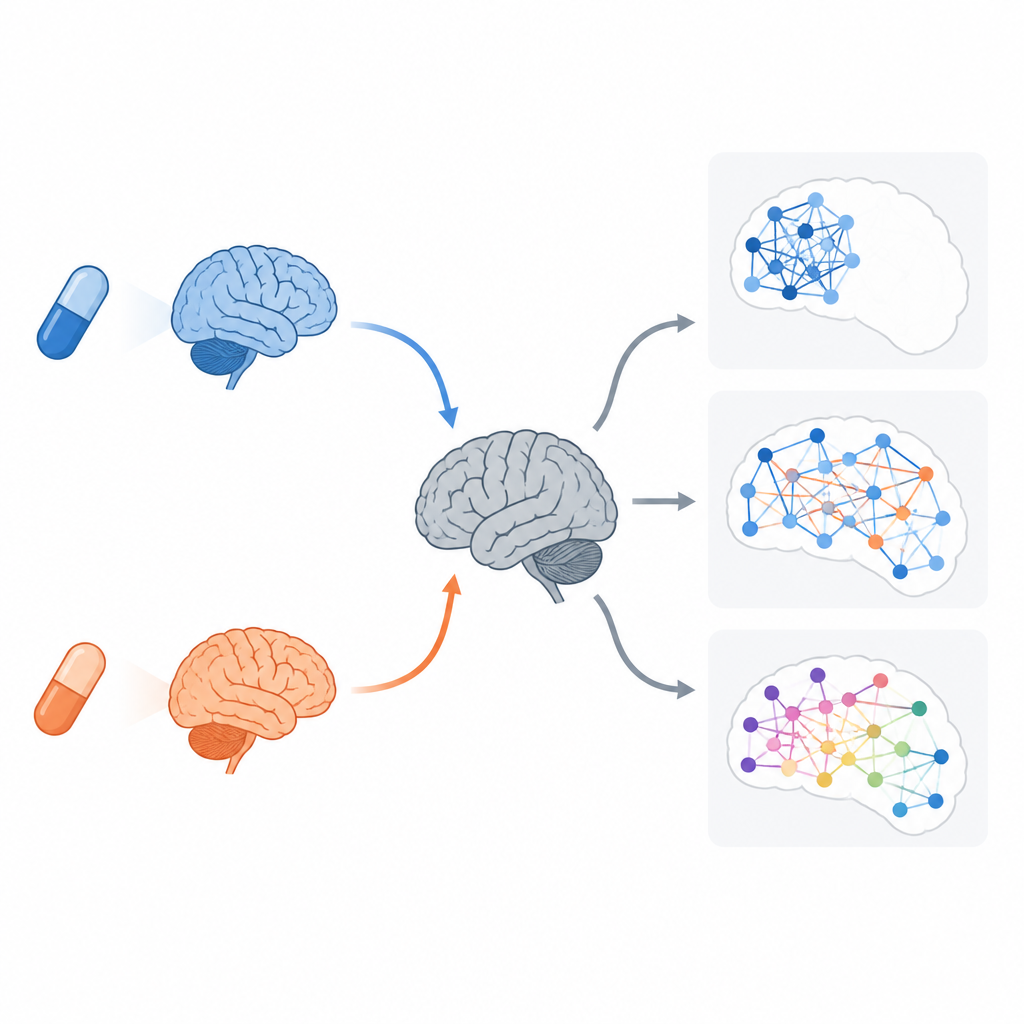
Psilocybin, found in certain mushrooms, has become a leading candidate for psychedelic-assisted therapy. 2C-B is a synthetic compound reported to cause similar perceptual changes but with fewer unpleasant emotional effects. Despite its popularity, almost nothing was known about how 2C-B changes brain activity in people. To fill this gap, the researchers invited 22 healthy volunteers to take part in three scanning sessions. On different days, each person received psilocybin, 2C-B, or a placebo without knowing which was which, and then lay in a powerful 7 Tesla MRI scanner while their resting brain activity was recorded.
How the brain’s networks were measured
The team focused on how different parts of the brain talk to each other over time. They measured how strongly regions were linked on average, how much those links fluctuated moment to moment, and how complex or varied the brain’s signals were. These properties were examined both within well known networks, such as those handling visual processing or self focused thought, and between these networks. Volunteers also answered questionnaires about how intense and unusual their experiences felt, allowing the scientists to relate shifts in brain organisation to changes in consciousness.
Shared and distinct brain effects
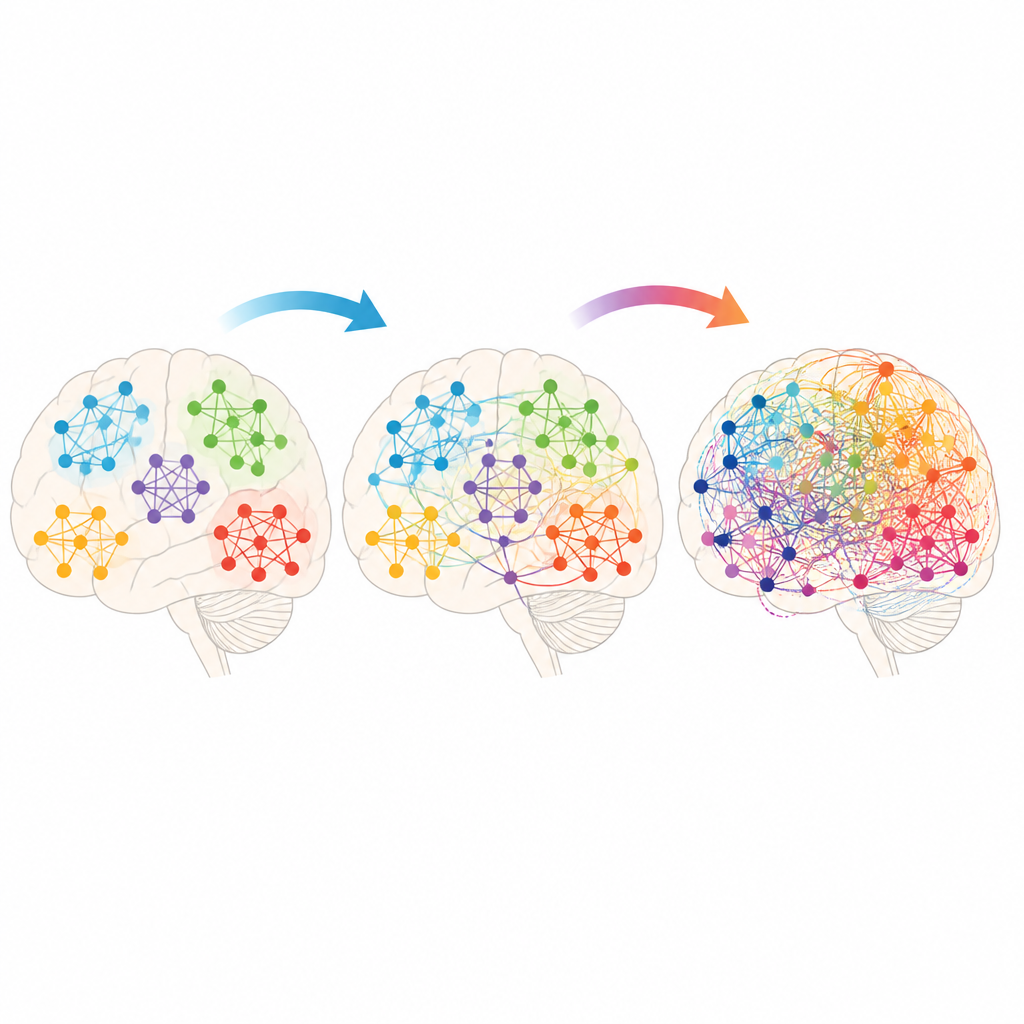
Both psilocybin and 2C-B produced broadly similar overall experiences and altered the brain in related ways. Under both drugs, communication within certain networks, especially those involved in vision and inward reflection, became weaker, while communication between distant networks and between deep and surface structures grew stronger. At the same time, brain signals became more complex, particularly in visual areas and parts of the thalamus, a hub that helps gate sensory information. However, psilocybin caused more widespread changes in how connections fluctuated over time, while 2C-B produced stronger strengthening of links in specific high level regions such as the medial prefrontal cortex.
Linking chemistry, circuits, and experience
To understand why the two drugs differed, the researchers compared their brain maps to existing maps of where various serotonin receptors and monoamine transporters are found. Areas with many 5-HT2A receptors, a key target of classic psychedelics, tended to show the largest drops in connection variability, while regions with fewer 5-HT1A receptors showed greater increases in signal complexity. Differences between psilocybin and 2C-B were strongly related to the brain’s distribution of dopamine transporters, hinting that 2C-B’s additional action on dopamine systems shapes its unique profile. When the team combined all their measures, they found that the more a person’s high level “association” regions such as prefrontal and temporoparietal areas became decoupled from the rest of the brain, and the more basic sensory and motor regions became aligned, the stronger that person’s psychedelic experience tended to be.
What this means for future treatments
In plain terms, both psilocybin and 2C-B appear to temporarily loosen the brain’s usual, rigid patterns of communication, especially in regions involved in selfhood and complex thought, while boosting the influence of sensory and emotional signals. 2C-B does this in a slightly more targeted way and may rely more on dopamine related systems than psilocybin does. These findings suggest that carefully tuning how a psychedelic interacts with different brain chemicals could allow clinicians to balance intensity, emotional side effects, and therapeutic impact. As a result, 2C-B emerges as a promising tool for probing how altered brain network patterns relate to conscious experience and, in time, for crafting more tailored psychedelic therapies.
Citation: Mallaroni, P., Singleton, S.P., Mason, N.L. et al. Spatiotemporal mapping of brain organisation following the administration of 2C-B and psilocybin. Mol Psychiatry 31, 3295–3307 (2026). https://doi.org/10.1038/s41380-026-03447-0
Keywords: psilocybin, 2C-B, brain connectivity, psychedelic neuroscience, functional MRI