Clear Sky Science · en
Leveraging the microscale effect to enhance the overload capacity of a piezoresistive differential pressure sensor
Why tiny pressure sensors matter
From airplanes and rockets to cars and oil wells, many machines rely on pressure sensors to stay safe and work properly. But sudden pressure surges can crack the delicate silicon parts inside these sensors, knocking them out just when they are needed most. This study shows how carefully reshaping and thinning the heart of a pressure sensor can make it far tougher without giving up its usefulness.
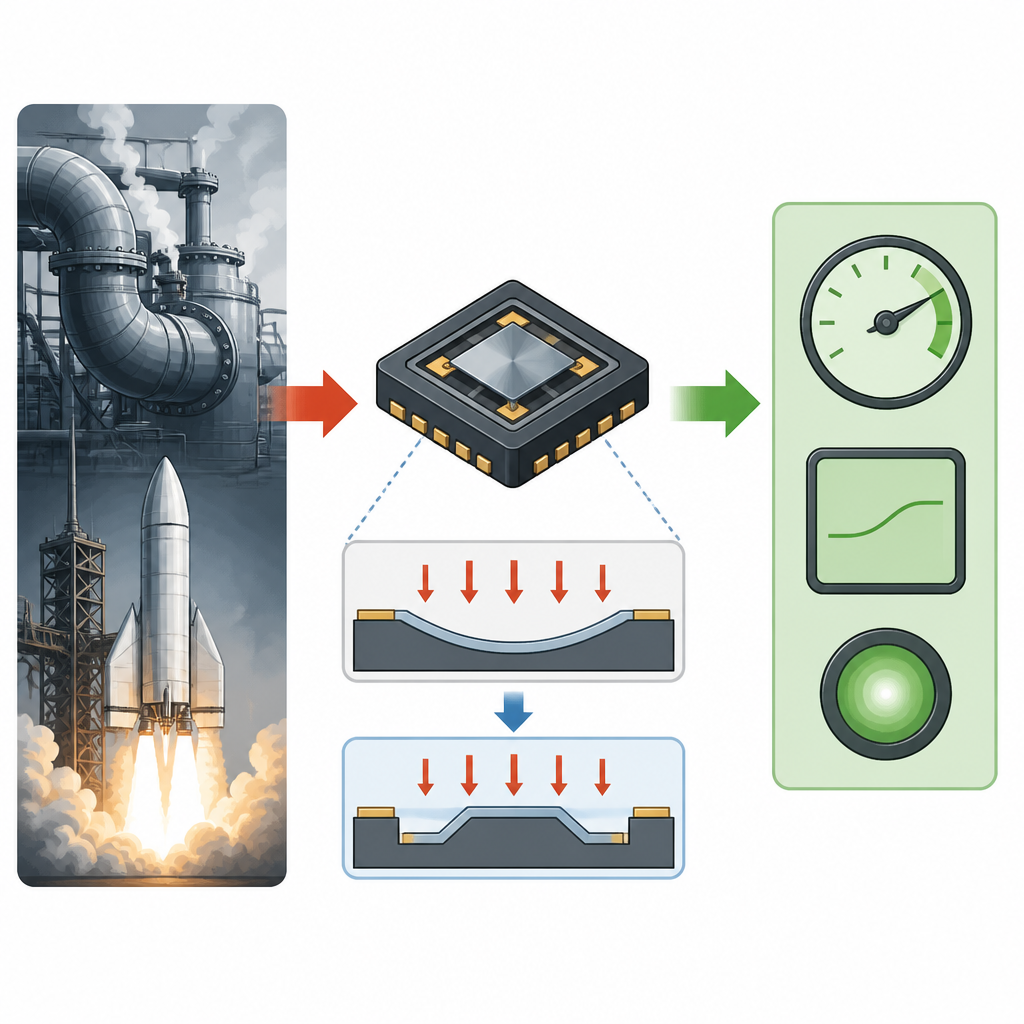
A closer look at the small scale
The core of many modern pressure sensors is a thin sheet of single-crystal silicon that bends slightly when pressure changes. At very small sizes, materials can behave differently from what we see in everyday objects. The authors explored how the strength of this silicon sheet changes as its thickness shrinks from hundreds of micrometers down to just a few dozen. By pressurizing tiny membranes until they burst, then using computer models to map the stresses inside them, they found that thinner membranes can actually withstand higher stresses before breaking.
How strength grows as size shrinks
The experiments showed that as silicon membranes became thinner, the stress needed to break them first rose and then leveled off. The team explains this with the idea of microscopic cracks on the surface. Thicker pieces contain a larger highly stressed area, so there is a higher chance that one of these tiny flaws will trigger failure. Thinner pieces have a smaller stressed area and fewer dangerous flaws, so they can sustain greater stress. Computer simulations confirmed that thicker membranes develop wider zones of concentrated stress, raising the odds that a crack will spread and the membrane will snap.
Designing a tougher sensor membrane
Armed with this understanding, the researchers designed a new type of sensing membrane called a CBIF structure, which adds a cross-shaped beam and a central island with rounded corners on an ultra-thin silicon sheet. The cross and island help focus useful stress where the electrical resistors sit, keeping the sensor responsive, while the rounded features smooth out sharp stress peaks that can start cracks. The ultra-thin membrane taps into the size-related strength gain. Using computer optimization, they tuned the key dimensions of the membrane so that stress stays below the breaking limit even when the sensor experiences pressure far beyond its normal range.
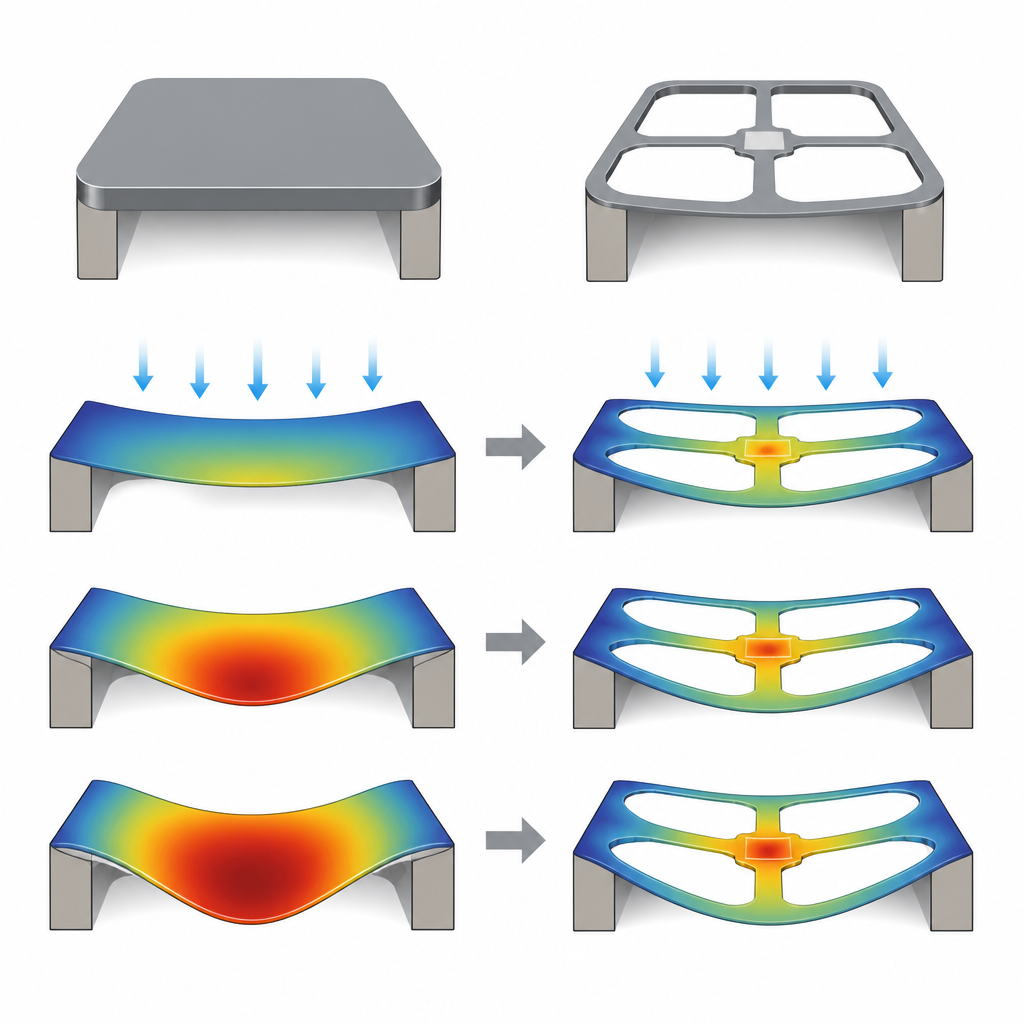
From simulation to working chips
The team then built real pressure sensor chips using standard silicon processing steps such as oxidation, wet etching, and bonding to glass. They compared three designs: a traditional flat "C-type" membrane, a thick CBIF membrane, and the optimized ultra-thin CBIF version. All were made to measure pressures from 0 to 100 kilopascals. Electrical tests showed that the new CBIF sensor kept a practical sensitivity similar to common devices. When pushed to their limits, the traditional membrane failed at a little over six times its normal maximum pressure, the thick CBIF version survived about eight times, while the ultra-thin CBIF design with microscale strengthening held out to roughly ten and a half times.
What this means for real-world devices
In simple terms, the study shows that making the sensing membrane thinner and smarter in shape can greatly improve how much abuse a pressure sensor can take. By using the natural strength boost that appears when silicon is made very thin, and combining it with a stress-friendly layout, the researchers created a sensor that is much harder to break under sudden overloads while still giving clear readings. This approach could help future sensors in aircraft, cars, and energy systems last longer and fail less often when exposed to harsh pressure spikes.
Citation: Li, M., Qiu, H., Yang, X. et al. Leveraging the microscale effect to enhance the overload capacity of a piezoresistive differential pressure sensor. Microsyst Nanoeng 12, 188 (2026). https://doi.org/10.1038/s41378-026-01332-y
Keywords: MEMS pressure sensor, silicon diaphragm, microscale effect, sensor overload, piezoresistive sensing