Clear Sky Science · en
A curved-beam piezoelectric MEMS resonator featuring multiple temperature plateaus with enhanced stability
Why tiny vibrating chips matter
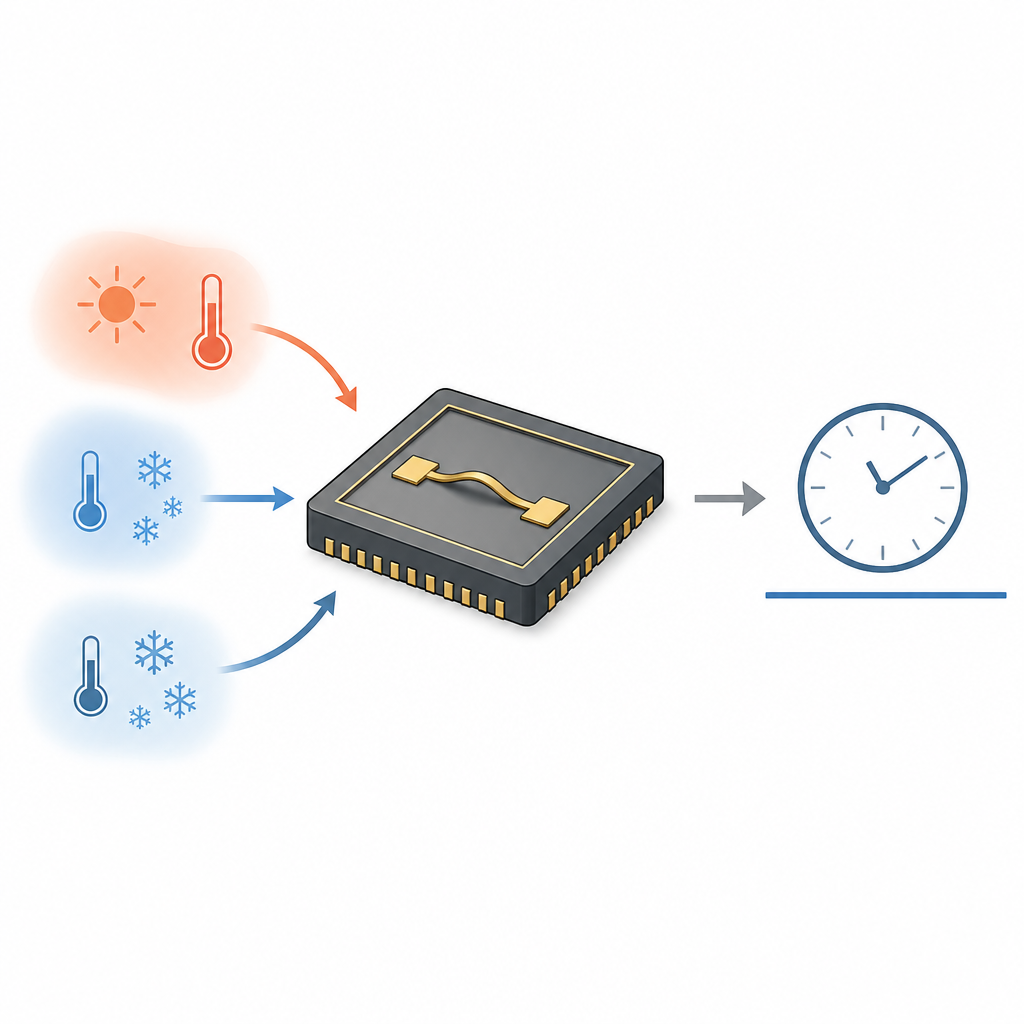
Inside phones, satellites, and cars, tiny vibrating parts act like tuning forks that keep digital clocks and radios in sync. This paper explores a new type of microchip resonator that keeps ticking at nearly the same pace even when the temperature changes, a long standing problem for shrinking timing hardware.
From quartz crystals to tiny silicon beams
Today, most accurate clocks rely on quartz crystals, which vibrate very steadily but are relatively bulky and hard to build directly into standard computer chips. Silicon based micro resonators are much smaller and easier to manufacture in large numbers, yet they suffer from one big weakness: their vibration frequency drifts as temperature rises or falls. As silicon warms, it softens slightly, so the resonant note of these devices usually slides downward with temperature, upsetting precise timing.
A curved beam with many voices
The researchers designed a microscopic beam made of silicon with a thin film of aluminum nitride on top, a material that converts electrical signals to mechanical motion and back. Unlike straight, highly symmetrical beams, this one follows a carefully shaped curved path called a Bézier curve. That gentle, built in bend breaks the usual symmetry and encourages many different patterns of vibration to exist in a tight range of frequencies. Using a standard chip making process, the team fabricated devices that show 17 distinct vibration modes below 5 megahertz, spanning in plane flexing, out of plane motion, and bulk like modes, all detectable in ordinary air without a vacuum package.
How temperature plateaus appear
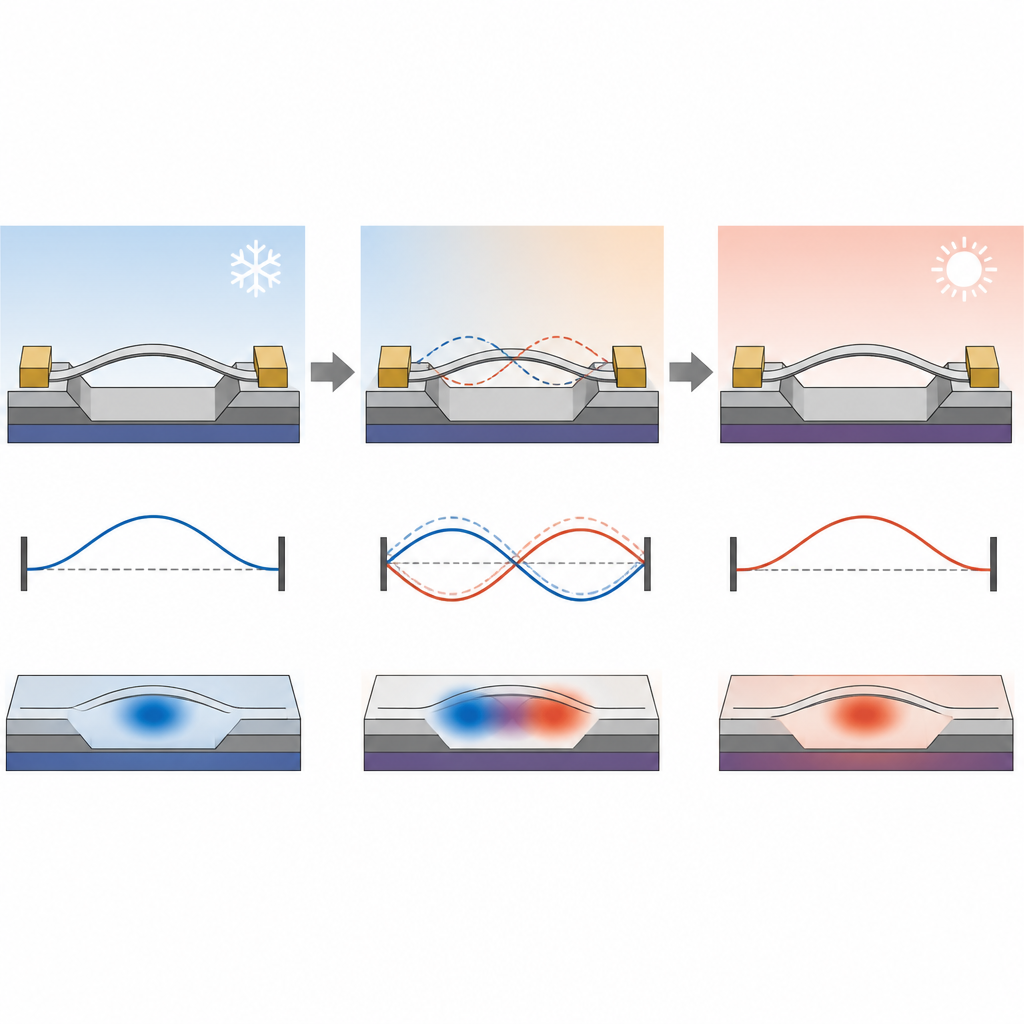
When the team slowly swept the temperature from freezing to well above room temperature, most vibration modes behaved as expected, drifting downward as the chip warmed. However, two high frequency modes, labeled Mode 16 and Mode 18, showed surprising flat regions where their frequency barely changed over a few degrees of temperature. Detailed frequency scans revealed that near these plateaus a second, nearby resonance peak appears, grows, and then replaces the original one, a sign that energy is being shared between two coupled vibration patterns. This interaction produces a kind of self balancing effect in which the usual thermal softening of silicon is offset by nonlinear stiffening created by the curved geometry and internal stresses in the beam.
Measuring stability in real temperature swings
To test whether these plateaus truly improve timing, the authors used phase locked loops and temperature chambers to mimic realistic thermal changes. At a plateau around 62 degrees Celsius in Mode 16, the resonator’s frequency stayed within about 17.4 parts per billion during gentle ±1 degree swings, and improved to about 2.0 parts per billion when the temperature was tightly held. Mode 18 displayed several plateau regions at different temperatures, with its best performance reaching 37.9 parts per billion. Importantly, noise measurements showed that the random background fluctuations of the device remained similar inside and outside the plateau, confirming that the improved stability comes from deterministic physics rather than lucky noise reduction.
What this means for future timing chips
For non specialists, the central message is that the authors found a way to let the resonator’s own mechanics cancel much of its temperature drift, without needing extra heater ovens, complex electronics, or exotic materials. By shaping a tiny beam so that different vibration patterns interact in just the right way, the device naturally settles into narrow temperature zones where its tick rate hardly changes. With further tuning of the beam’s curve and stresses, such self compensating resonators could become compact, low power timing references for everyday electronics, from internet connected sensors to communication systems.
Citation: Lian, Y., Li, Y., Chen, F. et al. A curved-beam piezoelectric MEMS resonator featuring multiple temperature plateaus with enhanced stability. Microsyst Nanoeng 12, 199 (2026). https://doi.org/10.1038/s41378-026-01323-z
Keywords: MEMS resonator, frequency stability, temperature plateaus, piezoelectric microdevices, timing reference