Clear Sky Science · en
Manufacturing of 8 million Q-factor micro hemispherical resonator gyroscopes via patterned coating technology
Smarter coatings for steadier motion sensors
From smartphones to spacecraft, modern navigation depends on tiny motion sensors that must vibrate cleanly and predictably. This paper shows how a new way of placing metal coatings on a bowl-shaped glass sensor can dramatically cut hidden energy losses, pushing these devices closer to the accuracy once reserved for bulky, expensive instruments.

Why a glass bowl can tell direction
The study focuses on a micro hemispherical resonator gyroscope, a thimble-sized glass shell that vibrates like a ringing wineglass. As the shell vibrates and the device rotates, the vibration pattern shifts in a way that reveals rotation rate and direction. The sharpness of this vibration, captured by a quantity called the quality factor, determines how cleanly the sensor can pick out motion from noise. Higher quality factors mean less energy lost and more precise readings, which are vital for demanding tasks such as spacecraft guidance and high-end inertial navigation.
The metal coating problem
Although the glass shell itself can naturally vibrate with very little loss, it is an insulator and must be coated with metal so that electronics can drive and read out its motion. The traditional approach covers the entire inner surface with a continuous metal film. This makes wiring easy but introduces serious drawbacks. The metal layer acts like a microscopic brake, converting vibration energy into heat and cutting the quality factor by half in some devices. Earlier attempts to reduce this loss by changing film thickness, improving heat treatment, or tweaking materials helped, but still left a large gap between these micro devices and their bigger, more accurate cousins.
How patterns tame hidden friction
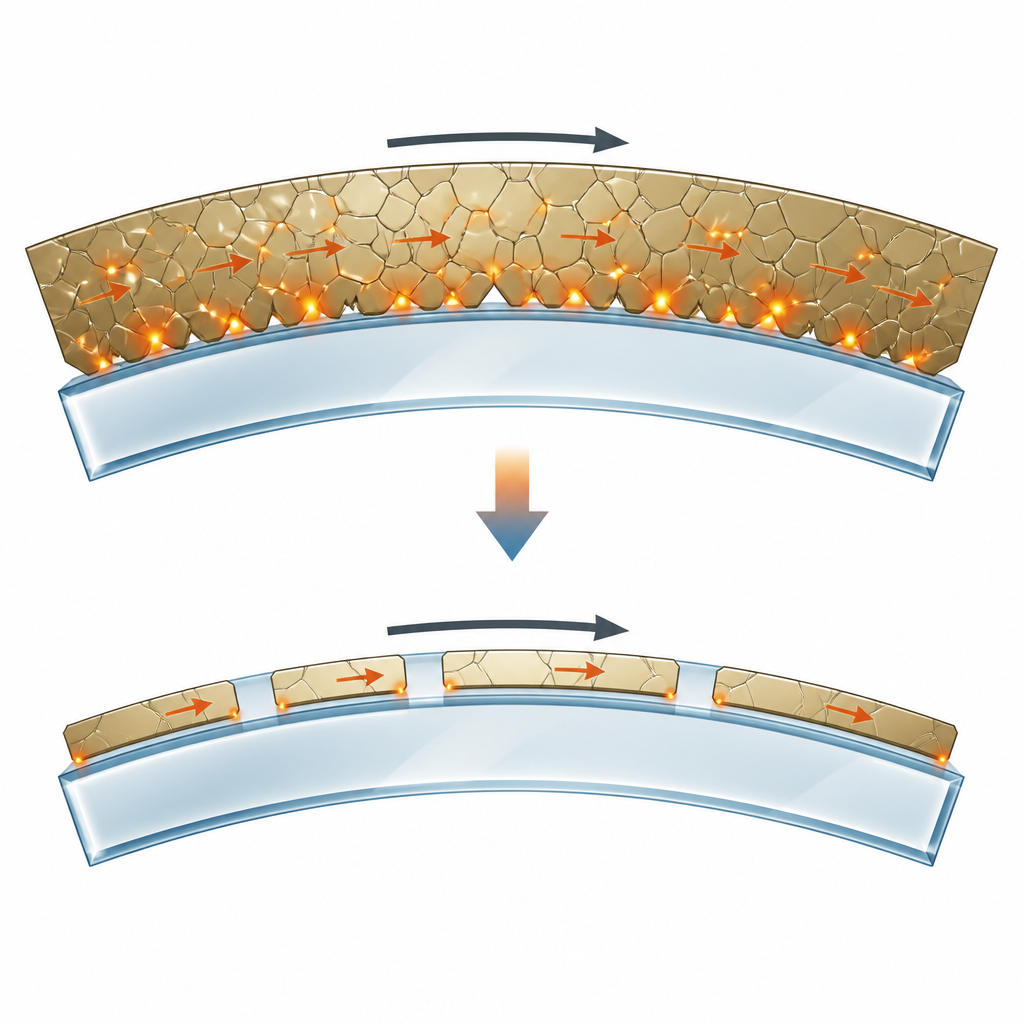
The authors propose a different idea: instead of coating the whole shell, they use a patterned metal layout that only connects what truly needs to be connected, from the central anchor point to the toothed rim that senses motion. Using 3D printed masks and magnetron sputtering, they lay down very thin titanium and platinum films as a handful of curved tracks rather than a blanket layer. The team then analyzes why this works at the microscopic level. Inside the metal, grains and their boundaries rub against each other whenever the shell flexes, and the mismatch in stiffness between metal and glass creates sliding at their interface. Both effects produce friction and heat. Because these losses scale with the coated area, shrinking the metal coverage directly shrinks the regions where this invisible rubbing occurs.
Keeping balance while cutting loss
Simply removing metal is not enough, because an uneven layout around the shell can disturb its natural symmetry. This disturbance shows up as unwanted harmonics in the vibration pattern and as tiny splits in the resonant frequency that hurt gyroscope stability. The researchers use a mathematical tool called harmonic analysis, similar to breaking a musical tone into pure notes, to design patterns whose first few symmetry errors are very small. A five-track pattern with carefully chosen spacing and width keeps these errors under about two percent while still greatly reducing metal area. They also account for practical issues, such as edge effects in sputtering, and settle on a track width that preserves pattern shape and film uniformity during manufacturing.
Measured gains in real devices
With the optimized pattern in place, the team builds and tests complete gyroscopes. Before coating, a device can reach a quality factor around 9.3 million. After adding the patterned film, it still keeps about 86 percent of this value, remaining above 8 million. In contrast, a fully coated twin device drops from 8.5 million to about 4.2 million, losing over half of its original sharpness. The patterned devices also show more even performance around the shell, with quality factor variations under one percent and frequency differences between key vibration modes kept below one thousandth of a hertz after fine laser tuning. These results confirm that reducing coated area while preserving symmetry is an effective route to high performance.
What this means for future sensors
For readers, the takeaway is that how and where we place metal wiring on tiny vibrating structures can matter as much as the material itself. By turning a uniform metal skin into a set of well designed tracks, the researchers preserve the gentle, long lasting ring of the glass shell while still enabling electronic control. This approach can be adapted to other precision resonators, helping bring chip sized navigation and sensing devices closer to the stability of room sized instruments without changing their fundamental operating principles.
Citation: Zhu, F., Wu, X., Shi, Y. et al. Manufacturing of 8 million Q-factor micro hemispherical resonator gyroscopes via patterned coating technology. Microsyst Nanoeng 12, 198 (2026). https://doi.org/10.1038/s41378-026-01321-1
Keywords: micro gyroscope, quality factor, thin film damping, patterned coating, inertial navigation