Clear Sky Science · en
Compact adaptive spectral imager enabled by MEMS Fabry-Perot filtering chip in longwave infrared
Sharper Eyes for Heat
Many things in our world glow in invisible heat light, from car engines to factory smokestacks. This paper introduces a new kind of camera that can see that heat in fine color-like detail, yet is small and light enough to ride on a drone. Such a tool could help spot pollution, search for hidden objects, and study rocks or chemicals from a distance.
Why Heat Colors Matter
Ordinary thermal cameras turn invisible heat into images that show hot and cold regions, but they usually lump many heat colors together. Longwave infrared spectral imaging goes further by separating heat into many narrow bands, a bit like splitting white light into a rainbow. Different gases, liquids, and solids have their own unique patterns across these bands, so recording them lets scientists tell materials apart, measure pollution, and recognize targets even at night or in fog. Existing instruments that do this well are large, heavy, and rely on moving parts that scan slowly, which limits where and how they can be used.
A Tiny Chip at the Heart of the Camera
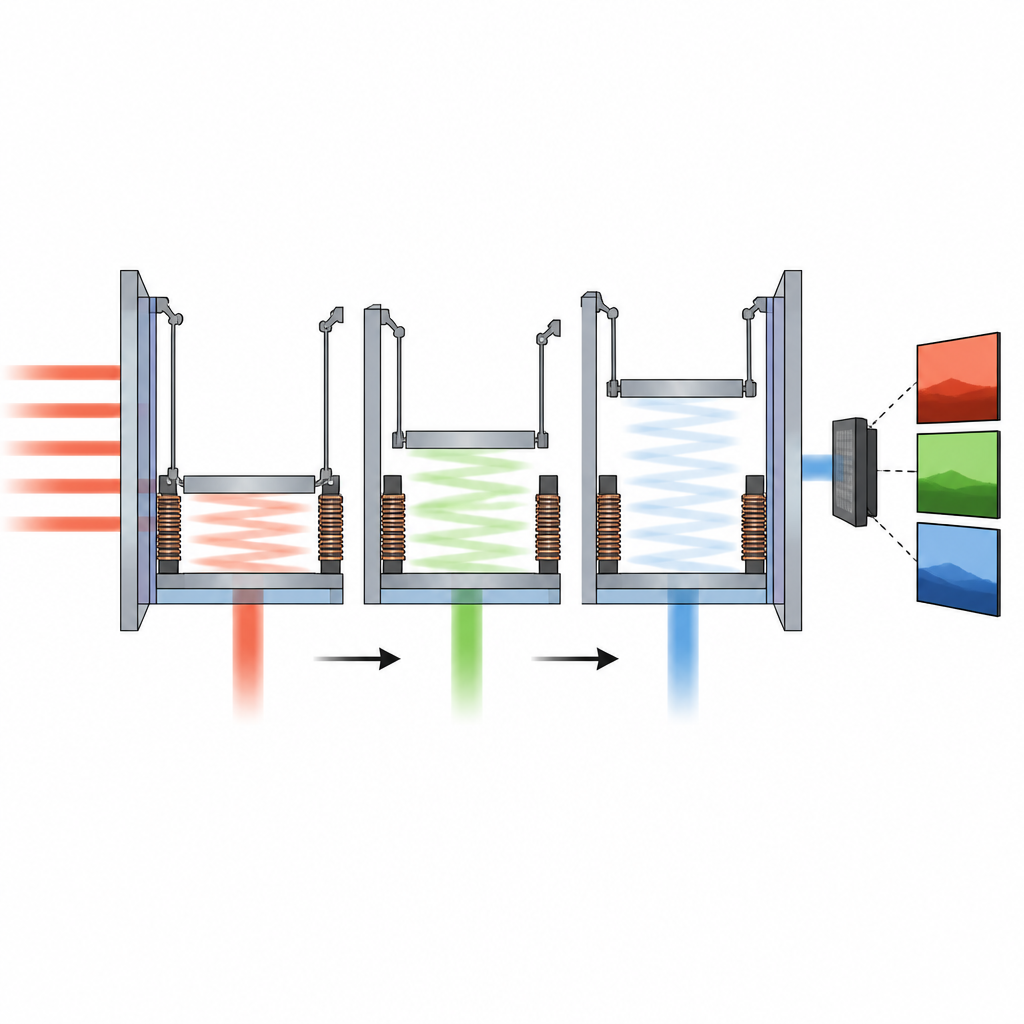
The researchers tackled this problem by building the core of the camera around a special chip called a MEMS Fabry–Perot filter. Inside this chip, two tiny mirrors face each other, forming a narrow cavity for light. By using electromagnetic forces to move one mirror by minute amounts, the chip lets through only a chosen slice of the infrared spectrum at any moment. The team previously showed that their chip works across the 8 to 12 micrometer range where many important heat fingerprints lie, and that its response changes in a smooth and predictable way with electric current. In this work they package the chip into a sturdy module and show it can sweep through wavelengths in different patterns, from coarse steps to fine scans, or jump to any preset set of bands.
Building a Compact Heat Color Camera
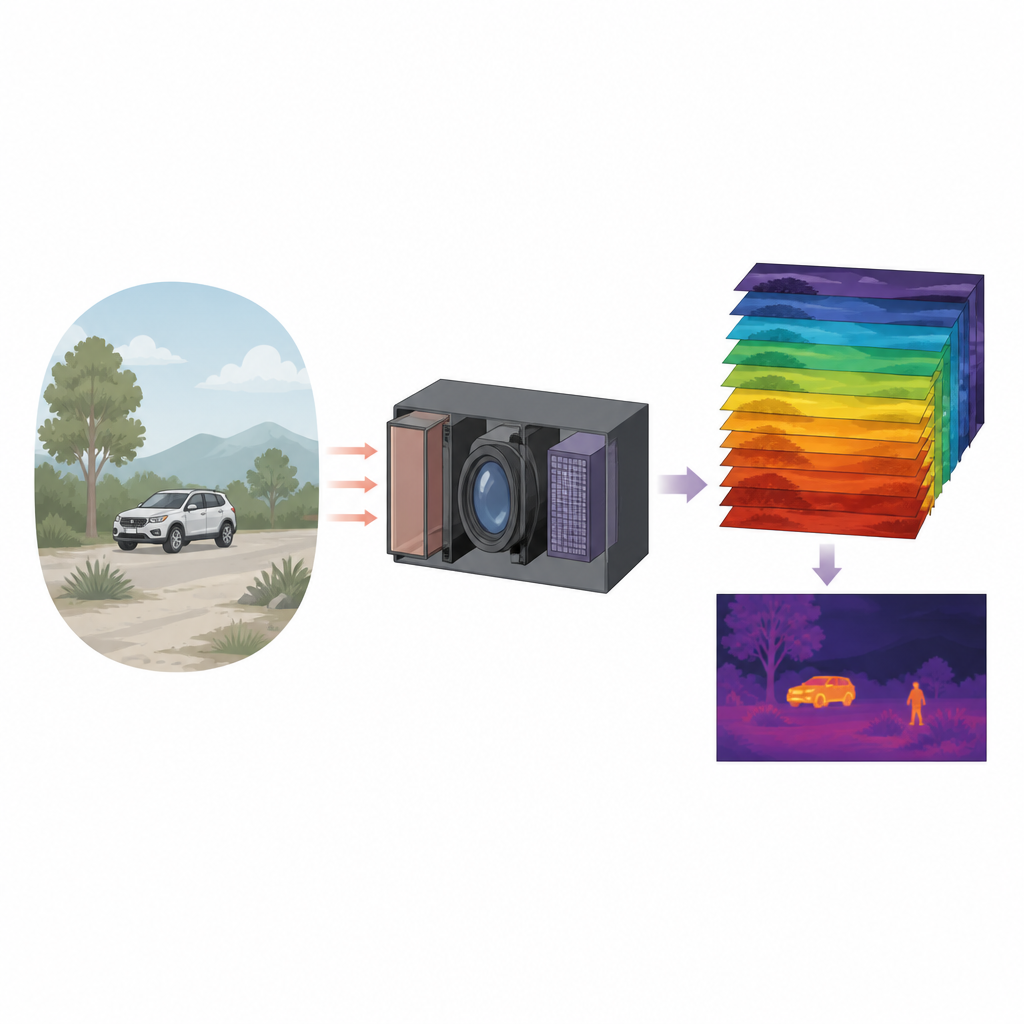
Using this tunable filter, the authors designed a full imaging system they call the compact adaptive spectral imager, or CASI. They place the chip in front of the lens, so incoming light first passes through the filter before reaching a small uncooled infrared detector. This layout keeps the light entering the filter nearly straight on, which reduces unwanted shifts in the selected wavelength and makes the module easy to swap in or out. The finished unit is about the size and weight of a small brick, significantly smaller than commercial systems that offer similar coverage. A lightweight control computer coordinates the filter and camera timing, deciding which heat colors to record and when, and builds a three dimensional block of data in which each slice is an image at a different heat band.
Letting the Camera Adapt to the Job
A key strength of CASI is that it does not always need to collect a full dense stack of heat colors. When a new scene is studied, the system can first run a slow, fine scan to capture detailed information. From this rich data, software can pick out which bands best separate targets from their surroundings. Later, the controller can command the chip to use only those chosen channels, reducing the number of images and speeding up capture. The authors demonstrate this idea using vehicles in an outdoor field. With full scans they measure how the heat colors of cars differ from sky and vegetation. Then, using a mathematical selection method, they choose a handful of useful bands and program CASI to record only those, creating a slimmer data block that still keeps the needed contrast.
Finding Hidden Targets More Efficiently
The team then links this adaptive approach with a standard target detection method. In a scene with real and decoy vehicles, a normal color photograph makes it hard to tell which are genuine. Using only the selected infrared bands, CASI builds a compact spectral data set of the same view. A detection algorithm then looks for pixels whose heat color pattern stands out from the surroundings and flags them as likely targets. The results show that the system can correctly pick out the real vehicles with high accuracy, while working from fewer bands than a full hyperspectral scan. This demonstrates that smart choice of bands, combined with flexible hardware, can cut data volume and time without giving up detection performance.
What This Means Going Forward
In simple terms, the study shows how to shrink a bulky lab style heat color camera into a compact box that can change how it looks at the world on the fly. By tuning a tiny moving mirror chip and coordinating it with a small detector, the CASI system can switch between detailed study and quick searches, and can focus only on the most telling heat colors for a given task. Although its sensitivity still trails that of larger cooled instruments, the authors see clear paths for improvement. With further refinement of both the optics and the onboard software, such adaptive infrared imagers could become common tools for monitoring pollution, surveying minerals, and carrying out security and search missions from drones and other small platforms.
Citation: Zhou, K., Wang, X., Tong, G. et al. Compact adaptive spectral imager enabled by MEMS Fabry-Perot filtering chip in longwave infrared. Microsyst Nanoeng 12, 207 (2026). https://doi.org/10.1038/s41378-026-01300-6
Keywords: infrared imaging, spectral imaging, MEMS filter, remote sensing, target detection