Clear Sky Science · en
A silicon microneedle array atmospheric pressure plasma ionization source for real-time trace gas chemical analysis
Why tiny needles in the air could matter to you
Imagine a device the size of a postage stamp that can sniff the air in real time and spot faint chemical traces linked to health, pollution, or even dangerous gases. This paper describes just such a tool, a silicon chip called ZAPPI that uses microscopic hollow needles and a small electrical glow to turn invisible gas molecules into signals scientists can read. It aims to bring lab-grade gas analysis out of bulky machines and into portable devices that could someday ride in a pocket, on a drone, or inside medical equipment.
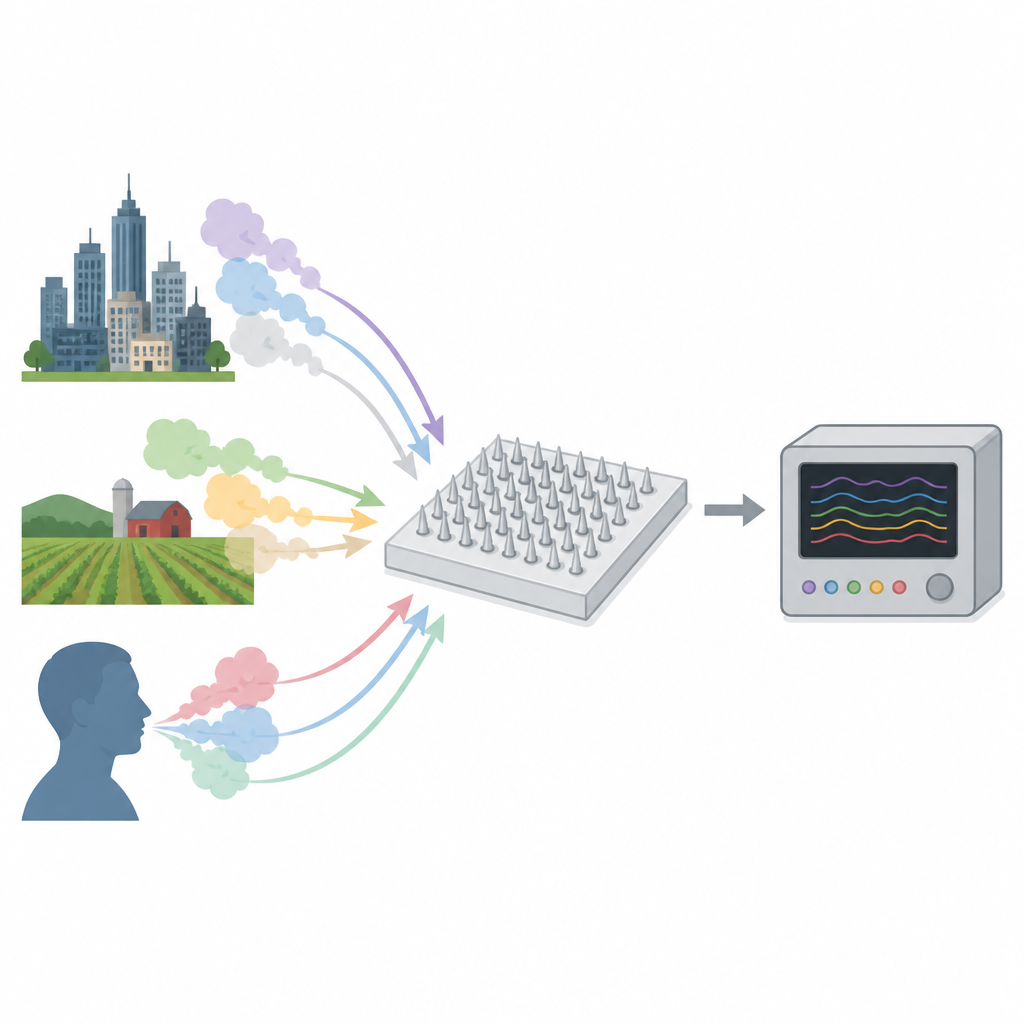
The challenge of smelling the air
Many fields now rely on sensing tiny amounts of chemicals in the air. Doctors study exhaled breath to look for early signs of disease. Farmers want fast feedback on plant health. Communities need to track smoke and pollution. Today, the most powerful method for this kind of trace gas analysis is mass spectrometry, which weighs molecules with exquisite precision but requires large, expensive instruments typically confined to laboratories. Smaller commercial sensors exist, such as metal oxide chips in air purifiers, but they often struggle to tell similar chemicals apart and to detect extremely low concentrations, limiting their usefulness in demanding real-world settings.
A new kind of micro air sensor
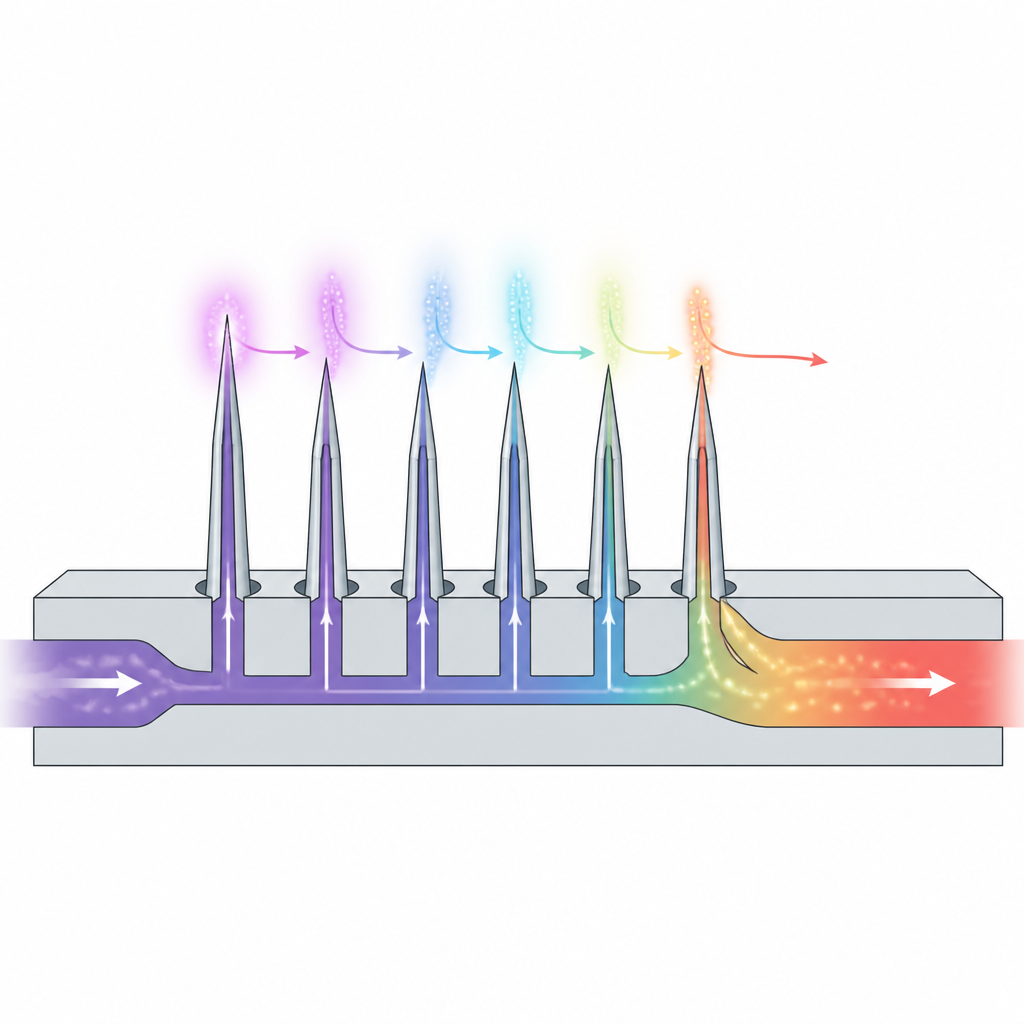
The authors built a new type of ionization source, the front end of a chemical detector that converts neutral gas molecules into charged ones that can be measured. Their device, ZAPPI, is a tiny array of hollow microneedles etched into a silicon wafer using the same style of microfabrication used for computer chips. Gas carrying target chemicals flows up through these needles, while another stream of carrier gas sweeps across the top. A voltage applied between the sharp needle tips and a flat metal plate beneath creates a faint, stable electrical glow in air, known as a corona, which charges passing molecules without needing radioactive materials or bulky ultraviolet lamps.
Guiding gas with sculpted needles
To make the most of this glow, the team carefully shaped the needles and the flow channels around them. Each needle has a central support surrounded by three helical fins, forming semi-enclosed paths for the analyte gas. Computer simulations showed how the carrier gas races between the needle tips and the ceiling of the channel, creating a low-pressure zone that pulls the injected chemicals directly into the most intense part of the plasma. Experiments with visible smoke confirmed that wisps emerging from the needle tips were swiftly swept along the channel, while the regions near the needle bases remained relatively clear. This design ensures that precious trace molecules spend their time where ionization is strongest, improving sensitivity.
Testing the glow and the chemistry
The researchers next examined how the device behaves electrically. By slowly increasing the voltage, they mapped out three regimes: a quiet state with almost no current, a middle region where current rises rapidly as the corona turns on, and a breakdown region where a full spark forms. Their measurements matched expectations for a controlled corona discharge in a narrow gap, and the onset voltage stayed nearly the same across different gas flow rates. Finally, they connected ZAPPI to two kinds of detectors: a high-end laboratory mass spectrometer and a compact ion current sensor. In both cases, the chip successfully ionized several test chemicals, including a nerve agent simulant, a breath biomarker, a flavoring compound, and a toxic pollutant, at very low flow rates and power levels.
What this means for future sniffers
The work shows that a silicon chip using an array of hollow microneedles and a gentle electrical glow can reliably turn trace gases into measurable signals at atmospheric pressure while using very little power. To a layperson, this means that the key building block of a smart, portable electronic nose has been demonstrated in a form that is compatible with mass-production techniques from the semiconductor industry. With further development and pairing to miniature separation and detection stages, ZAPPI could help enable handheld devices that watch over air quality, monitor personal exposure to harmful fumes, or assist doctors by reading the chemistry of a patient’s breath in real time.
Citation: Chew, B.S., Koch, D.T., Gibson, P. et al. A silicon microneedle array atmospheric pressure plasma ionization source for real-time trace gas chemical analysis. Microsyst Nanoeng 12, 197 (2026). https://doi.org/10.1038/s41378-026-01291-4
Keywords: trace gas sensing, microneedle plasma, ionization source, portable detectors, breath analysis