Clear Sky Science · en
A bell-bloom atomic magnetic-videorecorder with global shutter and differential readout
Watching Invisible Magnet Movies
Magnetic fields are all around us, from the beating of our hearts to the flow of current in tiny wires on a computer chip—but they are invisible and often extremely weak. This paper introduces a new kind of “magnetic video recorder” that can film these faint magnetic patterns in real time, with high detail, without touching the object and without bulky cryogenic equipment. Such a tool could help diagnose batteries, guide medical devices, or reveal how microscopic magnetic particles move and interact.
Turning Atoms into Tiny Magnetic Reporters
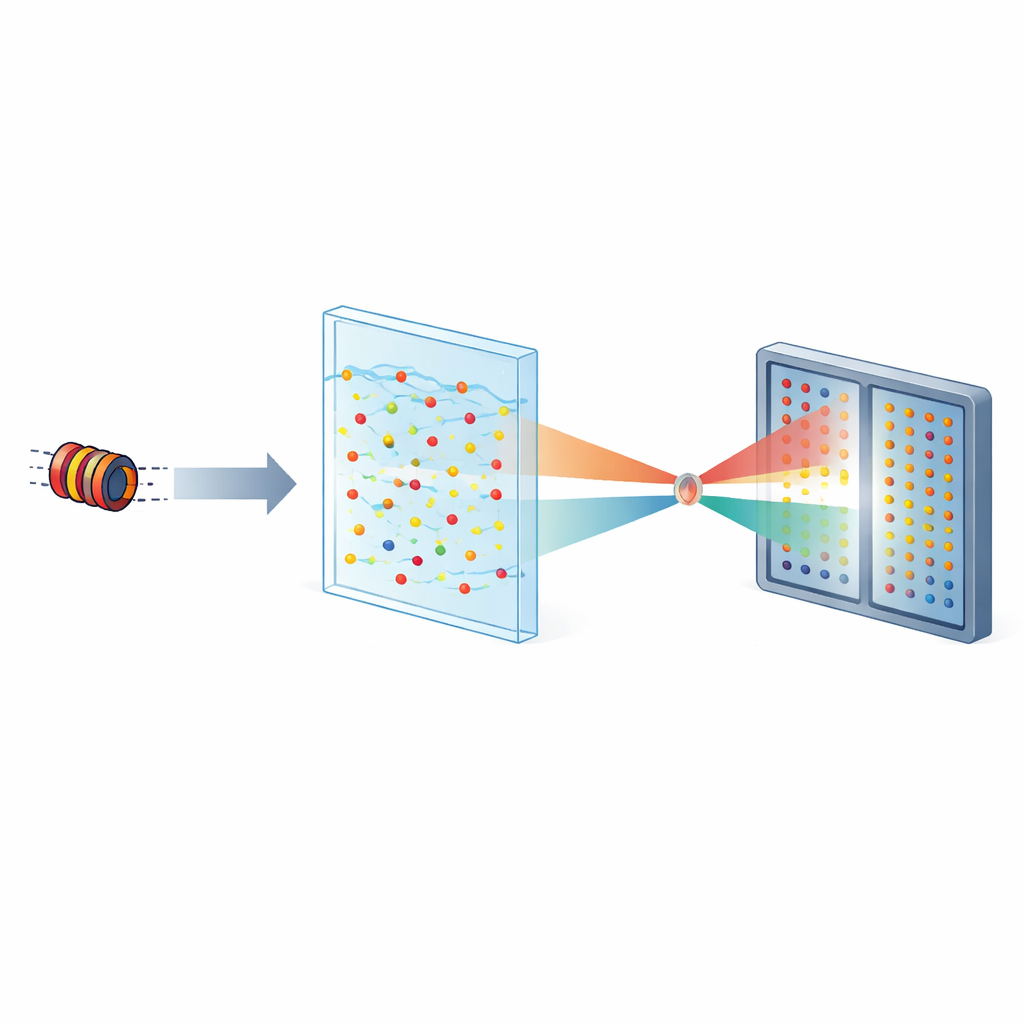
The core idea is to use a thin vapor of cesium atoms as a live screen that reacts to nearby magnetic fields. When a magnetic field is present, the atoms’ internal “spins” precess—much like tiny spinning tops wobbling in a steady direction. A carefully timed pulse of circularly polarized light first lines up these spins; after this “pump” stage, the light is turned off and the atoms are left to wobble freely in the surrounding magnetic field. A second, weaker “probe” beam of linearly polarized light passes through the same vapor and is subtly twisted by the spinning atoms. By measuring how this twist changes over time, the system can infer the strength of the magnetic field at that location.
Capturing a Magnetic Image All at Once
Traditional atomic magnetometers often scan point by point or use coarse arrays of detectors, which makes them slow and limits how much detail they can see. Here, the authors build a camera-like system with 684 independent channels that record a two-dimensional magnetic pattern over an area about 5 by 2.6 millimeters, at up to 205 frames per second. Instead of many separate sensors, they use a single high-speed image sensor divided into two halves. The probe beam is split into two orthogonal polarizations, creating matching spot patterns on the two halves. By subtracting the brightness of each pair of spots, the system cancels out common noise—such as laser power fluctuations—while preserving the tiny changes caused by magnetic fields.

Sharpening the Picture with Smart Optics
To get a clear, detailed magnetic picture, the authors must avoid blurring from both the chip and the atoms. On the sensor side, pixels can “talk” to their neighbors, causing crosstalk that smears fine structure. The team tackles this with a microlens array that concentrates light from each channel into a tight region on the sensor while leaving dark gaps in between, greatly reducing leakage. A digital micromirror device—an array of tiny tilting mirrors—shapes and spaces the probe beam into many well-separated sub-beams and allows each pair of spots on the two sensor halves to be matched precisely, even if the optics distort their shapes. On the atomic side, the authors analyze how atoms diffuse within the vapor cell and design the channel spacing so that neighboring regions remain effectively independent, reaching a spatial resolution of about 137 square micrometers, close to the physical limit set by diffusion.
Measuring Moving and Changing Fields
To show what their magnetic video recorder can do, the researchers film the magnetic field from a small solenoid coil carrying a steady current as it moves past the cell. They compare their recordings with computer simulations based on standard magnetic theory and find that the measured field distributions and their evolution over time closely match the predicted patterns, aside from small deviations due to imperfections in the test coil and its motion. The system achieves an average sensitivity of about 194 picotesla per square root hertz over a useful frequency range, and it can follow time-varying fields up to hundreds of hertz. This combination of sensitivity, frame rate, and field of view compares favorably with other two-dimensional magnetic imaging approaches, offering faster global recording than scanning methods and better sensitivity than many solid-state techniques.
Why This Magnetic Camera Matters
In simple terms, the authors have turned a thin cloud of warm atoms plus a smart optical camera into a high-speed video system for invisible magnetic patterns. It can “film” how weak magnetic fields vary across space and time without touching the object or cooling the sensor to extremely low temperatures. While it does not reach the ultimate sensitivity of the most delicate laboratory instruments, it strikes a practical balance: it is fast, relatively compact, and detailed enough to capture fine structures and moving sources. This makes it a promising tool for real-world tasks like monitoring the health of batteries, tracking tiny magnetic particles, or observing subtle electromagnetic processes in complex devices.
Citation: He, X., Dong, H., Hua, Z. et al. A bell-bloom atomic magnetic-videorecorder with global shutter and differential readout. Microsyst Nanoeng 12, 147 (2026). https://doi.org/10.1038/s41378-026-01282-5
Keywords: atomic magnetometry, magnetic imaging, optical sensing, CMOS sensor, Bell-Bloom technique