Clear Sky Science · en
Optimizing fatigue resistance and lifetime of MEMS scanning mirrors with a novel coupled parameter distribution structural framework
Sharper eyes for everyday sensing
From self-driving cars to delivery drones, many new technologies rely on tiny mirrors that sweep laser beams across the world to build 3D maps. These micro mirrors must move back and forth billions of times without breaking, all while surviving bumps, heat, and vibration. This study shows how carefully reshaping these microscopic parts can dramatically extend their working life, offering more reliable sensors for future vehicles and smart devices. 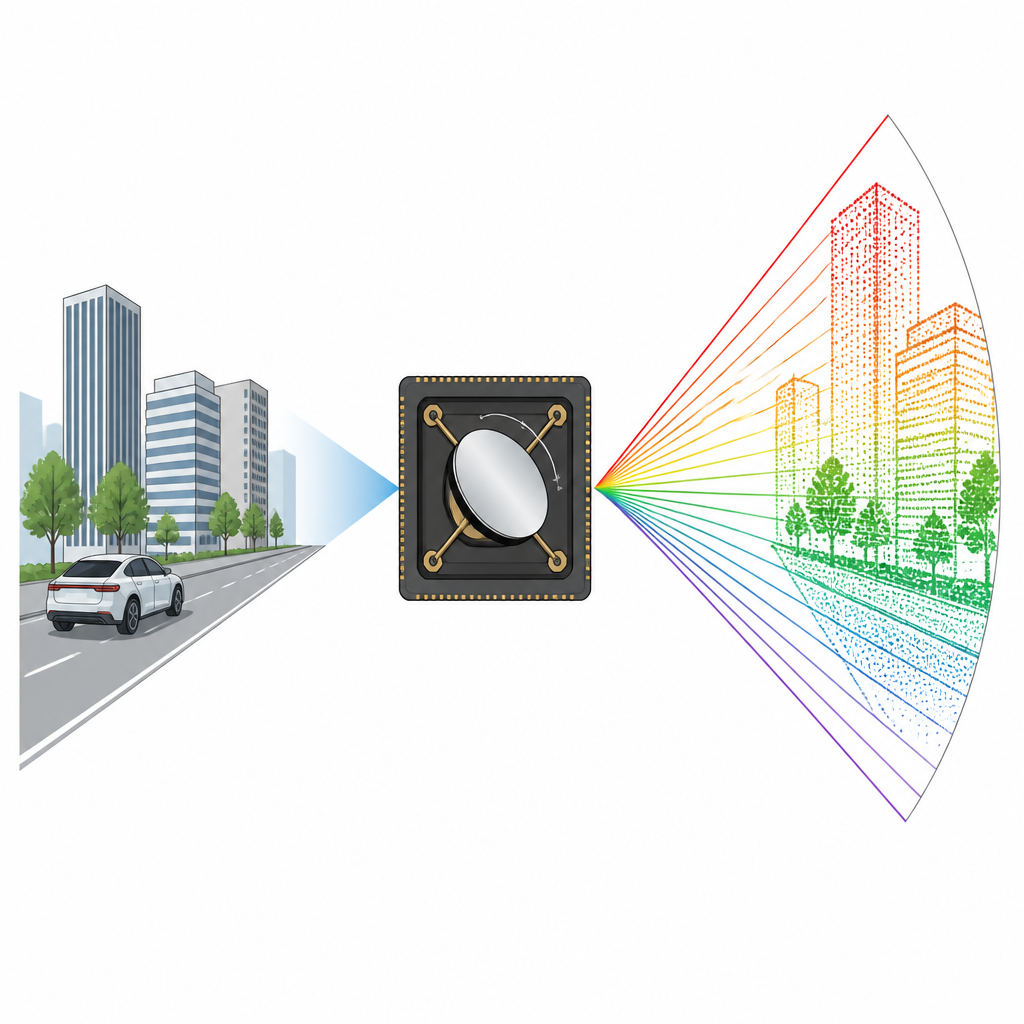
Why tiny mirrors face a big fatigue problem
Modern light detection and ranging, or LiDAR, uses beams of light to scan the surroundings and measure distance. At the heart of many LiDAR units sits a micro-electro-mechanical systems (MEMS) scanning mirror: a small reflective plate suspended on thin bars that twist like springs. Silicon versions are easy to manufacture but can shatter under shock. Metal mirrors made from tough alloys bend more without breaking, but they tend to wear out faster when they are driven at high speed. Each swing of the mirror adds to the stress on its slender support beams, and over time this repeated loading can lead to slow warping and eventual fracture, limiting the useful lifetime of the sensor.
Shaping stress instead of just changing materials
Rather than switching to yet another material, the authors focus on how to shape the supporting beams so that stress is spread out more evenly. In the original design, the beams have a constant width and show strong stress hot spots near where they are anchored. The team introduces a way to vary the beam width along its length using a set of control points, whose positions and local widths are all allowed to change. Computer simulations are used to find patterns that reduce the swing in stress during each cycle, a quantity closely tied to how quickly microscopic cracks grow. A smooth shape is then drawn through these optimized points, ensuring that the result can actually be fabricated.
A smarter framework for exploring designs
The core of the work is a “coupled parameter distribution” framework that treats both the placement of control points and their widths as design choices. Starting from an initial mirror with uniform beams, the method first maps out how stress varies along the beam. It then tries three strategies for placing control points: evenly across the beam, randomly, or concentrated where the stress is highest. For each case, a numerical search algorithm adjusts widths and positions, running repeated simulations to seek the lowest peak stress range while still meeting practical limits on mirror angle, vibration frequency, minimum width, and maximum safe stress. The process quickly finds a family of smooth beam shapes that turn two sharp stress peaks into several smaller ones spread along the beam, without hurting the mirror’s optical performance. 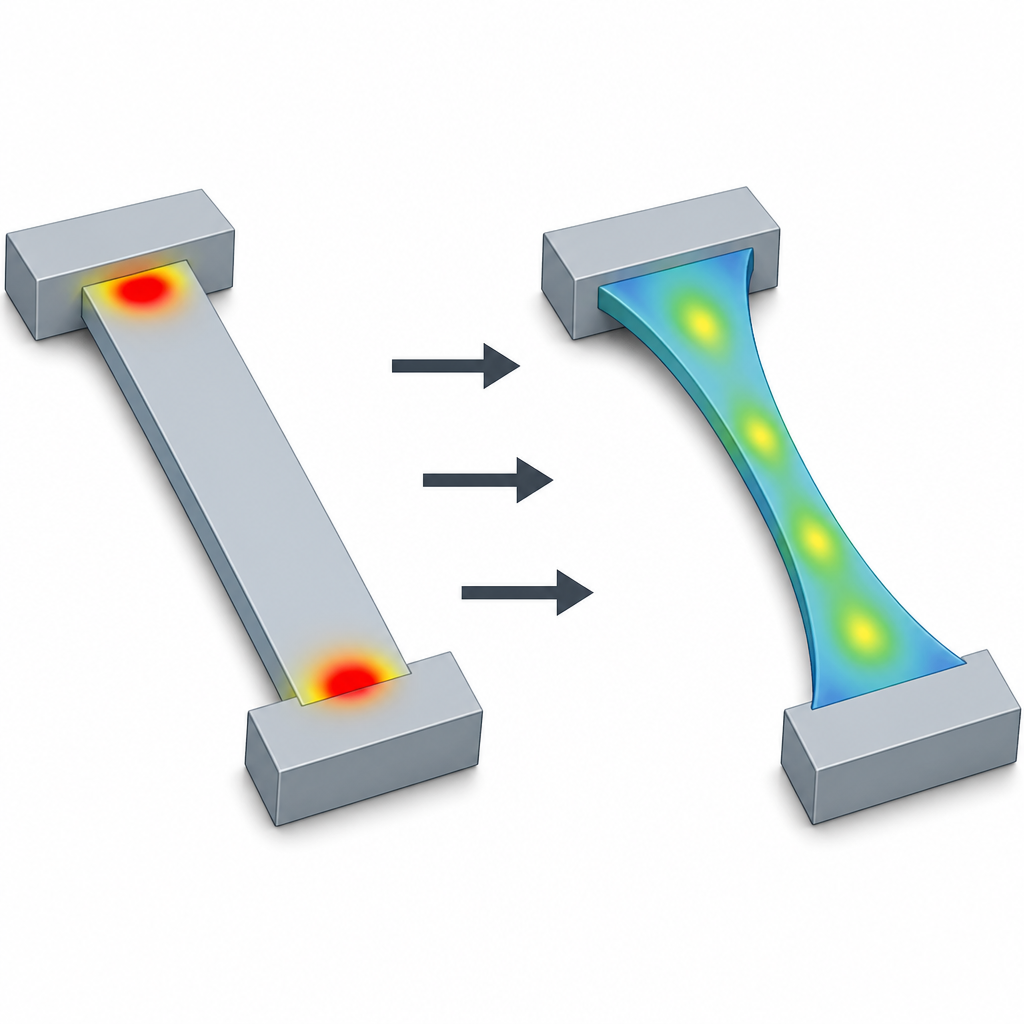
From computer models to real-world endurance
To test whether the reshaped beams truly last longer, the researchers built MEMS scanning mirrors with both the new “modulated-width” beams and the old constant-width beams. They drove the mirrors under the same conditions and tracked how the slow axis of motion gradually drifted as fatigue set in. Over 72 hours, devices with the optimized beams showed about one third less drift in angle, meaning they stayed more stable under repeated motion. In longer tests at elevated temperature, the new beams lasted on average about 691 hours before breaking, compared with 266 hours for the originals, a gain of roughly two and a half times. Using a standard model that connects high-temperature testing to everyday room conditions, the team estimates that the new design should survive on the order of 7,000 to 10,000 hours of operation.
What this means for future sensors
In plain terms, the study shows that smart geometry can do as much for durability as choosing a tougher material. By redistributing stress along the tiny support beams, the authors cut the worst stress swings nearly in half and significantly slowed down the gradual bending that blurs a mirror’s aim over time. Their framework is efficient enough to compete with more complex optimization methods while producing smooth, fabrication-ready shapes. Although they demonstrate the idea on titanium-alloy MEMS mirrors for LiDAR, the same approach could be applied to many other micro devices where thin beams face endless cycles of twisting and bending, helping the invisible moving parts inside tomorrow’s sensors last longer and perform more reliably.
Citation: Liu, S., Zhang, G., Zhang, Z. et al. Optimizing fatigue resistance and lifetime of MEMS scanning mirrors with a novel coupled parameter distribution structural framework. Microsyst Nanoeng 12, 189 (2026). https://doi.org/10.1038/s41378-026-01279-0
Keywords: MEMS scanning mirror, LiDAR, fatigue resistance, torsion beam design, microactuator reliability