Clear Sky Science · en
A miniaturized wireless and passive antenna sensor with meandering structure for integrated multi-directional strain and temperature sensing
Watching Machines Without Wires
From wind turbines and industrial robots to electric car batteries, many critical machines work under intense heat and mechanical stress. Knowing exactly how much they bend and how hot they get is essential to prevent failures and fires—but putting bulky, wired sensors into cramped, hot, or rotating parts is notoriously hard. This paper introduces a tiny wireless sensor that can quietly “listen” to both strain and temperature in several directions at once, even in scorching environments, offering a new way to keep modern infrastructure safer and longer‑lasting.
A Tiny Radio That Feels Stress
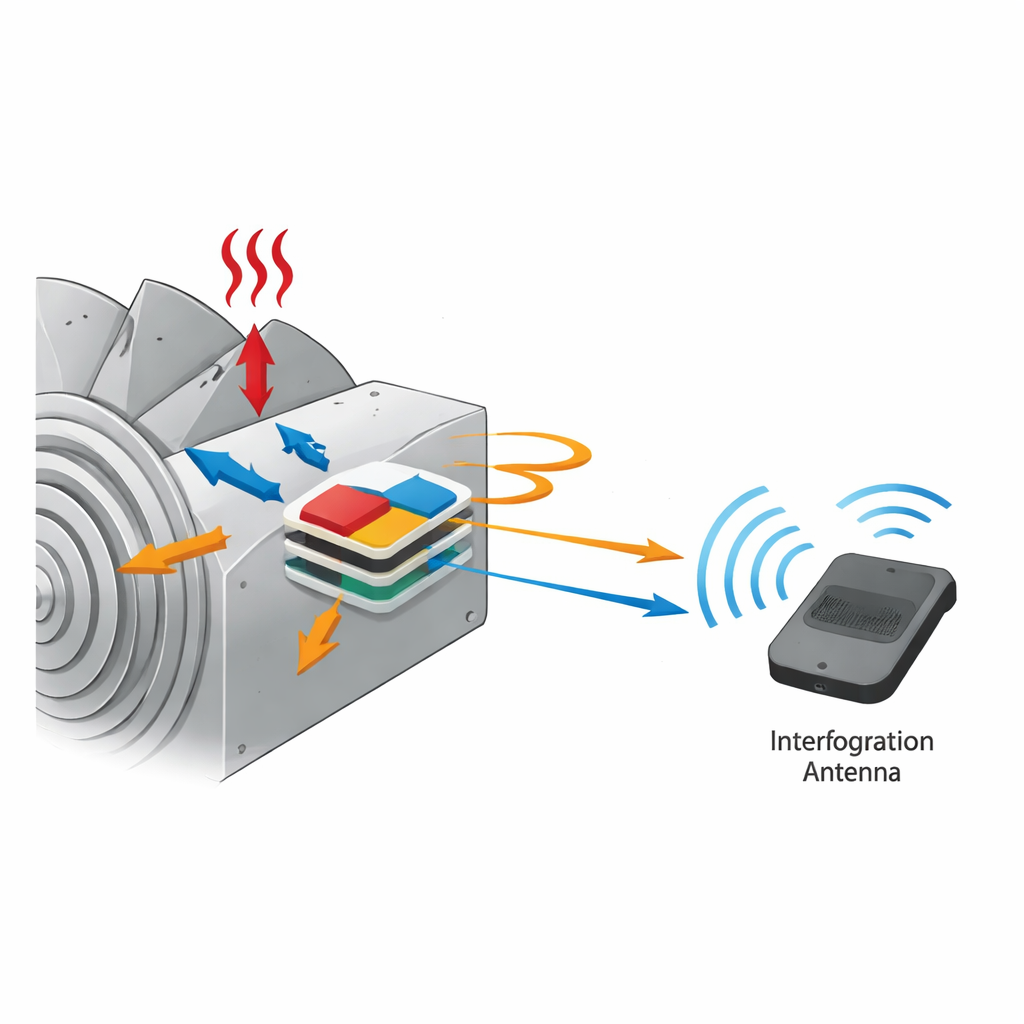
At the heart of the work is a special kind of flat radio antenna called a microstrip patch. Instead of using batteries or cables, the sensor is passive: an external antenna sends in a microwave signal, the sensor responds by resonating at specific frequencies, and the external antenna “hears” those echoes. When the sensor is stretched, compressed, or heated, its resonant frequencies shift in predictable ways. By measuring these shifts, engineers can infer how much strain and heat the structure is experiencing, without ever touching it with wires.
Shrinking the Sensor Without Sacrificing Performance
Conventional antenna-based sensors tend to be too large for tight spaces and often work only in one direction or at modest temperatures. The authors tackle this by carefully redesigning the antenna geometry. They use a high-permittivity alumina ceramic substrate that naturally allows smaller antennas at the same operating frequency. On top of that, they carve T-shaped meandering slots into the metal patches. These slots force electrical currents to follow a longer, winding path, which lowers the resonant frequency and lets the physical patch be shrunk. Compared with traditional designs at the same frequencies, the three patches in the new sensor reduce their radiation areas by roughly one‑third to one‑half, leading to an overall size cut of nearly 60 percent.
Measuring Strain from Several Directions and Heat at Once
The sensor integrates three miniaturized patches into a stepped three-dimensional layout on a single ceramic chip. One patch is tuned to sense strain along a primary direction (0 degrees), a second patch senses strain along two diagonal directions (45 and 135 degrees), and a third patch is dedicated to temperature. Each has its own resonant frequency between about 2 and 3.5 gigahertz, spaced at least 0.3 gigahertz apart so they can be read independently. When the structure bends in a particular direction, only the matching resonant peak shifts, while the others mostly change in strength but not position. When the temperature rises, the dielectric constant of the ceramic increases and the temperature patch’s resonant frequency moves steadily downward. In this way, the chip can simultaneously report a multi-directional picture of mechanical stress while also tracking how hot the environment is.

Built for Heat, Distance, and Real-World Noise
To make the system work in harsh, hot zones where conventional metal horn antennas might fail, the team also designs a separate interrogation antenna based on a coplanar waveguide. This companion antenna, made from the same alumina and platinum materials, withstands temperatures up to 800 °C and offers a wide bandwidth that comfortably covers all of the sensor’s resonant peaks. Tests show that the wireless link works best at a sensor–antenna spacing of 4–5 centimeters, where four clear resonances appear with strong quality factors. The researchers build three experimental setups: a room-temperature strain rig, a high-temperature furnace system for pure temperature measurements, and a variable-temperature strain system that can apply controlled strains up to 500 microstrain while ramping the temperature from 15 to 800 °C.
Turning Shifting Peaks into Reliable Numbers
Careful experiments confirm that the resonant frequencies track both strain and temperature in a repeatable way. At room temperature, each strain direction shows a distinct downward frequency shift with increasing strain, with sensitivities on the order of tens of kilohertz per microstrain and fitting errors below 0.1 percent. The temperature patch shows a clear drop in frequency as the furnace heats, with maximum sensitivity above 300 kilohertz per degree Celsius and stable behavior across three heating–cooling cycles. Because temperature also affects the strain-sensitive patches, the authors develop a mathematical correction: a two-dimensional polynomial model that uses both the measured temperature and the observed resonant frequency to solve for “true” strain. Across all directions, strains, and temperatures, the final strain errors stay within about 5 percent, and repeatability errors in frequency are well below a megahertz.
Why This Matters for Safer Technology
In simple terms, the work shows that a postage-stamp-sized piece of engineered ceramic and metal can act as a battery-free “nerve ending” for big machines, sensing how hard they are pulled in several directions and how hot they get, all through a short wireless link. By combining miniaturization tricks, heat-resistant materials, and smart data processing, the device overcomes long-standing limits of size, wiring, and temperature. Deployed on turbine blades, robot arms, or electric vehicle batteries, such sensors could warn of fatigue and overheating well before failure, enabling more reliable, efficient, and safer industrial systems.
Citation: Guo, L., Dong, H., Liang, S. et al. A miniaturized wireless and passive antenna sensor with meandering structure for integrated multi-directional strain and temperature sensing. Microsyst Nanoeng 12, 165 (2026). https://doi.org/10.1038/s41378-026-01271-8
Keywords: wireless strain sensing, high-temperature sensors, microstrip patch antenna, structural health monitoring, multidirectional stress