Clear Sky Science · en
Lithography-free, Pd-based bimorph cantilever switches for zero-standby-power chemo-mechanical H2 detection
Why safer hydrogen needs smarter sensors
Hydrogen is often hailed as a clean fuel of the future, but it comes with a catch: the gas is colorless, odorless, and can become explosive at fairly low concentrations in air. Industrial sites that produce, store, or use hydrogen must constantly watch for leaks, even though serious leaks are rare. Today that usually means running thousands of powered electronic sensors around the clock, wasting energy and requiring frequent battery changes. This study introduces a tiny mechanical switch that only wakes up when hydrogen is actually present, offering the promise of safer hydrogen systems with virtually no standby power use. 
A tiny see-saw that feels hydrogen
The heart of the new sensor is a microscopic see-saw-like structure called a cantilever. It is built from two thin metal layers stacked together: a top layer of palladium, which can soak up hydrogen, and a bottom layer of chromium, which does not. In normal air, the strip lies flat above a lower metal pad, leaving a nanoscale gap between them, so no current flows. When hydrogen arrives, the palladium layer absorbs it and expands slightly. Because only the top layer swells, the strip bends downward like a bimetallic thermostat, eventually touching the pad beneath and closing an electrical circuit. In this way, the presence of hydrogen is turned directly into a simple on–off electrical signal.
Making switches without complex chip factories
Many previous hydrogen switches relied on randomly formed cracks in metal films, which made their behavior hard to control and reproduce. Others used full microchip-style processing with multiple photolithography steps and harsh chemicals, increasing cost and environmental impact. The team instead developed a lithography-free method that uses water-soluble polymer nanofibers as temporary scaffolds. First, they electrospin very thin, well-aligned polymer strands onto an oxidized silicon wafer. Then they deposit chromium and palladium at a tilt, coating only one side of each fiber to form suspended metal strips with built-in nanogaps to the underlying electrodes. Finally, they dissolve the polymer in water and gently dry the chip using isopropyl alcohol to prevent the delicate beams from sticking down. The result is a regular array of nanoscale switches made with only benign solvents and without traditional patterning steps. 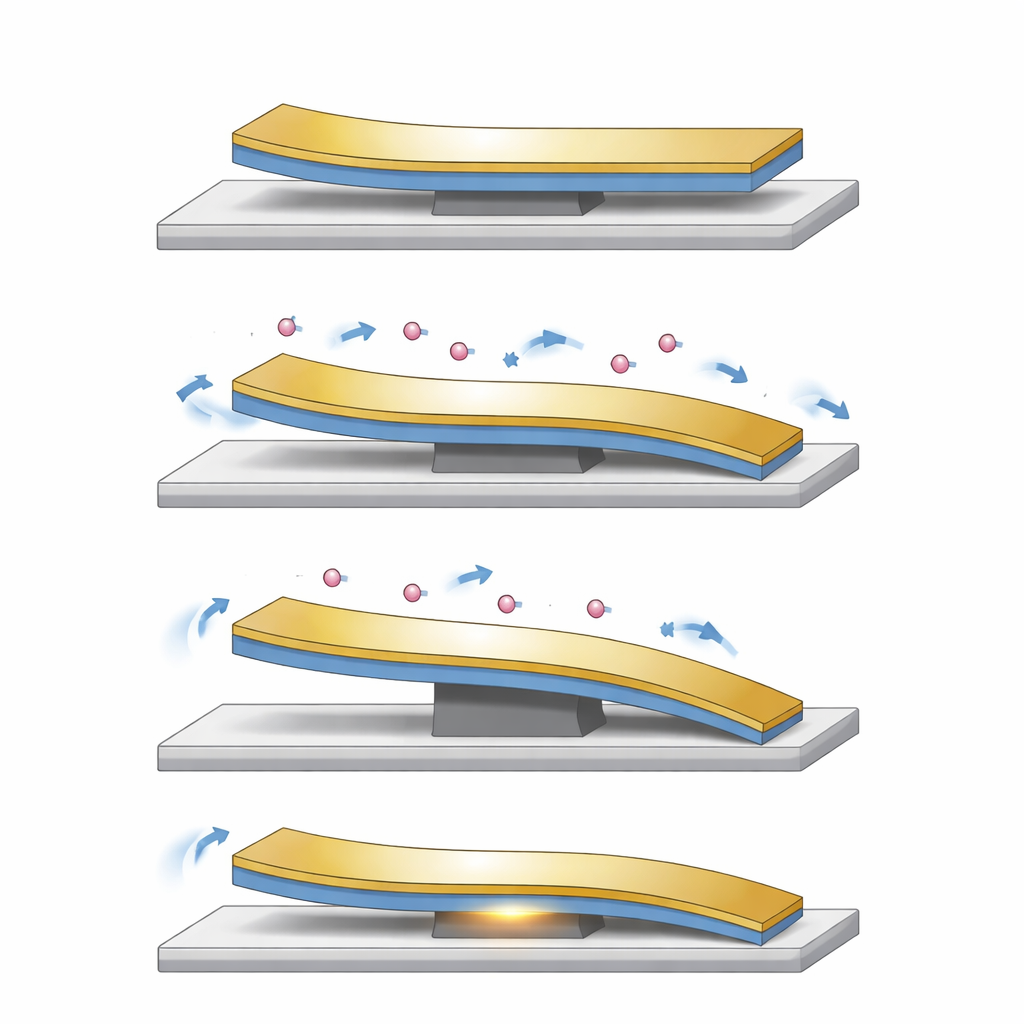
Tuning when the switch turns on
The researchers showed that they could control the hydrogen concentration needed to close the gap simply by changing the angle at which the metals were deposited and the thickness of the added palladium. Steeper angles created larger initial gaps that required more hydrogen-induced bending to bridge, while shallower angles produced smaller gaps and lower turn-on thresholds. Devices with the smallest gaps could detect hydrogen concentrations as low as 0.3 percent in air—well below the roughly 4 percent level where hydrogen becomes explosive. Once the threshold was crossed, the current jumped by more than a factor of 100,000 compared with the off state, because the device goes from an open circuit to a direct metal–metal contact.
Reliable, selective, and almost power-free
Because the switches are truly open circuits until hydrogen closes them, their standby currents were near the measurement noise floor, on the order of a few picoamperes. That translates to essentially zero power draw when there is no leak. The devices responded within tens of seconds once exposed to hydrogen, and many designs could be cycled repeatedly between on and off without significant drift. Their behavior changed very little with humidity and only modestly with temperature, and they showed no measurable response to several other common gases, underscoring their selectivity for hydrogen. By linking three switches in series, the authors further reduced the chance of false triggers from accidental contact or mechanical sticking.
What this means for everyday safety
For non-specialists, the takeaway is that this work offers a way to watch for dangerous hydrogen leaks without continually burning energy. These tiny mechanical switches sit idle, drawing effectively no power, until hydrogen itself physically moves them into contact and turns the alarm circuit on. The fabrication method avoids complicated photolithography and harsh chemicals, using simple fibers and water-based processing instead. Together, these advances point toward low-cost, environmentally friendlier hydrogen sensors that can be scattered in large numbers across pipelines, refueling stations, or remote energy installations, quietly standing guard and waking up only when they are truly needed.
Citation: Koh, D., Jo, E. & Kim, J. Lithography-free, Pd-based bimorph cantilever switches for zero-standby-power chemo-mechanical H2 detection. Microsyst Nanoeng 12, 124 (2026). https://doi.org/10.1038/s41378-026-01269-2
Keywords: hydrogen leak detection, zero standby power sensors, palladium cantilever switch, chemo-mechanical sensing, lithography-free nanofabrication