Clear Sky Science · en
Differential migratory phenotypes of human neutrophils and breast cancer cells in a wireless unidirectional electric field platform
Guiding Cells with Invisible Forces
Our bodies are full of tiny travelers—immune cells that rush to infections and cancer cells that sometimes escape and spread. This study explores a surprising way to steer such cells using invisible electric forces, without touching them with electrodes or sending current through their surroundings. The work shows that immune cells and breast cancer cells sense and respond very differently to these “wireless” electric fields, hinting at future ways to guide helpful cells and possibly slow harmful ones.

A Wireless Way to Shape Cell Movement
Electric fields are already known to nudge many kinds of cells, from skin cells closing a wound to tumor cells on the move. But almost all past experiments relied on electrodes dipping directly into liquid, which also pushes an electric current through the sample. That current can unintentionally change the chemistry around the cells, for example by shifting acidity. The authors wanted to answer a basic question: is the current itself necessary, or can cells sense the electric field alone? To test this cleanly, they built a new “wireless unidirectional electric field” (Wi‑uEF) device based on a simple idea—the same physics behind a parallel-plate capacitor.
A Custom Microscope-Ready Testbed
The team engineered two flat copper plates that sit above and below a standard cell dish, held in place by a fully 3D‑printed frame. When a voltage is applied, a steady electric field appears across the dish without electrodes ever touching the liquid. Computer simulations showed that the field inside a central viewing region is fairly uniform and can be tuned to levels similar to those naturally found in tissues, such as around healing wounds. Swappable holders allow either simple dishes or more complex microfluidic chambers, turning the setup into a flexible platform for watching live cells under the microscope while the field is applied.
Immune Cells Follow the Field, Cancer Cells Wander
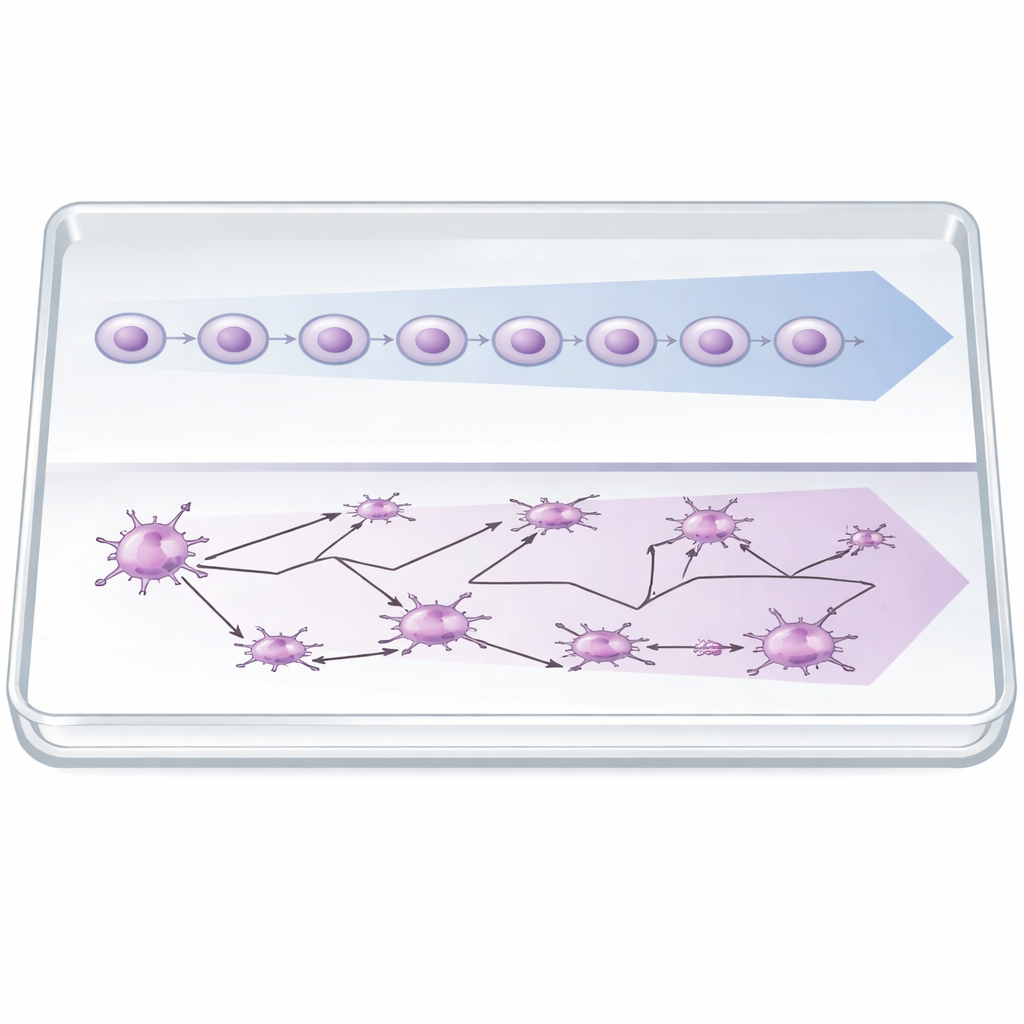
The researchers tested two cell types: human peripheral blood neutrophils, which are fast‑moving immune cells, and MDA‑MB‑231 breast cancer cells, a highly aggressive tumor line. Neutrophils were given a mild chemical signal to get them moving, then exposed to different strengths of wireless field. Careful tracking of hundreds of cells revealed that, on average, neutrophils tended to drift toward the “cathode” side of the field. Their paths became more organized and less random as the field increased, especially for the most mobile cells, even though their overall speed did not change much. In contrast, breast cancer cells behaved very differently. Under the same wireless fields they moved somewhat faster, but their paths became less straight and did not show a clear preference for either side. In other words, the field made them more restless but not more directed.
Making Sense of the Patterns with a Random Walk
To understand how the same physical cue could produce opposite behaviors, the team turned to a simple “random walk” model, a common way to describe motion made of many small, partly unpredictable steps. They imagined each cell as repeatedly choosing a new direction, but with two tunable tendencies: one to align with the field, and one to keep going in roughly the same direction as before. By adjusting these two tendencies, the model could reproduce the observed neutrophil behavior—moderate alignment with the field plus relatively steady motion—and the cancer cell behavior—weak alignment paired with frequent turning and reduced persistence. The model also captured the observation that the neutrophils showing the longest travel distances were the ones most strongly guided by the field.
What This Could Mean for Future Medicine
Altogether, the study shows that cells can sense and respond to a purely wireless electric field, even when very little or no current flows through their environment. Neutrophils treat the field as a directional cue, while these breast cancer cells mainly have their wandering patterns reshaped. This difference suggests that carefully designed wireless fields might one day be used to encourage immune cells into tumors or inflamed tissues while dampening harmful cancer cell migration. The Wi‑uEF platform, combined with simple yet powerful modeling, opens the door to exploring how a wide range of immune and cancer cells react to gentle, non-contact electrical guidance inside the body.
Citation: Palmerley, N., Liu, Y., Stefanson, A. et al. Differential migratory phenotypes of human neutrophils and breast cancer cells in a wireless unidirectional electric field platform. Microsyst Nanoeng 12, 139 (2026). https://doi.org/10.1038/s41378-026-01267-4
Keywords: electrotaxis, neutrophils, breast cancer cells, wireless electric fields, cell migration