Clear Sky Science · en
Extending the boundaries of ultraviolet-visible meta-optics via direct imprinting of tantalum pentoxide composite
Why tiny light-shaping surfaces matter
Imagine a camera lens as thin as a sheet of plastic that can focus ultraviolet and visible light with high clarity. Such flat optical elements, called metasurfaces, could shrink microscopes, projectors, and sensors into pocket-sized devices. This study explores a new way to build these intricate light-shaping surfaces more easily and over a wider range of colors, from deep ultraviolet to the visible spectrum, using a clever material and a single, stamp-like manufacturing step. 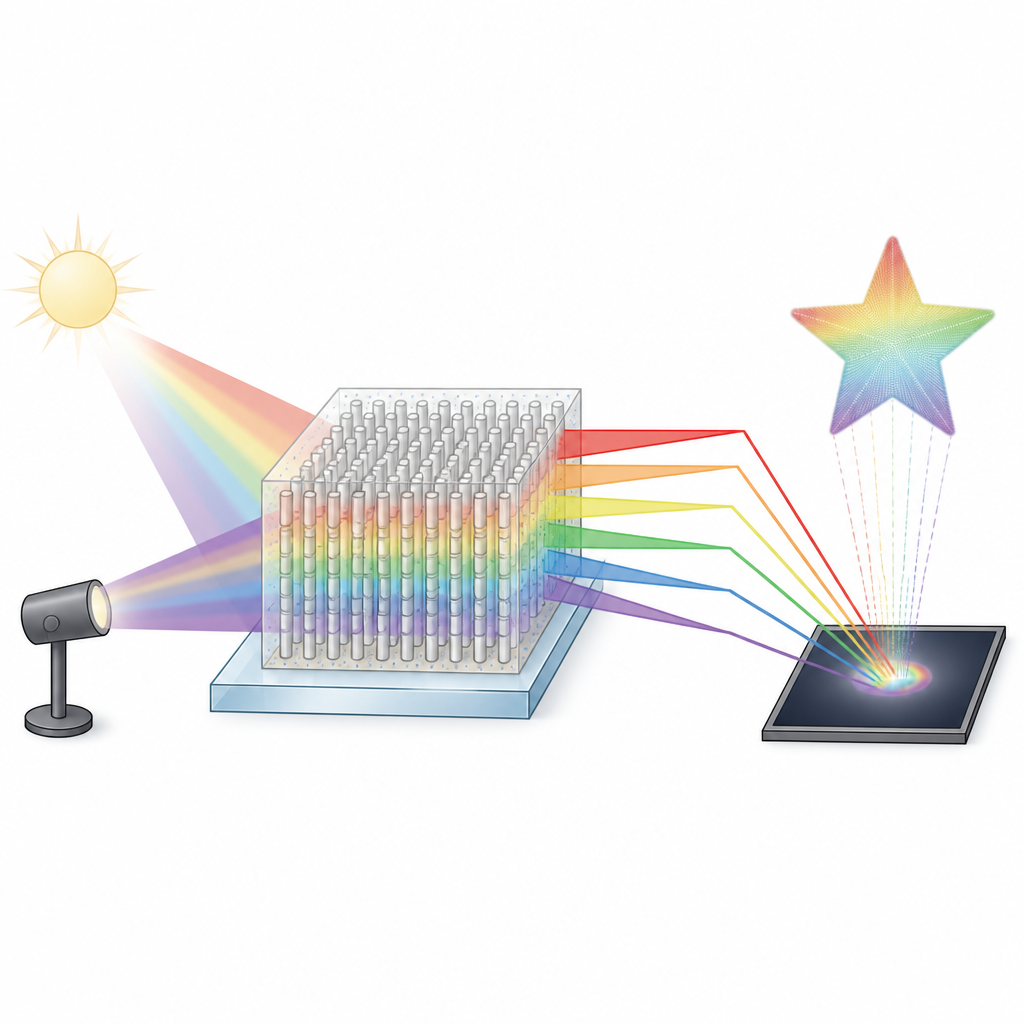
Flat optics in need of a better recipe
Metasurfaces work by using forests of tiny pillars or posts, each smaller than the wavelength of light, to twist and delay light waves in carefully designed ways. They can form images, focus beams, or encode information in unusual patterns of light. However, making metasurfaces that operate from ultraviolet to visible light has been difficult. The materials that bend light strongly enough often absorb ultraviolet light, while others that are transparent in the ultraviolet do not bend light quite enough. On top of that, traditional fabrication relies on slow and expensive techniques that carve patterns layer by layer, which is not ideal for mass production.
A new composite for clear ultraviolet to visible control
The researchers tackle the material problem by dispersing tiny particles of tantalum pentoxide into a UV-curable resin, creating what they call a particle-embedded resin. Most of these particles are smaller than 40 nanometers, so to light they behave like a smooth optical medium rather than a grainy mixture. Measurements show this composite has a relatively high refractive index of about 1.9 at a wavelength of 300 nanometers, while remaining nearly lossless from the ultraviolet edge into the visible range. Tests of thin films reveal smooth surfaces, very low scattering, and an internal structure that preserves the crystalline nature of the particles, which helps maintain their desirable optical behavior.
Stamping out forests of nano-pillars
To solve the manufacturing challenge, the team uses nanoimprint lithography, a method similar in spirit to stamping patterns into soft material. They first create a hard master mold with the desired nanoscale shapes using high-resolution tools only once. From this, they cast a flexible two-layer soft mold that can be reused many times. The tantalum pentoxide resin is dropped onto the soft mold, the solvent is allowed to evaporate, and then the mold is pressed onto a glass substrate and cured under ultraviolet light. By carefully tuning the pressure, curing time, and particle loading, they obtain tall, well-defined pillars with aspect ratios above 7.5 without extra etching or deposition. The process faithfully reproduces both rectangular posts and cylindrical pillars, which are building blocks for different types of metasurfaces. 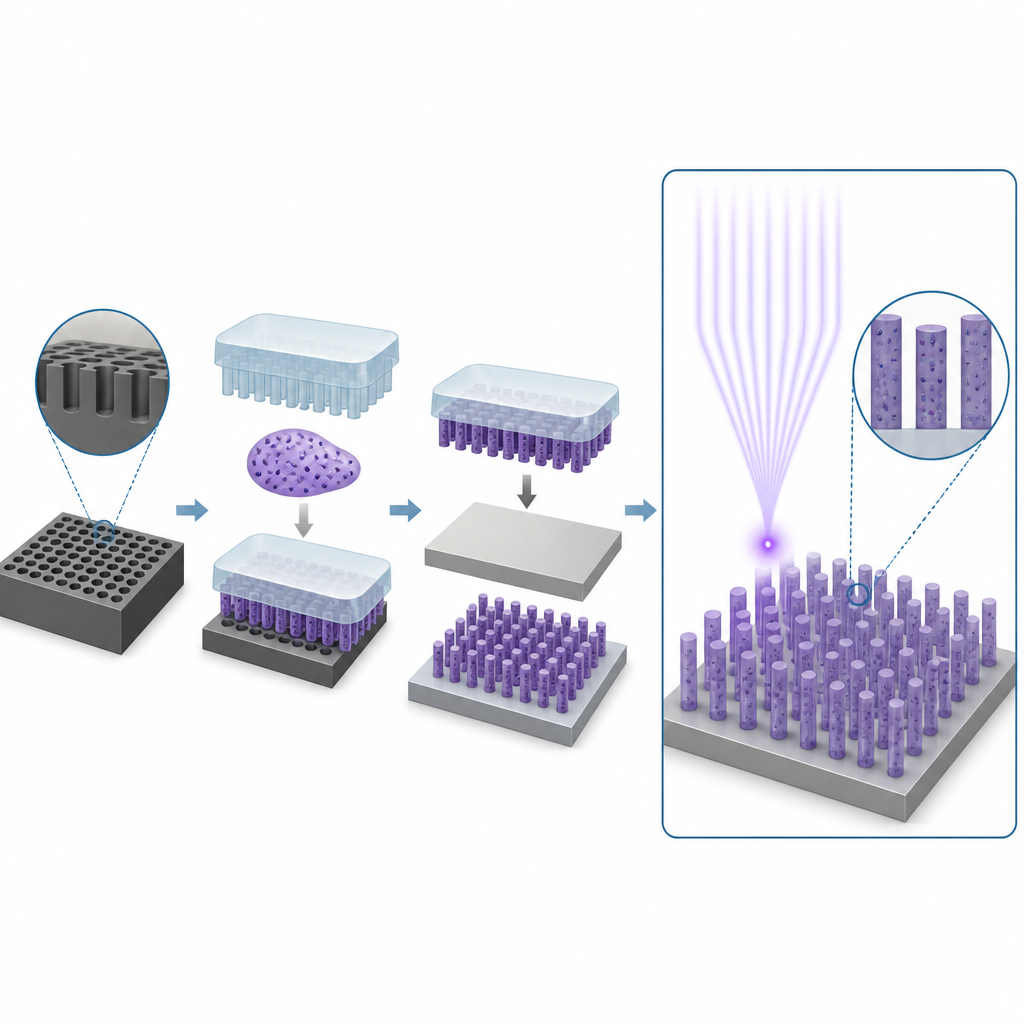
Flat holograms and ultraviolet lenses in action
With this platform, the authors build two demonstration devices. The first is a holographic metasurface made from two million rectangular posts whose orientations encode a desired image. Because this type of hologram uses geometric phase that depends on orientation rather than color, the same pattern works from 320 to 635 nanometers. Experiments show that the hologram reconstructs clear images across this range, with conversion efficiencies up to 64 percent at 320 nanometers. The second device is a metalens for 320 nanometer light, built from cylindrical pillars arranged so their diameters control the phase of transmitted light. This flat lens, only hundreds of nanometers thick, focuses ultraviolet light to nearly the diffraction limit with a measured focusing efficiency of 61.3 percent and can resolve fine test patterns used in microscopy.
What this means for future flat optics
In simple terms, the study shows that combining a high-index tantalum pentoxide composite with a stamp-like patterning method can produce high-performing flat optical elements that work from ultraviolet into visible light, without the costly, multi-step processing usually needed. The approach supports different nano-structures and phase-control methods, suggesting it can be adapted to a wide variety of lenses, holograms, and other compact optical components. With further refinement and scaling, this method could help turn flat optics into practical, manufacturable parts for imaging, sensing, secure data encoding, and portable ultraviolet instruments.
Citation: Lee, E., Kang, H., Yun, H. et al. Extending the boundaries of ultraviolet-visible meta-optics via direct imprinting of tantalum pentoxide composite. Microsyst Nanoeng 12, 202 (2026). https://doi.org/10.1038/s41378-026-01255-8
Keywords: metasurfaces, ultraviolet optics, metalens, nanoimprint lithography, tantalum pentoxide