Clear Sky Science · en
A review of glass thermal reflow: method, device, and applications
Shaping Glass for Tiny Devices
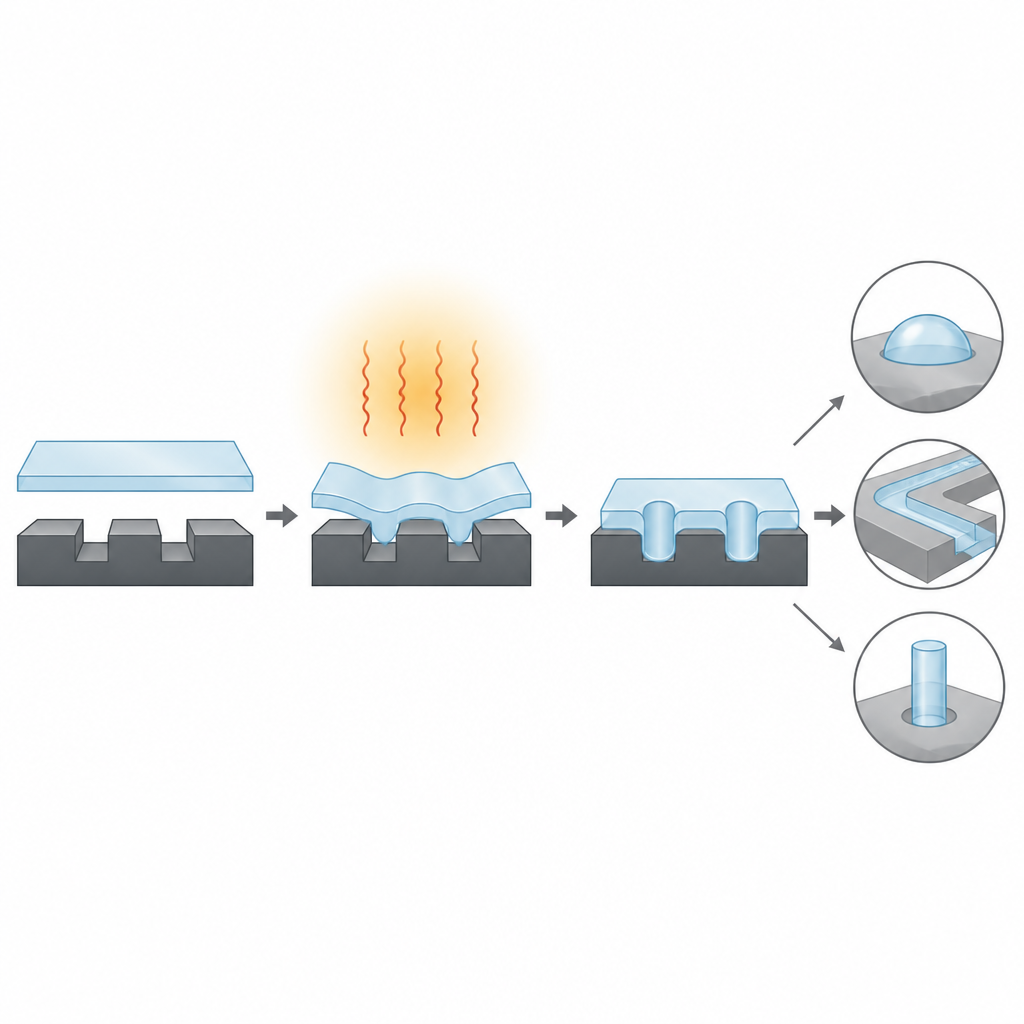
From smartphones to medical sensors, many of today’s most advanced gadgets rely on microscopic machines built on chips. This article explores a way to sculpt ordinary glass into intricate three-dimensional shapes small enough to fit inside those chips. By gently softening glass so it flows like thick honey into tiny molds, engineers can form smooth channels, lenses, and electrical insulators that are hard to make with other methods.
Why Glass Matters in Small Machines
Silicon has long been the workhorse material for microchips, but glass brings a different set of strengths. It lets light pass through, it is electrically insulating, stable at high temperature, and friendly to biological tissues. These traits make glass ideal for optical components, tiny fluid channels, and safe wiring paths inside complex systems. The challenge is that glass is also hard and brittle, which makes it difficult to carve into deep, narrow features using standard cutting or etching approaches without creating cracks, rough surfaces, or high costs.
Letting Glass Flow Like Honey
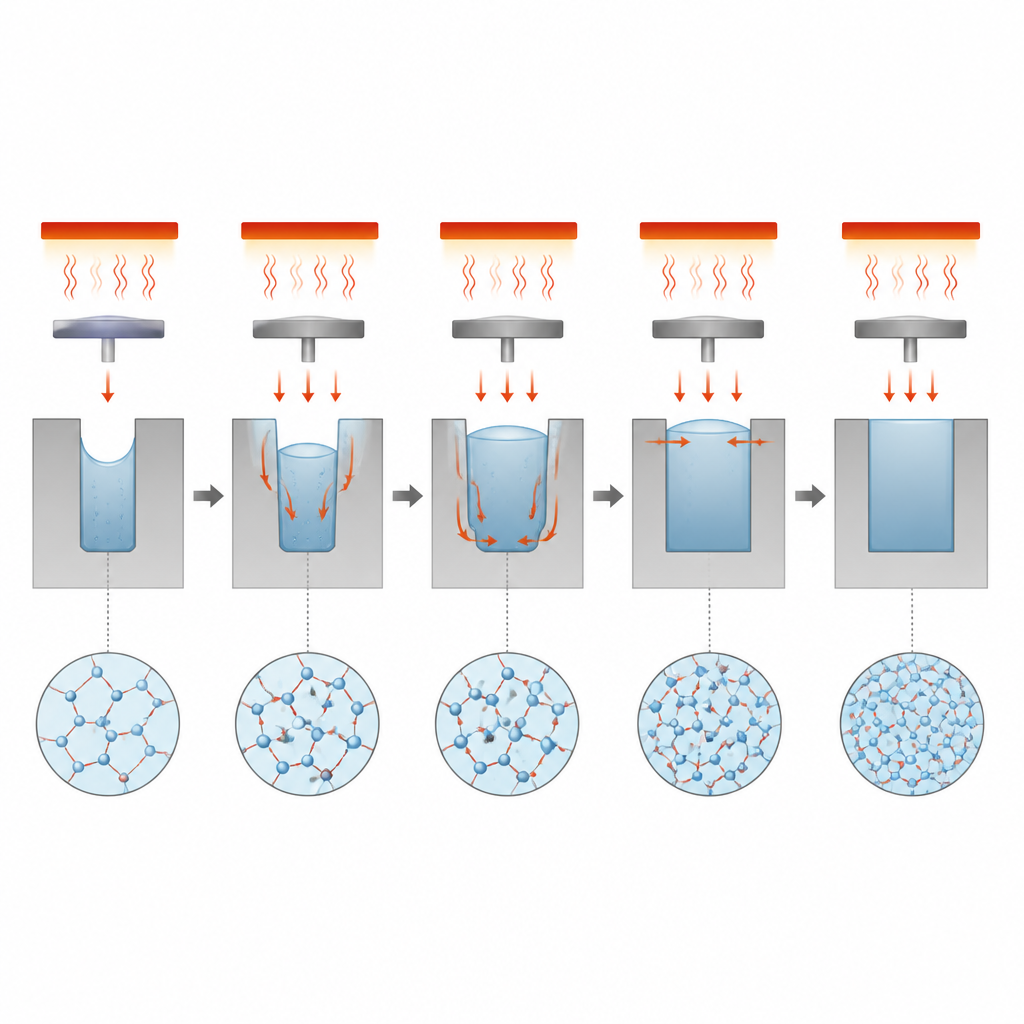
Glass thermal reflow tackles this challenge by taking advantage of what happens when glass is heated just enough to soften without melting completely. In a typical process, engineers first etch patterns into a silicon wafer to form molds, then bond a flat glass sheet on top. When heated in a furnace, the glass softens and is pushed by pressure and surface forces into the empty spaces. By tuning simple knobs such as temperature, pressure, time, slot width, and surface smoothness, they can control how deeply and how quickly glass flows, and how smooth the final shape becomes. Computer models help relate these knobs to the final depth of flow, giving designers a map for predicting and improving results.
Tuning the Process for Quality
The review explains how fine details of the process strongly affect quality. Wider cavities fill faster than very narrow ones, higher temperature lowers the glass’s resistance to flow, and greater pressure can speed filling but eventually brings diminishing returns. Rough mold walls change how the softened glass wets the surface and can slow filling or trap defects, so extra steps such as oxidation and polishing are used to smooth them. Heating for too long or at the wrong schedule can introduce bubbles, surface pits, or tiny voids at the glass–silicon boundary. Carefully planned heating and cooling cycles, sometimes including special annealing steps, are therefore crucial for avoiding cracks and unwanted crystals while preserving transparency.
New Tricks with Powders and Double-Sided Flows
Beyond the basic method, researchers have developed variations to reach even more demanding shapes. In double-sided reflow, glass is bonded to both sides of a patterned silicon wafer so softened glass flows in from above and below, quickly filling thick structures such as through-glass electrical connections. Another route uses loose glass powders packed into molds and then sintered into solid glass. With carefully controlled powder size and composition, this approach can fill extremely narrow trenches and achieve tiny feature sizes well below a micrometer, while still forming tall, slender structures with high aspect ratios.
What These Tiny Glass Shapes Can Do
Once formed and polished, reflowed glass structures enable a wide range of devices. Curved cavities and shells can act as miniature housings or resonators; rounded tips improve contact in glass micropipettes and microneedles used for studying or treating single cells. Glass’s poor heat conduction is a benefit in micro-hotplates, wind sensors, and tiny accelerometers, where keeping heat confined reduces power use. When combined with metal or silicon columns, glass forms robust three-dimensional wiring that insulates signals even at high frequencies. Smooth, precisely curved surfaces produced by reflow are also ideal for microlenses, lens arrays, and tiny light-guiding structures that shape and route light on a chip, and for bioelectronic probes that must be both transparent and gentle to tissue.
How Reflow Compares and What Comes Next
Compared with other ways of shaping glass, such as wet or dry chemical etching, laser carving, or 3D printing, thermal reflow occupies a middle ground. It does not reach the very finest feature sizes of advanced laser methods, but it offers smoother surfaces, simpler equipment, and wafer-scale batch processing. The authors point out that more work is needed to fully explain how defects form, to refine models that predict outcomes, and to standardize recipes that give repeatable results across large wafers. They also see promise in combining reflow with laser machining and 3D printing, and in developing new glass formulas tailored for better flow, strength, or optical behavior.
Takeaway for Everyday Technology
In plain terms, glass thermal reflow is a controlled way of softening glass so it gently sinks into tiny molds and solidifies into useful shapes. By mastering this flow, engineers can create smooth, reliable glass structures that guide light, isolate heat and electricity, and safely interact with living tissue. As the process and materials continue to improve, this quiet, furnace-based technique is likely to play an increasing role in the hidden glasswork that underpins future sensors, medical tools, and optical chips.
Citation: Zhu, M., Shi, P., Zhang, G. et al. A review of glass thermal reflow: method, device, and applications. Microsyst Nanoeng 12, 179 (2026). https://doi.org/10.1038/s41378-026-01239-8
Keywords: glass thermal reflow, microfabrication, MEMS glass, through-glass via, microlens arrays